




01. Edit your 720 2012 online
Type text, add images, blackout confidential details, add comments, highlights and more.

Type text, add images, blackout confidential details, add comments, highlights and more.

Draw your signature, type it, upload its image, or use your mobile device as a signature pad.

Send it via email, link, or fax. You can also download it, export it or print it out.
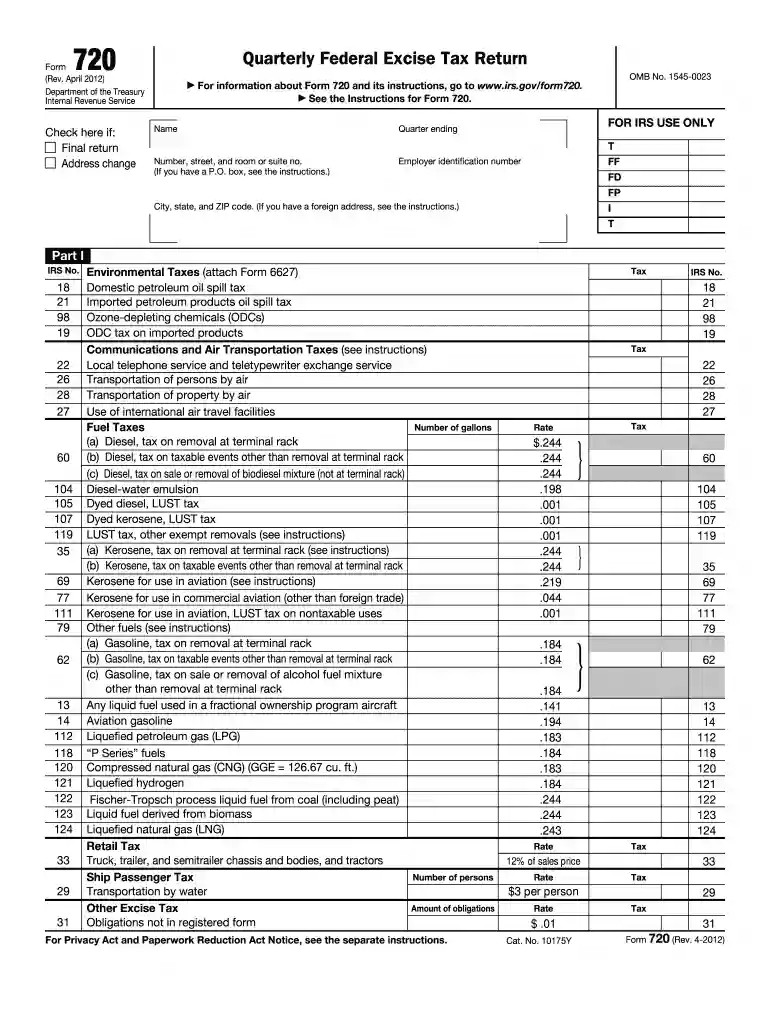
IRS Form 720, known as the Quarterly Federal Excise Tax Return, is a document used by businesses to report and pay federal excise taxes on specific goods and services. In 2012, this form remained essential for entities dealing with items subject to excise taxes, covering categories such as environmental taxes, fuel taxes, and manufacturers' taxes. Understanding the purpose and proper use of this form is crucial for compliant tax reporting and avoiding potential penalties.
Form 720 contains various sections requiring detailed reporting of tax liabilities. It is vital to accurately fill out:
Completing IRS Form 720 requires meticulous attention to detail and accuracy. The following steps will guide you in preparing the form:
Specific sections might require auxiliary worksheets or schedules. These sheets help in detailing complex liabilities or cumulative calculations:
IRS Form 720 from 2012 can typically be obtained through various official channels:
The IRS provides specific guidelines to ensure accurate reporting through Form 720:
Form 720 has strict due dates that must be adhered to:
Understanding the target demographic for Form 720 helps in identifying if your business needs this form:
Form 720 can be processed using several tax preparation software solutions:
Non-compliance with Form 720 filing requirements can lead to significant consequences:
By grasping these aspects of IRS Form 720, businesses can ensure precise compliance with federal excise tax obligations, harnessing digital tools and adhering to deadlines for effective tax management.
We've got more versions of the 720 2012 form. Select the right 720 2012 version from the list and start editing it straight away!
| Versions | Form popularity | Fillable & printable |
|---|---|---|
| 2025 | 4.5 Satisfied (21 Votes) | |
| 2025 | 4.5 Satisfied (23 Votes) | |
| 2024 | 4.2 Satisfied (28 Votes) | |
| 2024 | 4.3 Satisfied (26 Votes) | |
| 2023 | 4.6 Satisfied (31 Votes) | |
| 2023 | 4.4 Satisfied (58 Votes) | |
| 2022 | 4.1 Satisfied (22 Votes) | |
| 2022 | 4.8 Satisfied (140 Votes) | |
| 2021 | 4.3 Satisfied (170 Votes) | |
| 2021 | 4.4 Satisfied (97 Votes) | |
| 2020 | 4.2 Satisfied (117 Votes) | |
| 2020 | 4.4 Satisfied (333 Votes) | |
| 2019 | 4.3 Satisfied (79 Votes) | |
| 2018 | 4.3 Satisfied (189 Votes) | |
| 2017 | 4.3 Satisfied (128 Votes) |
At DocHub, your data security is our priority. We follow HIPAA, SOC2, GDPR, and other standards, so you can work on your documents with confidence.
For alternative fuel mixtures produced after December 31, 2011, the alternative fuel mixture credit can be taken as a credit only on. Schedule C (Form 720)Read more
Jun 19, 2012 To provide information important for protecting the health of military and civilian personnel, three studies were conducted to.Read more
The return of any tax to which this part 40 applies must be made on Form 720, Quarterly Federal Excise Tax Return, according to the instructions applicable toRead more


