




01. Edit your form online
Type text, add images, blackout confidential details, add comments, highlights and more.

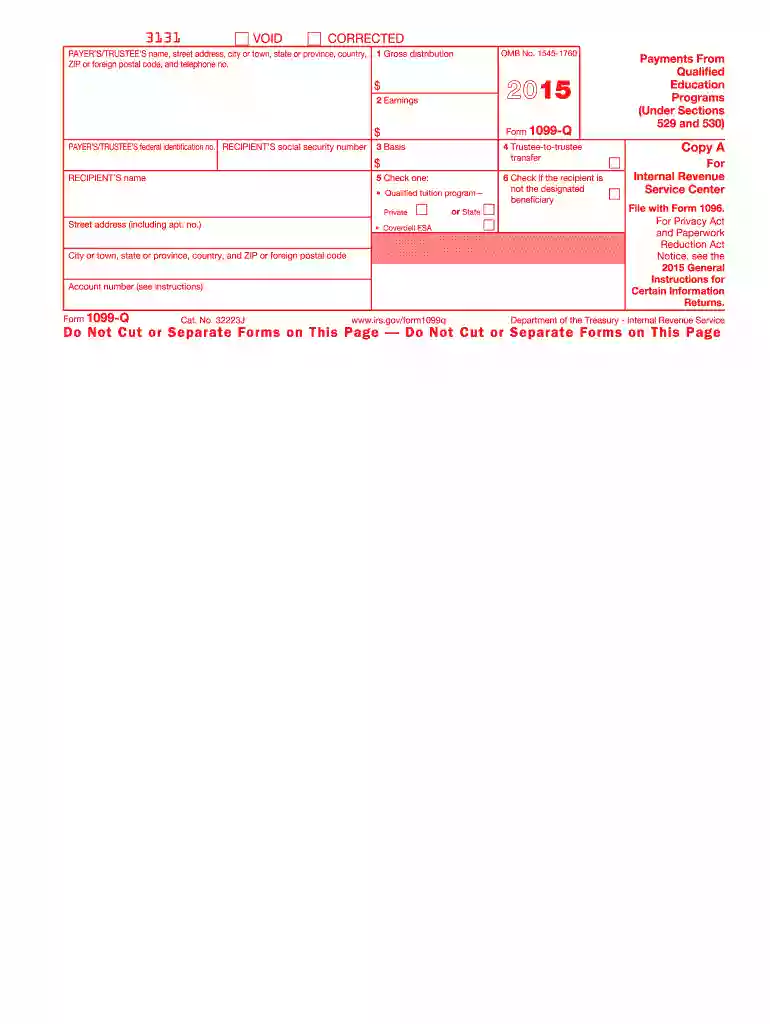
Type text, add images, blackout confidential details, add comments, highlights and more.

Draw your signature, type it, upload its image, or use your mobile device as a signature pad.

Send it via email, link, or fax. You can also download it, export it or print it out.
The 2015 Form 1099-Q is a tax document used in the United States to report distributions from qualified education programs, such as Section 529 Plans and Coverdell Education Savings Accounts under Section 530. These programs were established to support educational savings by offering tax advantages. The form is primarily utilized by organizations and trustees who manage these accounts and need to provide detailed financial information to the IRS and account holders.
To effectively use the 2-Q, both the payer and the recipient must understand its purpose and requirements. It's vital to know that this form provides information about the total distributions from educational savings plans, which impact tax calculations for both parties.
Filling out the 2-Q form requires attention to detail. Here’s how to approach this task:
Understanding key terminology is essential for accurately managing and filling out the 2-Q form.
The IRS provides specific instructions on how to handle the 2-Q form, ensuring correct reporting and tax compliance.
Compliance with deadlines is crucial when working with tax forms like the 2-Q form.
Failure to comply with IRS guidelines and deadlines for the 2-Q can result in penalties.
The document can be managed in both digital and paper formats, each with specific considerations.
We've got more versions of the 2015 1099 q form form. Select the right 2015 1099 q form version from the list and start editing it straight away!
| Versions | Form popularity | Fillable & printable |
|---|---|---|
| 2025 | 4.1 Satisfied (59 Votes) | |
| 2019 | 4.8 Satisfied (25 Votes) | |
| 2018 | 4.2 Satisfied (109 Votes) | |
| 2017 | 4.4 Satisfied (145 Votes) | |
| 2016 | 4.4 Satisfied (338 Votes) | |
| 2015 | 4.1 Satisfied (48 Votes) | |
| 2014 | 4 Satisfied (49 Votes) | |
| 2013 | 4 Satisfied (59 Votes) | |
| 2012 | 4.4 Satisfied (63 Votes) | |
| 2011 | 4.2 Satisfied (57 Votes) | |
| 2010 | 4.4 Satisfied (53 Votes) |
At DocHub, your data security is our priority. We follow HIPAA, SOC2, GDPR, and other standards, so you can work on your documents with confidence.
Form 1099-Q from each of the programs from which you received a QTP other government payment statements (Form 1099-G); and interest, dividend, andRead more
May 2, 2017 Employers must report the compensation paid and any backup withholding on Forms 1099-MISC and Form 945, Annual Return of. Withheld FederalRead more
Sep 18, 2014 File Form 1099-Q, Payments From Qualified Education. Programs (Under Sections 529 and 530), if you (a) are an officer or an employee, or theRead more


