




01. Edit your form online
Type text, add images, blackout confidential details, add comments, highlights and more.

Type text, add images, blackout confidential details, add comments, highlights and more.

Draw your signature, type it, upload its image, or use your mobile device as a signature pad.

Send it via email, link, or fax. You can also download it, export it or print it out.
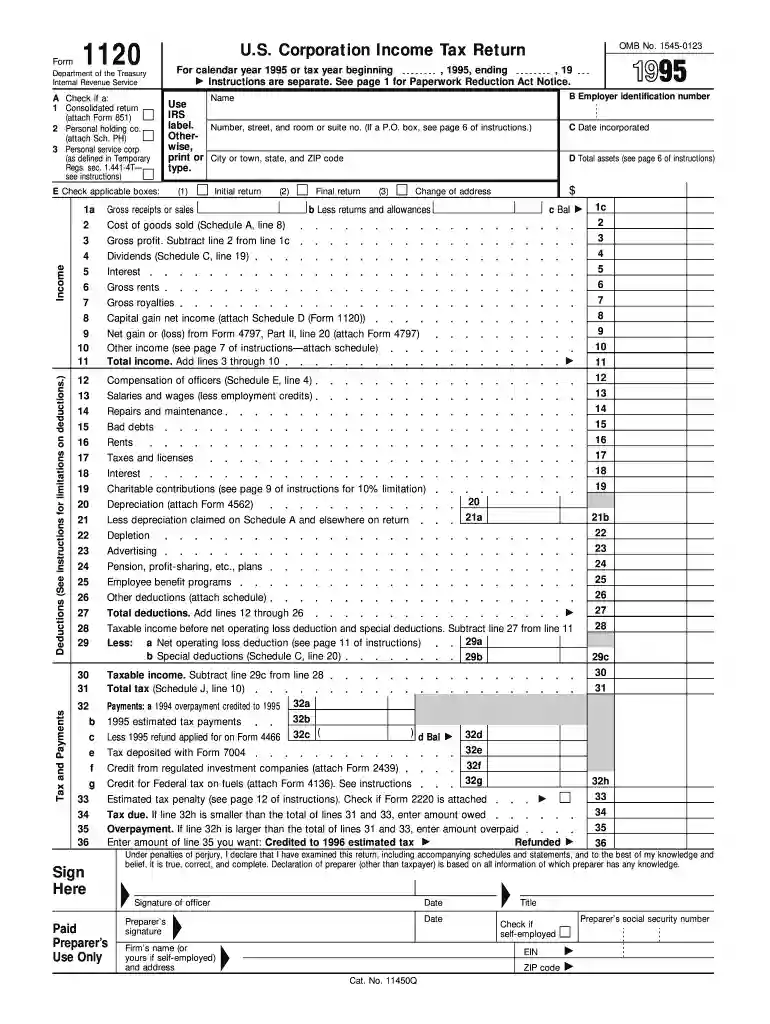
The 1995 Form 1120 is officially known as the U.S. Corporation Income Tax Return. It is used by corporations to report their income, deductions, and tax liabilities. This form serves as a comprehensive document that details a corporation's financial activities over the tax year. It is instrumental in calculating the taxes a corporation owes to the Internal Revenue Service (IRS).
Corporations must provide a detailed account of their income, including sales revenue and other types of income, such as dividends and interest. The form also requires corporations to list deductions they are claiming, which can include business expenses, depreciation, and employee compensations. Through careful computations, it aids in determining the taxable income and ultimately the tax that the corporation is liable to pay for that year.
Corporations can obtain the 1995 Form 1120 through several basic methods. Although the form is older, it may still be accessible for purposes of amendment or historical accuracy in reporting. The IRS website is a primary source for archived forms. Corporations can download the form directly from the IRS's forms and instructions archive section. Additionally, businesses may contact the IRS directly via their telephone support line to request the form.
Corporations that work with tax professionals or accounting firms may also be able to obtain older forms like the 1995 Form 1120 through these channels. Accountants often maintain extensive archives of tax forms for compliance and advisory purposes.
The 1995 Form 1120 must be completed with accuracy to ensure compliance with IRS regulations. Falsification or misreporting on this form can result in legal penalties. The information provided in the form should reflect truthful financial activity and adhere to IRS instructions.
Corporations are advised to keep detailed and accurate records to support each entry on the form. In case of any discrepancies or audits, having organized records can aid in quickly resolving IRS inquiries.
The primary users of the 1995 Form 1120 are corporations operating within the United States. This includes C-corporations which are required to file this form annually to report earnings and pay corporate income taxes.
Smaller corporations, such as S-corporations, may not use this particular form as they have different tax reporting requirements, often utilizing Form 1120-S to report income that passes through to shareholders who then report this income on their personal tax returns.


Failing to file the 1995 Form 1120 on time or submitting inaccurate information can attract penalties from the IRS. The basic penalty for failing to file is typically five percent of the unpaid tax for each month the return is late, up to a maximum of 25% of the unpaid tax. Additionally, inaccuracies can lead to further scrutiny or audits, resulting in fines or additional taxes owed.
Corporations are responsible for verifying that their returns are complete and filed promptly to avoid these penalties. It's advisable to consult a tax professional to navigate any complexities associated with the form, especially due to its age and potentially outdated references or rules.
We've got more versions of the 1995 form 1120 form. Select the right 1995 form 1120 version from the list and start editing it straight away!
| Versions | Form popularity | Fillable & printable |
|---|---|---|
| 2025 | 4.4 Satisfied (37 Votes) | |
| 2024 | 4.6 Satisfied (32 Votes) | |
| 2023 | 4.2 Satisfied (33 Votes) | |
| 2022 | 4.8 Satisfied (59 Votes) | |
| 2021 | 4.8 Satisfied (80 Votes) | |
| 2020 | 4.3 Satisfied (37 Votes) | |
| 2019 | 4.4 Satisfied (228 Votes) | |
| 2018 | 4.3 Satisfied (133 Votes) | |
| 2017 | 4.3 Satisfied (98 Votes) | |
| 2016 | 4.4 Satisfied (267 Votes) | |
| 2015 | 4.3 Satisfied (34 Votes) | |
| 2014 | 4.2 Satisfied (35 Votes) | |
| 2014 | 4 Satisfied (59 Votes) | |
| 2013 | 4 Satisfied (42 Votes) | |
| 2013 | 4.8 Satisfied (25 Votes) |
At DocHub, your data security is our priority. We follow HIPAA, SOC2, GDPR, and other standards, so you can work on your documents with confidence.
File the 1995 return for calendar year 1995 and fiscal years that begin in 1995 and end in 1996. For a fiscal year, fill in the tax year space at the top of theRead more
Form 1120 (1995). Cost of Goods Sold (See page 12 of instructions.) 1. Inventory at beginning of year. 1. 2. Purchases. 2. 3. Cost of labor. 3. 4. AdditionalRead more
An example of a 2D graphic is shown on the left (Figure i). All 2D graphics are archived in one of two portable document.Read more


