Definition and Meaning
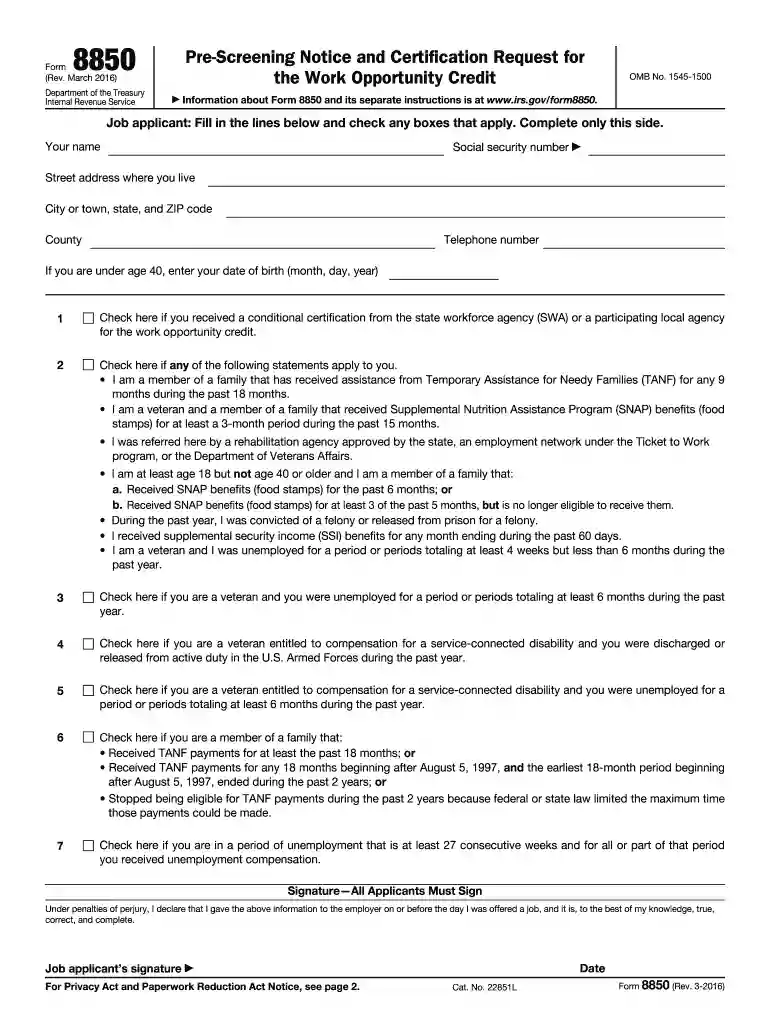
Form 8850, known as the Pre-Screening Notice and Certification Request for the Work Opportunity Credit, is an IRS form used primarily by employers in the United States to determine potential eligibility for tax credits. This form pertains to the employment of individuals who belong to specific targeted groups, such as veterans or individuals receiving public assistance. Employers use this form to initiate the process of certifying an employee as qualified for the Work Opportunity Credit, thereby potentially reducing their tax liability.
Key Elements of Form 8850
- Applicant Information: Personal details of the job applicant, including name, address, and Social Security number.
- Targeted Group Criteria: Specific criteria that establish whether the applicant belongs to an eligible group.
- Employer Declaration: A section where employers certify their intent to employ individuals meeting certain criteria.
- Signature Fields: Mandatory signing by both the employer and applicant to complete the certification process.
How to Use the 2 Form
Navigating the completion and submission of the 8850 form involves several steps to ensure it is accurate and valid. Here's how you can effectively utilize this form:
- Pre-Screening Process: Start by determining if your prospective hire belongs to a targeted group that qualifies for the Work Opportunity Credit.
- Filling out the Form: Ensure all sections, especially the personal and eligibility criteria, are accurately filled out by both the applicant and employer.
- Certifying Information: The employer and applicant must sign the form to confirm the provided information is truthful and complete.
Important Steps
- Reviewing Eligibility: Confirm whether targeted groups such as qualified veterans, ex-felons, or individuals receiving public assistance are covered.
- Accurate Completion: Incomplete or incorrect information can delay certification, so double-check all entries.
- Maintain Records: Keep a copy for your records as proof of submission and for any potential audits.
How to Obtain the 2 Form
Obtaining the Form 8850 is straightforward and can be achieved through various methods:
- IRS Website: Visit the official IRS website to download a PDF version of the form.
- Tax Software: Utilize tax preparation software that may provide downloadable forms.
- Mail: Request a physical copy from the IRS if you prefer a hard-copy format.
Methods for Obtaining
- Online Access: Most tax professionals and employers find downloading from the IRS site convenient and fast.
- Direct Request: For less tech-savvy individuals or businesses, requesting via mail might be more suitable.
- Third-Party Providers: Some third-party services and tax professionals can assist in obtaining and completing the form.
Steps to Complete the 2 Form
Completing Form 8850 requires careful entry of all requested information. Below are the steps and sections involved:
- Applicant's Information: Fill in the applicant's personal data including name, address, and SSN.
- Eligibility Criteria: Indicate if the applicant falls under any targeted groups.
- Employer Details: Employers must provide business name and tax identification number.
- Certifications: Both parties sign the form confirming the eligibility and correctness of the information.
Detailed Instructions
- Verification: Ensure the employer checks identification documents to verify the applicant's claims.
- Submission Timing: The form must be submitted to the state workforce agency within 28 days after the employee's start date for the tax credit.
Specific Users
- Small Business Owners: Often look to maximize tax credits for hiring.
- Large Corporations: May have dedicated teams for optimizing employment-related financial benefits.
- Non-Profits: While typical tax credits might not apply, awareness of eligibility can align with hiring missions.
Legal Use of the 2 Form
Understanding the legal implications and requirements for the 8850 form is crucial for compliance:
- IRS Regulations: The form must be used in accordance with IRS guidelines to avoid disqualification of tax credits.
- Certification Requirements: States require certifications before allowing the credits which rely on accurate and timely submission.
- Use in Employment Practices: The form should be integrated legally and ethically into hiring practices.
Legal Considerations
- Confidentiality: Ensure applicant's sensitive information is handled according to privacy laws.
- Compliance: Failing to comply with submission timelines or incorrect forms can lead to penalties or loss of credit eligibility.
Filing Deadlines and Important Dates
Timing is essential when dealing with IRS forms and certifications:
- Initial Deadline: Filing must occur within 28 days of the applicant's start date.
- Certification Deadlines: Each state's workforce agency may have differing processing timelines after submission.
- Tax Year Considerations: Ensure the form aligns with the fiscal year for which tax credits are being claimed.
Critical Timelines
- Year-End Review: Encourage businesses to review their submissions and credits as they approach fiscal year close.
- State Notifications: Be aware of state-specific notices regarding extensions or changes to submission deadlines.
IRS Guidelines
Following IRS guidelines ensures compliance and proper tax credit processing:
- Detailed Instructions: The IRS provides comprehensive instructions; adherence ensures precise submissions.
- Use of Form 8850: Dedicatedly for Work Opportunity Credit evaluation and no other tax credits.
- Updates and Changes: Regularly review IRS publications for any updates that may affect form use or procedures.
Compliance Measures
- Periodic Training: For HR departments to stay updated on form usage and changes in eligibility criteria.
- Check IRS Bulletins: Subscribing to IRS announcements can help businesses stay compliant with any amendments.