




01. Edit your 2013 form 8582 online
Type text, add images, blackout confidential details, add comments, highlights and more.

Type text, add images, blackout confidential details, add comments, highlights and more.

Draw your signature, type it, upload its image, or use your mobile device as a signature pad.

Send it via email, link, or fax. You can also download it, export it or print it out.
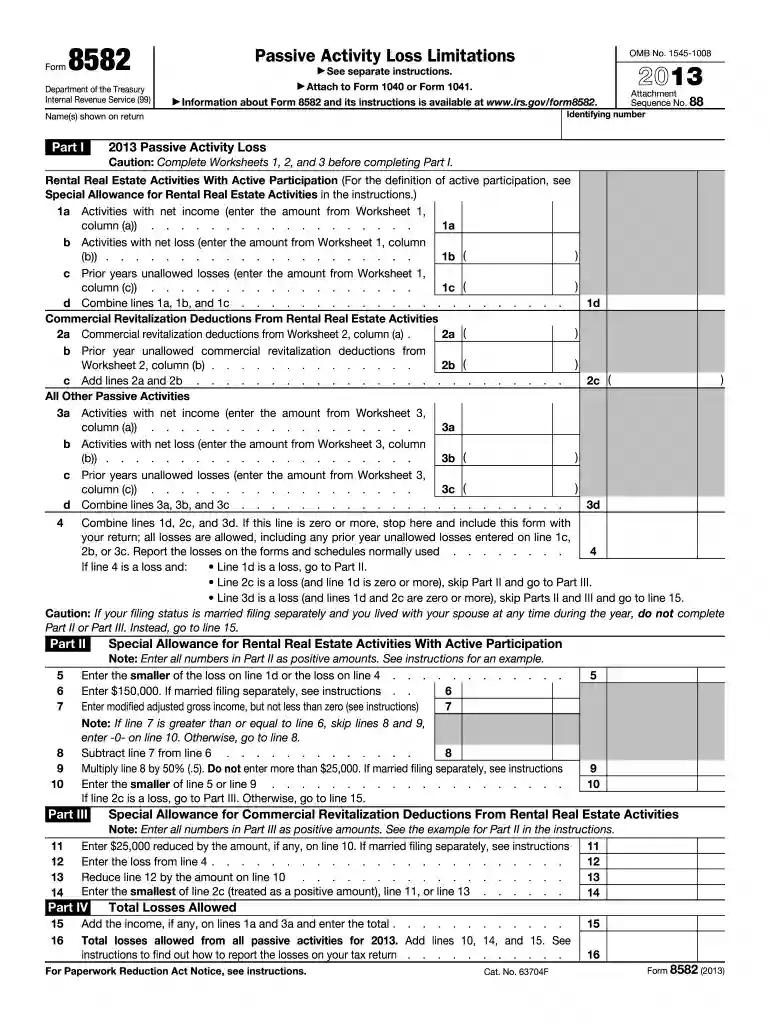
Form 8582 is an IRS tax document used by individuals and estates to report limitations on passive activity losses. Its primary purpose is to limit the losses that taxpayers can claim from passive activities, which typically include rental real estate and investment activities, against their non-passive income. The 2013 version follows the guidelines set by the IRS for that tax year, ensuring that taxpayers correctly calculate and report allowable losses. Passive activity is defined by the IRS as any trade or business activity in which the taxpayer does not materially participate.
To utilize Form 8582 effectively, taxpayers must first gather necessary financial data related to their passive income activities. This involves documenting all rental activities, investments, and related income or losses for the tax year. Afterward, they will complete specific worksheets attached to Form 8582 to calculate the allowable amount of passive activity losses. Essential components of this process encompass detailing each activity's income, losses, and any previously unclaimed losses from prior tax years.
Form 8582 is integral for taxpayers claiming passive losses, as it ensures compliance with IRS regulations on passive activity losses. The form prevents taxpayers from abuse of loss deductions against non-passive income, thereby maintaining the integrity of the tax code and promoting fair reporting. Accurate completion of Form 8582 is crucial to avoiding IRS penalties and ensuring an accurate representation of a taxpayer’s financial situation.
This form is predominantly used by individuals and estates with investments in rental real estate or other passive income activities that have generated losses. Individuals actively participating in these ventures, such as landlords or investors with minority stakes in businesses, are the primary users. The form is also applicable for small business owners operating within certain passive activity types, which require accurate loss reporting.


Failure to accurately file Form 8582 or report passive activity losses can lead to severe penalties, including fines and interest on unpaid taxes. The IRS holds taxpayers accountable for honest reporting, and discrepancies discovered may trigger an audit or further investigation. Ensuring accurate and truthful reporting of losses is crucial in maintaining compliance with federal tax laws.
The IRS provides comprehensive guidelines on completing Form 8582, detailing specific instructions for each worksheet and section. Taxpayers must adhere to these protocols and ensure the form is attached to the relevant tax return by the standard filing deadline, generally April 15, to avoid penalties or misfiling. Extensions to this deadline must be correctly requested and approved by the IRS.
We've got more versions of the 2013 form 8582 form. Select the right 2013 form 8582 version from the list and start editing it straight away!
| Versions | Form popularity | Fillable & printable |
|---|---|---|
| 2025 | 4.3 Satisfied (23 Votes) | |
| 2024 | 4.4 Satisfied (55 Votes) | |
| 2023 | 3.8 Satisfied (31 Votes) | |
| 2022 | 4.9 Satisfied (27 Votes) | |
| 2021 | 4.8 Satisfied (135 Votes) | |
| 2020 | 4.4 Satisfied (190 Votes) | |
| 2019 | 4.3 Satisfied (203 Votes) | |
| 2018 | 4.2 Satisfied (72 Votes) | |
| 2017 | 4.2 Satisfied (115 Votes) | |
| 2016 | 4.4 Satisfied (185 Votes) | |
| 2015 | 4.3 Satisfied (53 Votes) | |
| 2014 | 4 Satisfied (32 Votes) | |
| 2013 | 4.2 Satisfied (52 Votes) | |
| 2012 | 4.3 Satisfied (49 Votes) | |
| 2011 | 4.2 Satisfied (35 Votes) |
At DocHub, your data security is our priority. We follow HIPAA, SOC2, GDPR, and other standards, so you can work on your documents with confidence.
Worksheet 3For Form 8582, Lines 3a, 3b, and 3c (See instructions.) Name of activity. Current year. Prior years. Overall gain or loss. (a) Net income.Read more
Apr 15, 1976 Increased section 179 deduction dollar limits. The maximum amount you can elect to deduct for most sec- tion 179 property you placedRead more
Starting in 2013, 3.8% Medicare tax on unearned income of high income individuals and trusts starts (1411) Reported (and computed) using Form 8582.Read more


