




01. Edit your form online
Type text, add images, blackout confidential details, add comments, highlights and more.

Type text, add images, blackout confidential details, add comments, highlights and more.

Draw your signature, type it, upload its image, or use your mobile device as a signature pad.

Send it via email, link, or fax. You can also download it, export it or print it out.
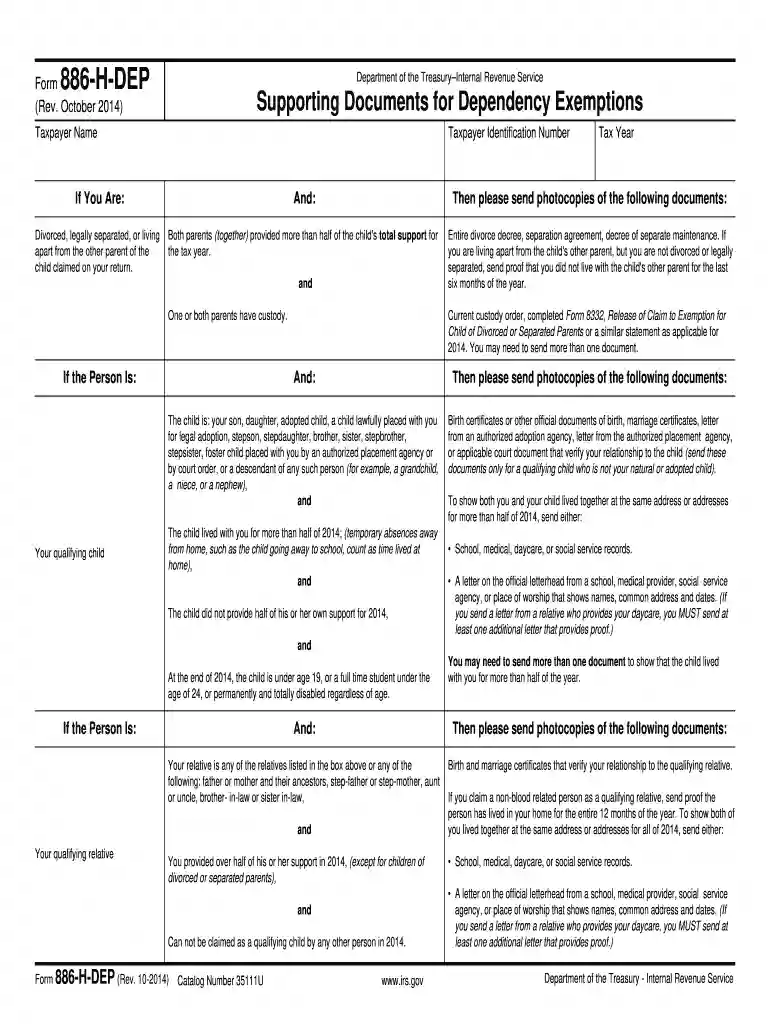
Form 886-H-DEP is a document from the Internal Revenue Service (IRS) that details the necessary supporting documents for claiming dependency exemptions on tax returns. Essential for taxpayers who are divorced, separated, or otherwise living apart from the child's other parent, the form outlines what is required to establish eligibility for dependency claims. This includes specific documentation such as custody agreements, birth certificates, and financial support evidence.
The form is used to compile necessary documentation for supporting dependency exemption claims on your tax return. Follow the guidance to ensure all relevant documents are included with your submission to avoid processing delays or denials.
You can access Form 886-H-DEP through the IRS website by downloading a PDF version. It can also be obtained through tax software solutions compatible with IRS forms or requested by mail directly from the IRS.
Using Form 886-H-DEP ensures clarity and compliance with IRS regulations concerning dependency exemptions. It streamlines the process for taxpayers, reducing errors and unnecessary governmental inquiries.
This form is essential for taxpayers seeking to claim dependents on their tax returns, particularly when parents are divorced or separated. It's also used by those claiming qualifying relatives in specific situations.
The IRS provides specific guidelines on the types of documents needed with Form 886-H-DEP. These guidelines emphasize the importance of accuracy and thoroughness to ensure all dependency claims are substantiated.
Ensure your submission includes all necessary documents to substantiate dependency claims, including proof of residency and financial support documentation.
Choose the submission method that best fits your preference: online, mail, or in-person. Each method has distinct processes for document handling.
Failing to submit necessary documentation with Form 886-H-DEP can result in denied dependency claims and potential penalties imposed by the IRS.
Real-world scenarios show how individuals successfully use Form 886-H-DEP to ensure lawful and accurate dependency claims.
We've got more versions of the 2014 886 form form. Select the right 2014 886 form version from the list and start editing it straight away!
At DocHub, your data security is our priority. We follow HIPAA, SOC2, GDPR, and other standards, so you can work on your documents with confidence.
by K Wolf 2014 This work investigates the effects of x-rays and electron bombardment on chalcogenide glasses and RCBM devices based on these materials.
A letter from your employer on company letterhead or stationary indicating dates of employment and gross amount of wages paid and withholdings deducted.Read more


