




01. Edit your form online
Type text, add images, blackout confidential details, add comments, highlights and more.

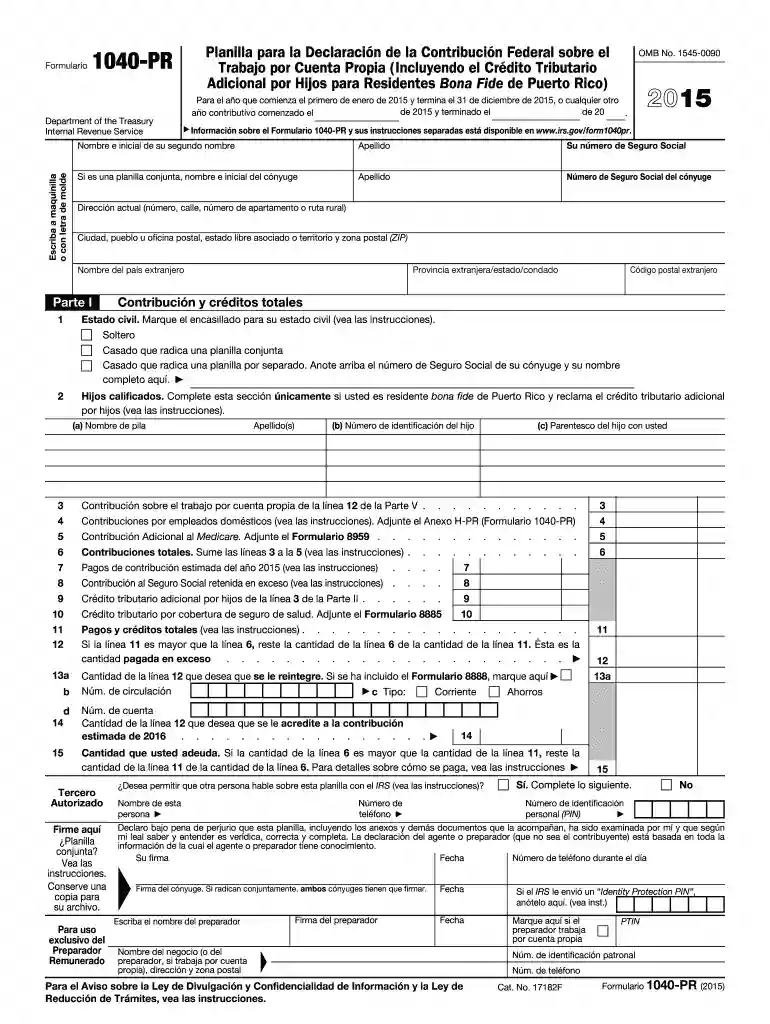
Type text, add images, blackout confidential details, add comments, highlights and more.

Draw your signature, type it, upload its image, or use your mobile device as a signature pad.

Send it via email, link, or fax. You can also download it, export it or print it out.
The 2015 Form 1040-PR is a specialized tax document designed for self-employed individuals residing in Puerto Rico. This form is crucial for reporting income derived from self-employment activities and is specifically tailored to accommodate the unique tax structure applicable to Puerto Rican taxpayers. A significant feature of the Form 1040-PR is its section dedicated to claiming the Additional Child Tax Credit, which can provide a financial benefit for qualifying taxpayers with dependent children. Understanding the specific purpose and structure of this form aids in accurate tax reporting and maximizes potential tax credits.
Acquiring the 2015 Form 1040-PR can be done through multiple channels to ensure accessibility:
Each method ensures that you have access to the necessary documents for timely tax compliance.
Completing the 2015 Form 1040-PR involves several crucial steps to ensure accuracy:
Each step is vital for ensuring that the form is complete and acceptable for submission to the IRS.
Several sections within the 2015 Form 1040-PR require detailed attention:
Attention to these key elements ensures that the form is correctly completed and maximizes potential deductions and credits.
Compliance with legal requirements when using the 2015 Form 1040-PR is essential. This includes adhering to U.S. federal tax laws applicable in Puerto Rico and recognizing the specific nuances of Puerto Rican income and deductions. Understanding the ESIGN Act, applicable for electronic submissions, ensures compliance when e-filing. Any misinformation or omission can result in penalties, highlighting the importance of accuracy. Legal guidelines also dictate the timely filing of this form to avoid late fees or interest on unpaid taxes.
The primary eligibility for the 2015 Form 1040-PR is self-employment income. Additional criteria include:
Understanding these criteria helps determine whether filing this specific form is necessary for your tax situation.


The IRS provides comprehensive guidelines that dictate the correct filing process for the 2015 Form 1040-PR:
Adhering to these guidelines ensures compliance and reduces the risk of audits or penalties.
Real-world applications of the 2015 Form 1040-PR illustrate its utility:
These examples demonstrate the form’s versatility in different self-employment contexts, assisting tax filers in understanding how best to report income and claim credits effectively.
We've got more versions of the 1040 pr 2015 form form. Select the right 1040 pr 2015 form version from the list and start editing it straight away!
| Versions | Form popularity | Fillable & printable |
|---|---|---|
| 2022 | 4.4 Satisfied (40 Votes) | |
| 2021 | 4.7 Satisfied (33 Votes) | |
| 2020 | 4.8 Satisfied (179 Votes) | |
| 2019 | 4.4 Satisfied (70 Votes) | |
| 2018 | 4.4 Satisfied (72 Votes) | |
| 2017 | 4.2 Satisfied (66 Votes) | |
| 2016 | 4.4 Satisfied (120 Votes) | |
| 2015 | 4 Satisfied (45 Votes) | |
| 2014 | 4 Satisfied (33 Votes) | |
| 2013 | 4 Satisfied (31 Votes) | |
| 2012 | 4 Satisfied (37 Votes) | |
| 2010 | 4.3 Satisfied (35 Votes) | |
| 2007 | 3.9 Satisfied (41 Votes) |
Based on eSignature laws, forms approved electronically have the same validity as traditionally approved ones. You can eSign almost any business and private documentation. Four types of documents still call for handwritten signatures only - wills and testamentary trusts, court orders and other court papers, state statutes governing divorce, adoption, or other family law, and notice of cancellation of utility services. If you follow the regulations and use a safe and compliant software solution, like DocHub, you can eSign your 1040 pr 2015 form without printing it.
Document editing with DocHub is equally convenient on desktop and mobile devices. You just need an internet browser to modify your 1040 pr 2015 form on Android. Open our website and sign in to access the tools you need. Add your document and introduce your intended changes. Next, you can keep your form in your document storage or send it out right away.
At DocHub, your data security is our priority. We follow HIPAA, SOC2, GDPR, and other standards, so you can work on your documents with confidence.
There are no forms to mail! The Fastest, Most Accurate Way To. File Your Tax Return. ○ Proof of Acceptance! You get electronic acknowledgementRead more
May 2, 2017 Report bonuses as wages and as (Form 1040). For example, 2015 and GU shows that you are correcting a 2015 Form W-2GU.
by PE Campaign Cited by 1 U.S. Individual Income Tax Return 2015 OMB No. 1545-0074 IRS Use OnlyDo not write or staple in this space. For the year Jan. 1Dec. 31Read more


