




01. Edit your form online
Type text, add images, blackout confidential details, add comments, highlights and more.

Type text, add images, blackout confidential details, add comments, highlights and more.

Draw your signature, type it, upload its image, or use your mobile device as a signature pad.

Send it via email, link, or fax. You can also download it, export it or print it out.
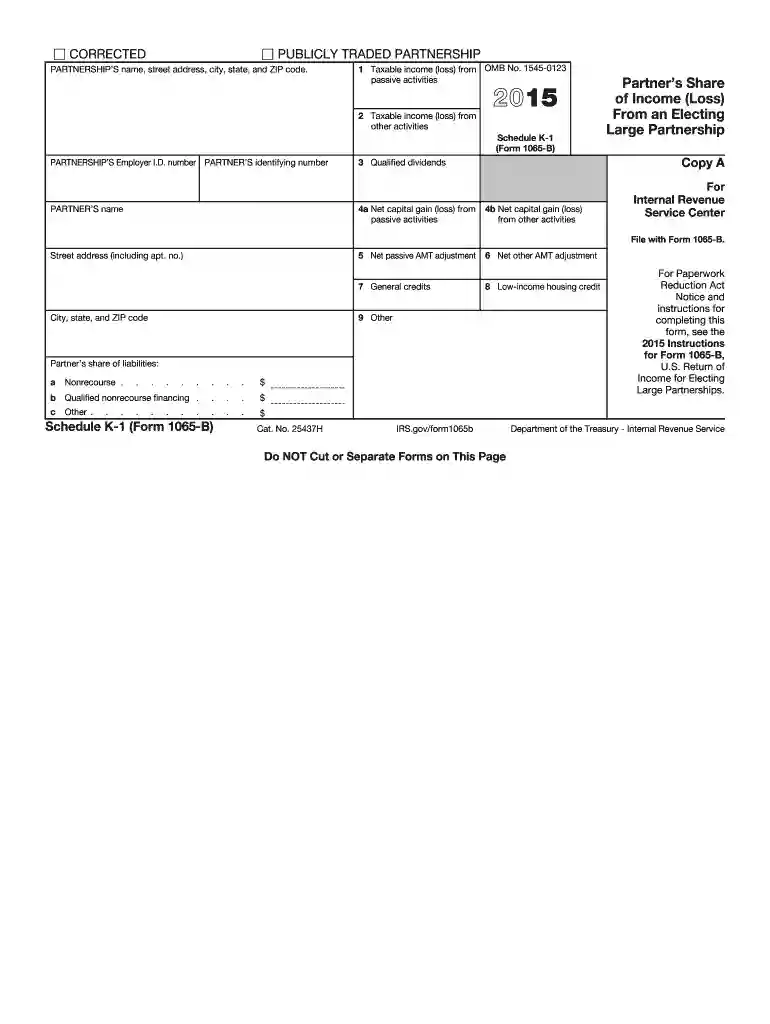
The 2015 Schedule K-1 (Form 1065-B) is used in the United States for reporting a partner's share of a partnership’s income, deductions, credits, and other tax-related items. Designed for a publicly traded partnership, this form helps partners accurately calculate their income tax liability for a given tax year. The Schedule K-1 directs where and how each item should be reported on an individual or entity's own income tax return. The form covers several sections, such as passive income, qualified dividends, net capital gains, and liability information.
Partnerships are responsible for preparing a Schedule K-1 for each partner and distributing them annually. While partners themselves do not need to request the form from the IRS, keeping records of their partnership agreements and any communication from the partnership is crucial. Additionally, partnerships or their accountants can use tax preparation software to generate these forms, after ensuring the software supports the 2015 tax year.
Schedule K-1 is typically used by partners in corporations, limited liability companies (LLCs), and limited partnerships. Any individual or entity that has a stake in such a business structure during the tax year will use this form to identify their share of the profits or losses, aiding in accurate tax reporting.


The IRS requires that partnerships file and distribute Schedule K-1 to partners well before the April tax deadline, usually by the fifteenth day of the third month following the fiscal year-end of the partnership. For example, partnerships using a calendar year must file by March 15. Following IRS guidelines ensures compliance and prevents delays in the partner's individual tax filings.
Failing to file a Schedule K-1 correctly or omitting required information can result in penalties. The IRS may impose fines for inaccuracies or late submissions. Partnerships should ensure they adhere strictly to IRS timelines and reporting accuracy to avoid financial penalties.
Popular tax preparation software, such as TurboTax and QuickBooks, support the integration and filing of Schedule K-1. These platforms allow for seamless data importation and management, facilitating the completion of the K-1 with less manual effort. Using software offers additional benefits such as in-built guidance and error-checking capabilities to ensure compliance with IRS requirements.
Partners, especially those receiving income from multiple partnerships, rely on Schedule K-1 for accurate tax reporting. For instance, a partner with an LLC and ownership in a publicly traded partnership will receive different K-1s detailing distinct income streams or losses. Understanding each K-1’s data fields allows them to consolidate their personal tax return accurately, ensuring they meet their full tax obligations without oversight.
We've got more versions of the 2015 irs k 1 form form. Select the right 2015 irs k 1 form version from the list and start editing it straight away!
At DocHub, your data security is our priority. We follow HIPAA, SOC2, GDPR, and other standards, so you can work on your documents with confidence.
by V AVDEEV 2015 Cited by 3 Compare U.S. Dept of the Treasury Internal Revenue Serv., I.R.S. Form 1065: Schedule K-1: Partners Share of Income, Deductions, Credits, Etc.Read more
This list identifies the codes used on Schedule K-1 for all partners and provides summarized reporting information for partners who file Form 1040. For detailedRead more
Apr 15, 1976 ships (shown on Schedule K-1 (Form 1065), Partners. Share of Income, Deductions, Credits, etc.) to his or her nonpartnership section 179Read more


