




01. Edit your form online
Type text, add images, blackout confidential details, add comments, highlights and more.

Type text, add images, blackout confidential details, add comments, highlights and more.

Draw your signature, type it, upload its image, or use your mobile device as a signature pad.

Send it via email, link, or fax. You can also download it, export it or print it out.
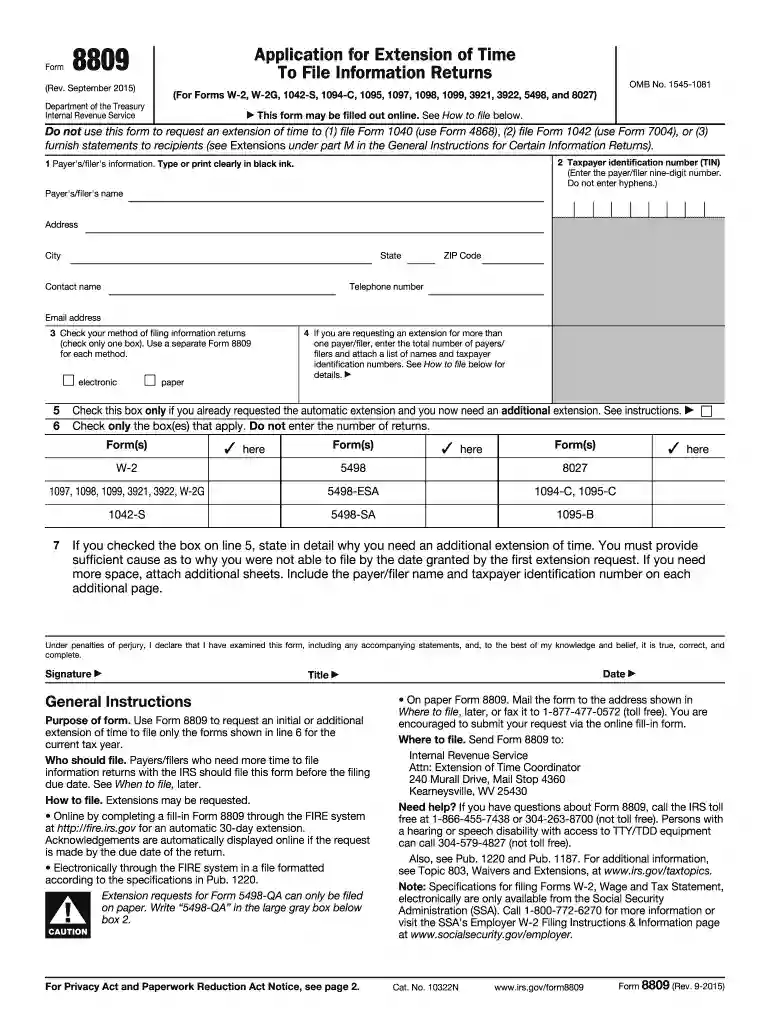
The 2015 Form 8809, officially known as the Application for Extension of Time to File Information Returns, serves a vital role in the U.S. tax filing process. Its primary function is to allow businesses and individual taxpayers to request additional time to file specific information returns with the IRS. The form applies to various informational forms, including W-2 and 1099, among others. Understanding its core purpose and application ensures that taxpayers are compliant with federal tax obligations while managing their filing timelines effectively.
Acquiring the 2015 Form 8809 involves straightforward methods, ensuring accessibility for taxpayers. The form can be downloaded from the official IRS website, reflecting its digital availability, which aligns with contemporary access needs. Furthermore, the IRS provides the possibility of obtaining paper versions upon request, although this is less common in modern filing processes.
Completing the 2015 Form 8809 involves a series of methodical steps to ensure accuracy and compliance. Each section of the form requires specific information pertinent to the taxpayer or business seeking an extension. The process ensures that the IRS has enough information to justify the extension request.
Eligibility for filing the 2015 Form 8809 hinges on specific criteria set forth by the IRS. Taxpayers must meet these conditions to be approved for an extension. Understanding these guidelines ensures preparedness and reduces the likelihood of denial.


Understanding the terminology associated with the 2015 Form 8809 is necessary for accurate completion and compliance. Key terms provide clarity and ensure that the processes are followed correctly.
The IRS provides comprehensive guidelines outlining the correct use and submission of Form 8809. Compliance with these guidelines ensures the facilitator of the process and avoidance of unnecessary delays or penalties.
Filing deadlines are crucial to ensure a valid extension request via Form 8809. The IRS specifies these dates, and acting within this timeframe is critical for approval.
Failure to comply with deadlines or requirements related to the 2015 Form 8809 can result in significant penalties. Understanding these potential repercussions underscores the importance of meeting all IRS mandates.
The choice between digital and paper submission of Form 8809 has implications for processing time and ease of use. Understanding these differences assists in determining the most efficient submission method.
Real-world scenarios illustrate the pragmatic use of the 2015 Form 8809, guiding users through practical applications and outcomes.
We've got more versions of the 2015 8809 form form. Select the right 2015 8809 form version from the list and start editing it straight away!
At DocHub, your data security is our priority. We follow HIPAA, SOC2, GDPR, and other standards, so you can work on your documents with confidence.
May 2, 2017 You may request one 30-day extension to file Form W-2 by submitting a complete application on Form 8809,. Application for Extension of Time toRead more
Purpose of form. Use Form 8809 to request an initial or additional extension of time to file only the forms shown in line 6 for the current tax year.Read more
Nov 11, 2015 You can get an automatic 30-day extension of time to file by completing Form 8809, Application for Extension of Time To File Information ReturnsRead more


