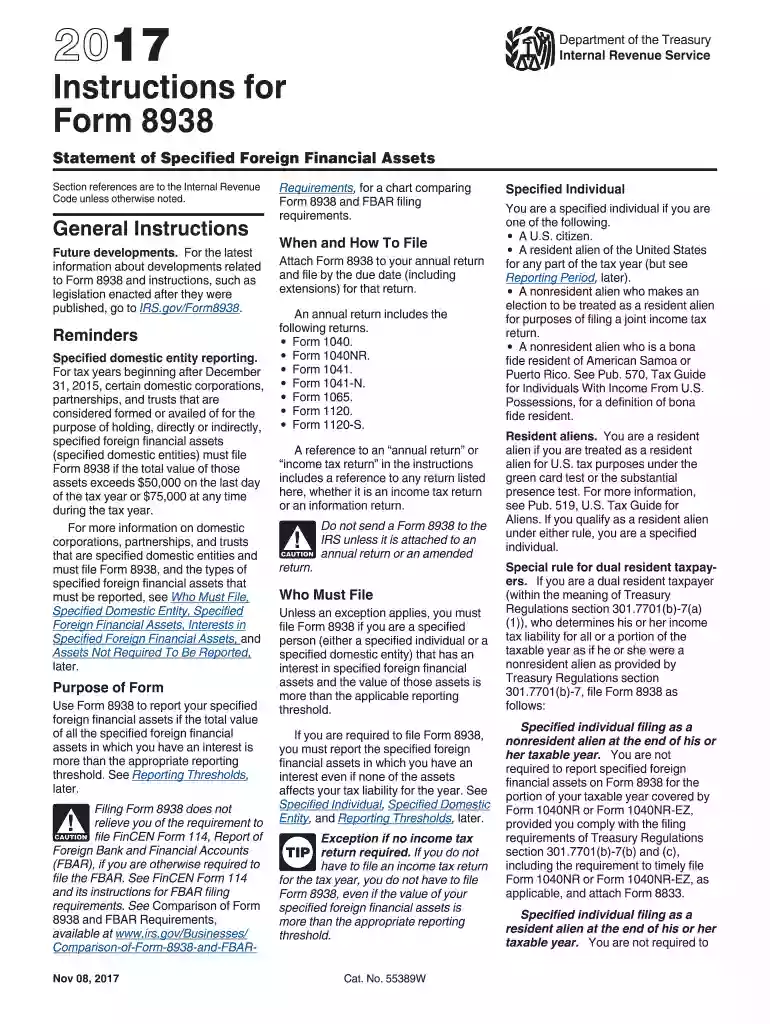
- irs 2026

Get Form
- irs Preview on Page 1

Here's how it works

01. Edit your form online
Type text, add images, blackout confidential details, add comments, highlights and more.

02. Sign it in a few clicks
Draw your signature, type it, upload its image, or use your mobile device as a signature pad.

03. Share your form with others
Send it via email, link, or fax. You can also download it, export it or print it out.

How to use or fill out Form 8938 with our platform

Form edit decoration
9.5
Ease of Setup
DocHub User Ratings on G2
9.0
Ease of Use
DocHub User Ratings on G2
  1. Click ‘Get Form’ to open it in the editor.
  2. Begin by entering your identifying information at the top of the form, including your name and taxpayer identification number.
  3. In Part I, summarize your foreign deposit and custodial accounts. Report the total number of accounts and their maximum values during the tax year.
  4. Proceed to Part II to summarize other foreign assets. Indicate the number of assets and their maximum values, noting any acquisitions or dispositions during the year.
  5. Complete Part III by reporting any tax items attributable to specified foreign financial assets, such as interest, dividends, and gains.
  6. If applicable, fill out Parts IV through VI for additional details on specified foreign financial assets not held in a financial account.

Start using our platform today for free to streamline your Form 8938 completion!

See more - irs versions

We've got more versions of the - irs form. Select the right - irs version from the list and start editing it straight away!
Versions Form popularity Fillable & printable
2021 4.8 Satisfied (251 Votes)
2020 4.4 Satisfied (127 Votes)
2019 4.2 Satisfied (89 Votes)
2018 4.4 Satisfied (135 Votes)
2017 4.1 Satisfied (73 Votes)
2016 4.3 Satisfied (73 Votes)
2015 4.4 Satisfied (571 Votes)
2011 4 Satisfied (48 Votes)
be ready to get more

Complete this form in 5 minutes or less

Get form

Got questions?

We have answers to the most popular questions from our customers. If you can't find an answer to your question, please contact us.
Contact us
THE Fed IRS Social Security and IRS notices number line is 1-800-829-0922. Sometimes this number will get you help fastest. There is also 1-800-829-3676 which is free IRS tax HELP for Tax FORMS. And 1-800-829-4933 for IRS Business Taxes.
For individual tax returns, call 1-800-829-1040, 7 AM - 7 PM Monday through Friday local time. The wait time to speak with a representative may be long. This option works best for less complex questions.
If you cant pay the full amount you owe, pay as much as you can now and make arrangements to pay your remaining balance. Visit .irs.gov/paymentplan for more information on installment agreements and online payment agreements. You can also call us at 1- 800-829-0922 to discuss your options.
IRS customer support, which can be reached at 1-800-829-0922, is available Monday through Friday from 7AM to 7PM.
Most refunds are issued in less than 21 calendar days. The fastest way to get a refund is by filing electronically and choosing direct deposit as the delivery method. Taxpayers who do this typically get their refund in less than 21 days.

Security and compliance

At DocHub, your data security is our priority. We follow HIPAA, SOC2, GDPR, and other standards, so you can work on your documents with confidence.

Learn more
ccpa2
pci-dss
gdpr-compliance
hipaa
soc-compliance

People also ask

Use Wheres My Refund, call us at 800-829-1954 and use the automated system, or speak with an agent by calling 800-829-1040 (see telephone assistance for hours of operation). However, if you filed a married filing jointly return, you cant initiate a trace using the automated systems.
Keep in mind that any interest you receive on tax refunds is considered taxable income during the year you receive it. Call us at 1-800-829-0922 to review your account with a representative. Be sure to have your account information available when you call.
Some 1 million taxpayers are eligible for stimulus payments of up to $1,400. The money, technically known as Recovery Rebate Credit, is for those who did not receive one or more Economic Impact Payments issued during the COVID pandemic.

Related links