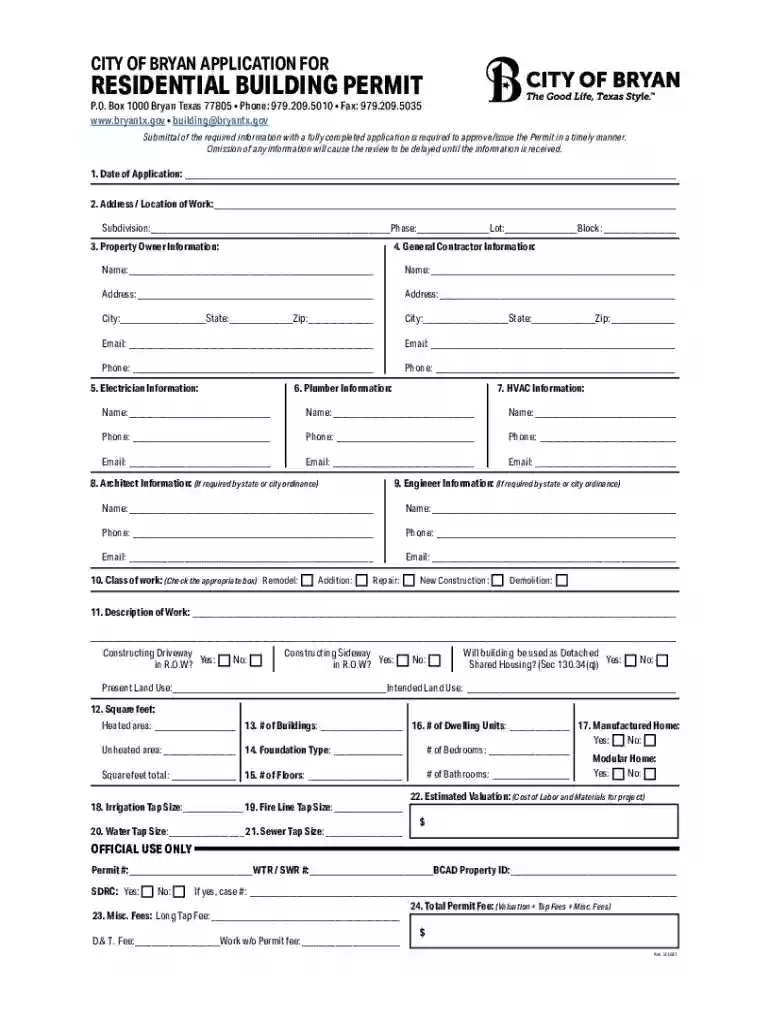
Residential Building Application 2026

Get Form
Residential Building Application Preview on Page 1

Here's how it works

01. Edit your form online
Type text, add images, blackout confidential details, add comments, highlights and more.

02. Sign it in a few clicks
Draw your signature, type it, upload its image, or use your mobile device as a signature pad.

03. Share your form with others
Send it via email, link, or fax. You can also download it, export it or print it out.

How to use or fill out Residential Building Application with our platform

Form edit decoration
9.5
Ease of Setup
DocHub User Ratings on G2
9.0
Ease of Use
DocHub User Ratings on G2
  1. Click ‘Get Form’ to open the Residential Building Application in the editor.
  2. Begin by entering the 'Date of Application' at the top of the form. This is crucial for tracking your submission.
  3. Fill in the 'Address / Location of Work' section, including subdivision, phase, lot, and block details to specify where the work will occur.
  4. Provide information for both the Property Owner and General Contractor. Include names, addresses, emails, and phone numbers to ensure clear communication.
  5. Complete sections for Electrician, Plumber, Architect, and Engineer information if applicable. Ensure all contact details are accurate.
  6. Select the 'Class of work' by checking the appropriate box (e.g., Remodel, New Construction) and provide a detailed 'Description of Work'.
  7. Fill in additional fields such as square footage, number of buildings, and estimated valuation to give a comprehensive overview of your project.
  8. Review all entries for accuracy before signing at the bottom of the application. Initial each statement to confirm understanding of requirements.

Start using our platform today to streamline your Residential Building Application process for free!

See more Residential Building Application versions

We've got more versions of the Residential Building Application form. Select the right Residential Building Application version from the list and start editing it straight away!
Versions Form popularity Fillable & printable
2021 4.8 Satisfied (45 Votes)
be ready to get more

Complete this form in 5 minutes or less

Get form

Got questions?

We have answers to the most popular questions from our customers. If you can't find an answer to your question, please contact us.
Contact us
A house plan is a set of construction or working drawings (sometimes called blueprints) that define all the construction specifications of a residential house such as the dimensions, materials, layouts, installation methods and techniques.
The most popular type of foundation in construction is the shallow foundation, specifically the strip foundation, due to its suitability for various soil conditions and building sizes.
The permitting process can take anywhere from several months to over 1 year. The first step in the process is submitting an application for the building permit. Once the application is received, the city will review it to ensure that it meets all local zoning and building codes.
Poured concrete is the strongest type of foundation for a house. Concrete is incredibly strong and durable, and it can be poured into any shape. This makes it ideal for supporting the weight of a house. Block foundations are also very strong, but they are not as flexible as poured concrete.
Concrete Slab Foundation. A concrete slab is one of the most common types of house foundations, requiring the least amount of lot prep to begin building. Crawl Space Foundation. Homes with a crawl space foundation are elevated a few feet off the ground. Basement Foundation.

Security and compliance

At DocHub, your data security is our priority. We follow HIPAA, SOC2, GDPR, and other standards, so you can work on your documents with confidence.

Learn more
ccpa2
pci-dss
gdpr-compliance
hipaa
soc-compliance

People also ask

Which type of foundation is strongest? Pile Foundation and Raft Foundation are considered the strongest because they transfer the building load to deeper soil layers or distribute it evenly, making them suitable for high-rise or weak soil areas.
Two main types of foundations are used in residential construction, shallow and deep. Shallow foundations extend down around 1.5 meters or less and are suitable for single-family homes and low-rise buildings.
A building containing separate residences where a person may live or regularly stay. Each residence contains independent cooking and bathroom facilities and may be known as an apartment, a residence, or a condominium. See also apartment building and condominium.

Related links