Type text, add images, blackout confidential details, add comments, highlights and more.

02. Sign it in a few clicks
Draw your signature, type it, upload its image, or use your mobile device as a signature pad.

03. Share your form with others
Send appointment represent via email, link, or fax. You can also download it, export it or print it out.

How to use or fill out declaration appointment with our platform
Ease of Setup
DocHub User Ratings on G2
Ease of Use
DocHub User Ratings on G2
Click ‘Get Form’ to open the declaration appointment in the editor.
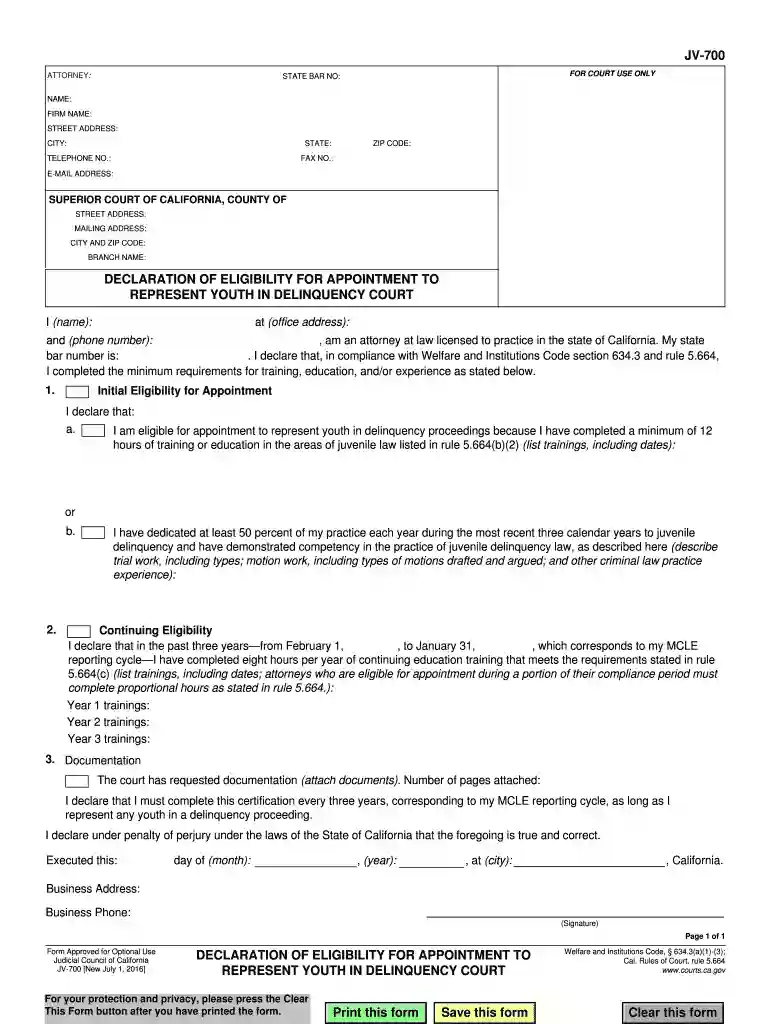
Begin by filling in your attorney details, including your name, state bar number, firm name, and contact information. Ensure accuracy as this information is crucial for identification.
In the 'Initial Eligibility for Appointment' section, indicate your eligibility by selecting either option a or b. If you choose option a, list your completed training hours along with dates. For option b, describe your experience in juvenile delinquency law.
Proceed to the 'Continuing Eligibility' section. Document your continuing education trainings for the past three years by listing each year’s trainings and corresponding dates.
Attach any required documentation as requested by the court. Specify the number of pages attached in the designated field.
Finally, complete the certification statement at the bottom of the form, including date and location of execution. Don’t forget to sign!
Start using our platform today to streamline your document editing and ensure a smooth completion of your declaration appointment!
We've got more versions of the declaration appointment form. Select the right declaration appointment version from the list and start editing it straight away!
Declaration forms are essential documents used across multiple sectors to provide information declared by an individual or organization. Theyre crucial in legal, business, and international travel settings due to their ability to offer transparency and ensure compliance.
What is the purpose of a court declaration?
Use of Declarations in a California Court Hearing A declaration is a written statement made under penalty of perjury in which the party is declaring that the facts are true and correct. The act of signing a statement is made under oath. It is generally an admissible form of evidence in the form of writing.
What does it mean to file a declaration?
The Basics. What is a Declaration? It is a written statement that you swear under penalty of perjury is the truth. Swearing under penalty of perjury means you understand that you can get in trouble if it turns out that your written statement is not true.
What is required for a declaration?
A declaration is an official statement, or proclamation, such as an affidavit . If the person making the declaration (called the declarant ) lies in it, the declarant may be guilty of perjury . [Last reviewed in September of 2022 by the Wex Definitions Team ]
What does it mean to file a declaration in court?
It is a written statement, sworn to be the truth under penalty of perjury by someone with direct knowledge about the issues in a court case. What is it for? You usually use Declarations when filing or responding to motions in court. A declarations information can help the judge1 decide on the motion.
declaration appointment
Declaration appointment onlineDeclaration appointment templateDeclaration appointment formAppointment Affidavit instructionsDeclaration of Guardianship formAppointment affidavit meaningWhat is the oath of office for federal employeesSf61 form
Related links
Appointment Declaration
I declare under penalties of the Penal Law that I have completed all of the forms and questionnaires presented to me and that the statements contained therein
Apr 14, 2024 This is a President guide I going go show you, only what you need to know about this. You already know you can set appointments and buffs and debuffs.
Cookie consent notice
This site uses cookies to enhance site navigation and personalize your experience.
By using this site you agree to our use of cookies as described in our Privacy Notice.
You can modify your selections by visiting our Cookie and Advertising Notice.