




01. Edit your 2014 maine online
Type text, add images, blackout confidential details, add comments, highlights and more.

Type text, add images, blackout confidential details, add comments, highlights and more.

Draw your signature, type it, upload its image, or use your mobile device as a signature pad.

Send it via email, link, or fax. You can also download it, export it or print it out.
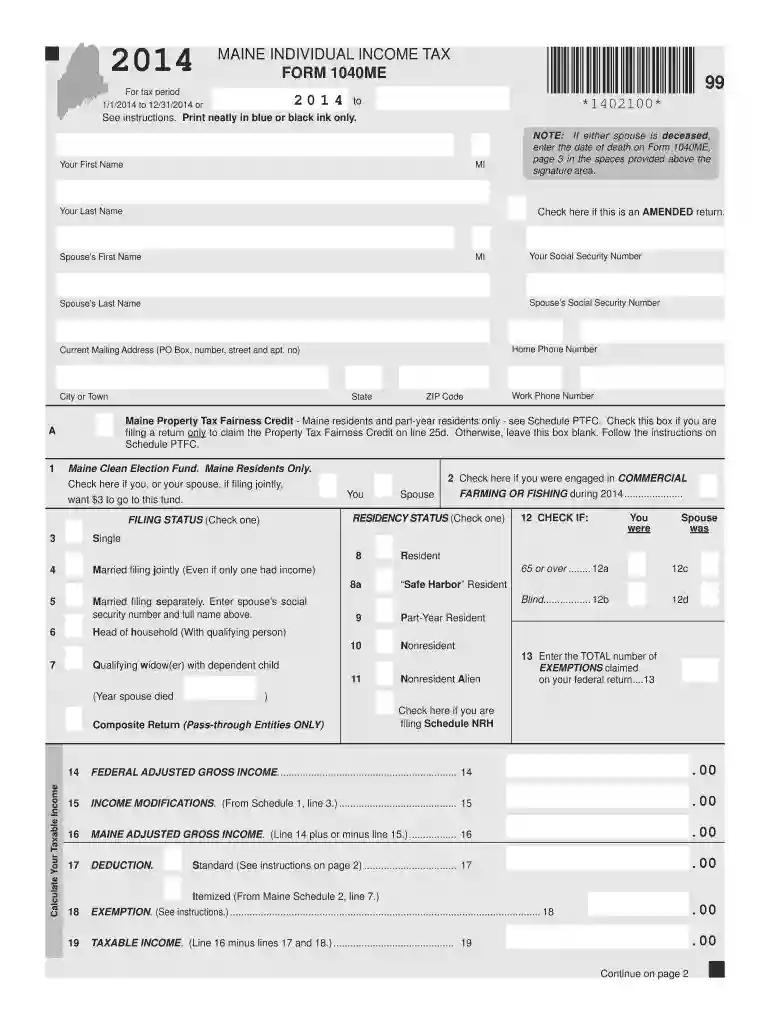
The Maine Individual Income Tax Form 1040ME for 2014 serves as the official document for residents of Maine to report their annual income, claim deductions, and calculate their state tax liabilities. This form is integral for taxpayers to accurately disclose their earnings, identify applicable credits, and determine the amount they owe or the refund they are due. Completion and submission of this form are essential for staying compliant with Maine’s tax regulations.
To use the Form 1040ME effectively, taxpayers need to gather their financial documents from the year, including W-2s, 1099s, and records of any deductible expenses. Users must input their personal information, such as name, address, and social security number, followed by detailed financial data, including income sources, deductions, and credits. Maine residents must follow the form’s instructions to ensure all applicable sections are filled out correctly, which aids in accurately calculating the tax due or refund.
Maine has unique tax credits and deductions that differ from federal provisions. Notably, the Property Tax Fairness Credit allows for a reduction in liability based on property tax burdens relative to income. Additionally, state taxes must consider residency status, as part-year residents need to adjust calculations accordingly. These differences necessitate careful reading of state instructions to ensure compliance.
Typically, the deadline to file is April 15, mirroring federal deadlines, though extensions can be requested. It is crucial to file by this date to avoid penalties and interest on unpaid tax dues. If April 15 falls on a weekend or holiday, the deadline moves to the next business day. Keep track of any changes or updates announced by the Maine Revenue Services.
Maine residents have several submission options for the 1040ME. Traditional paper filing involves mailing the completed form to the designated Maine Revenue Services address. Alternatively, electronic filing through Maine’s i-File system or reputable tax software provides a streamlined, faster process with confirmation receipts, reducing the risk of errors and facilitating easier updates or corrections.
Failing to file the Form 1040ME by the specified deadline results in penalties and accrued interest on any outstanding taxes. Maine imposes a failure-to-file penalty, which increases based on the duration of non-compliance, and a failure-to-pay penalty if the tax due is not settled promptly. In severe cases, continued non-compliance may lead to legal action or wage garnishment. Always aim to submit accurate and timely filings to avoid these consequences.
We've got more versions of the 2014 maine form. Select the right 2014 maine version from the list and start editing it straight away!
| Versions | Form popularity | Fillable & printable |
|---|---|---|
| 2025 | 4.2 Satisfied (40 Votes) | |
| 2024 | 4.8 Satisfied (37 Votes) | |
| 2023 | 4.4 Satisfied (60 Votes) | |
| 2022 | 4.9 Satisfied (41 Votes) | |
| 2021 | 4.8 Satisfied (173 Votes) | |
| 2020 | 4.2 Satisfied (71 Votes) | |
| 2019 | 4.4 Satisfied (63 Votes) | |
| 2018 | 4.3 Satisfied (103 Votes) | |
| 2017 | 4.3 Satisfied (162 Votes) | |
| 2016 | 4.2 Satisfied (119 Votes) | |
| 2015 | 4.4 Satisfied (157 Votes) | |
| 2014 | 4 Satisfied (24 Votes) | |
| 2013 | 4.4 Satisfied (232 Votes) | |
| 2011 | 4 Satisfied (43 Votes) | |
| 2010 | 4 Satisfied (59 Votes) |
At DocHub, your data security is our priority. We follow HIPAA, SOC2, GDPR, and other standards, so you can work on your documents with confidence.
Maine generally imposes an income tax on all individuals that have Maine-source income. The income tax rates are graduated, with rates ranging from 5.8% to 7.Read more
Mar 1, 2017 2016 Maine Individual Income Tax Form 1040ME. A worksheet will be included with Form 1040ME to calculate the amount of the credit. Who willRead more


