




Here's how it works

01. Edit your form online
Type text, add images, blackout confidential details, add comments, highlights and more.

02. Sign it in a few clicks
Draw your signature, type it, upload its image, or use your mobile device as a signature pad.

03. Share your form with others
Send it via email, link, or fax. You can also download it, export it or print it out.
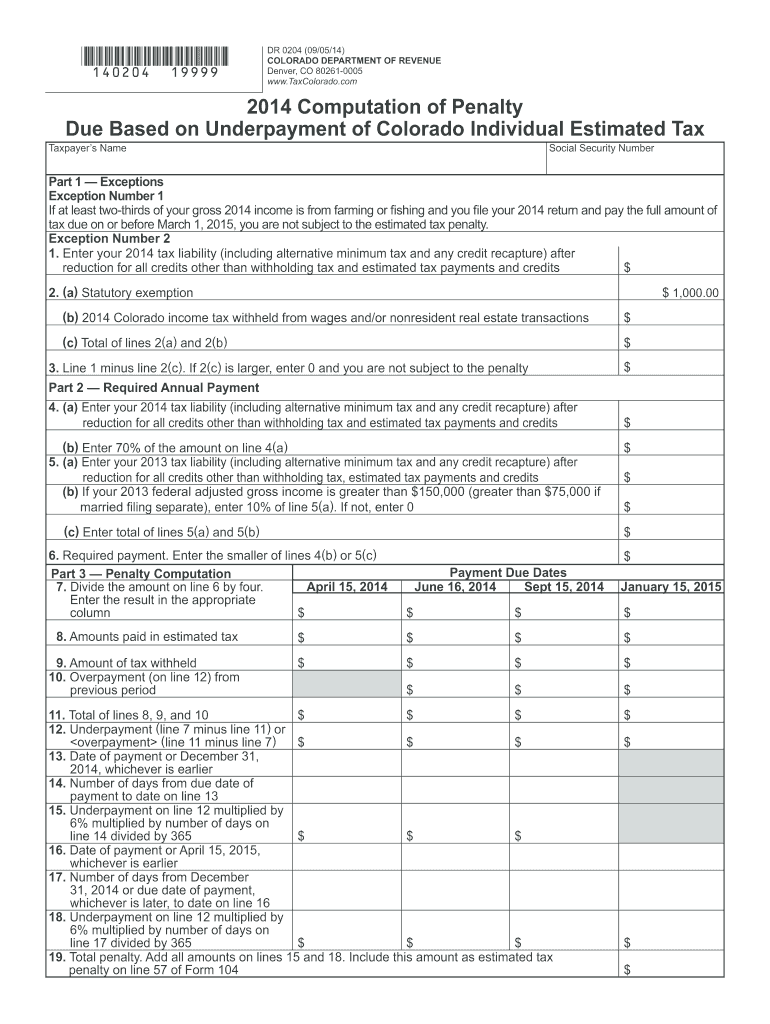
How to use or fill out DR 0204 - colorado with our platform

- Click ‘Get Form’ to open the DR 0204 in the editor.
- Begin by entering your name and Social Security Number in the designated fields at the top of the form.
- In Part 1, review the exceptions. If applicable, fill in your income details to determine if you qualify for an exception from the estimated tax penalty.
- Proceed to Part 2. Enter your 2014 tax liability and calculate the required annual payment based on the provided guidelines.
- In Part 3, compute any penalties by following the instructions for each line carefully. Ensure all calculations are accurate before moving on.
- Finally, complete Part 4 if you choose to use the annualized installment method. Fill in your taxable income and calculate accordingly.
Start using our platform today to easily fill out your DR 0204 form online for free!
Fill out DR 0204 - colorado online
It's free
It's free
See more DR 0204 - colorado versions
We've got more versions of the DR 0204 - colorado form. Select the right DR 0204 - colorado version from the list and start editing it straight away!
| Versions | Form popularity | Fillable & printable |
|---|---|---|
| 2025 | 4.3 Satisfied (29 Votes) | |
| 2024 | 4.6 Satisfied (23 Votes) | |
| 2023 | 4.8 Satisfied (45 Votes) | |
| 2022 | 4.9 Satisfied (28 Votes) | |
| 2021 | 4.8 Satisfied (62 Votes) | |
| 2020 | 4.3 Satisfied (206 Votes) | |
| 2019 | 4.2 Satisfied (92 Votes) | |
| 2018 | 4.4 Satisfied (100 Votes) | |
| 2017 | 4.4 Satisfied (102 Votes) | |
| 2014 | 4.3 Satisfied (28 Votes) |
Security and compliance
At DocHub, your data security is our priority. We follow HIPAA, SOC2, GDPR, and other standards, so you can work on your documents with confidence.
Learn more


