
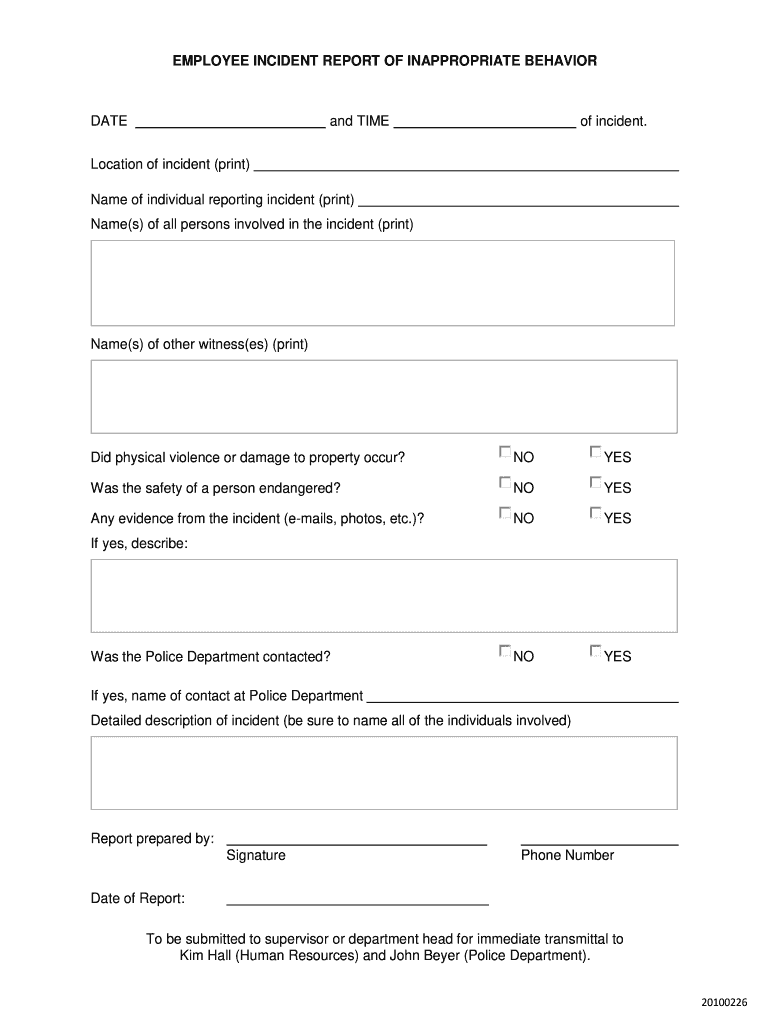







Definition of Employee Incident Report
An employee incident report is a formal document used to record details of an incident involving employee behavior at the workplace. It serves as a crucial tool for addressing cases of misconduct or inappropriate actions, ensuring that all relevant details are documented for future reference and action. The report captures the specifics of the incident, including date, time, location, individuals involved, and any witnesses. This documentation is vital for maintaining workplace standards and can be referenced for corrective measures.
Key elements of an employee incident report include:
- Incident Description: A thorough account of what transpired.
- Involved Parties: Names and roles of individuals participating in or witnessing the incident.
- Location and Time: Precise details on where and when the incident took place.
- Impact Assessment: An evaluation of the event's effects on employees and operations.
- Images or Evidence: Any supporting documentation such as photographs or video recordings.
Procedure for Completing an Incident Report
Completing an employee behavior incident report requires careful attention to detail to ensure accuracy and comprehensiveness. Here’s a step-by-step guide:
- Gather Information: Before filling out the report, collect all relevant details. This includes speaking with witnesses and reviewing any existing evidence related to the incident.
- Fill Out the Report: Include all required sections, starting with the date, time, and location of the incident. Clearly describe the behavior observed, using objective language to avoid bias.
- Document Individuals Involved: List the names and roles of all employees involved, including any witnesses. This captures different perspectives and aids in further inquiry.
- Complete Additional Fields: Include any further information required, such as the impact of the incident on workplace operations or morale.
- Review and Revise: After completing the report, review it for clarity and accuracy. Ensure factual correctness before submission.
- Submit the Report: Send the completed report to the designated supervisor or HR department for further action.
Consequences of Failing to Report
Neglecting to report incidents of employee misconduct can have far-reaching consequences for an organization. It may lead to various issues, including:
- Legal Liability: Organizations may face legal repercussions if incidents are not documented and acted upon, particularly if the behavior results in harassment or discrimination claims.
- Negative Workplace Culture: Failing to address misconduct can create a culture of tolerance for inappropriate behavior, damaging morale and employee trust.
- Increased Turnover: Employees may choose to leave an organization where they feel unsafe or unsupported, leading to higher turnover rates that can undermine business stability.
Importance of Timeliness
Timely reporting is essential. Prompt documentation ensures that memories are fresh and details are accurately captured. This immediacy is critical in assessing the involved parties’ behavior and determining corrective actions.
Types of Misconduct Typically Documented
Employee incident reports can cover a wide variety of misconduct. Some common types include:
- Disrespectful Behavior: This may involve verbal altercations, inappropriate jokes, or personal attacks directed at colleagues.
- Unprofessional Conduct: Actions such as excessive tardiness, dress code violations, or failure to adhere to company policies fall into this category.
- Harassment: Any form of harassment, whether verbal, physical, or psychological, should be meticulously documented to initiate appropriate interventions.
- Substance Abuse: Observations related to drug or alcohol use at work are severe violations that necessitate immediate reporting and context-specific follow-up.
Template for Incident Report on Employee Behavior
An effective template for documenting an employee behavior incident report should include predefined sections to ensure all relevant information is captured consistently. A simple structure may contain:
- Title: Employee Incident Report
- Date of Incident: [Insert Date]
- Time of Incident: [Insert Time]
- Location: [Insert Location]
- Individuals Involved: [List Names]
- Witnesses: [List Names]
- Behavior Description: [Detailed account of the incident]
- Evidence: [Reference any physical or digital documentation]
- Submitted By: [Insert Name and Position]
- Date Reported: [Insert Date]
Using a standardized form helps create uniformity in reporting, making it easier to analyze trends and address issues systematically over time.
Legal Considerations in Incident Reporting
When dealing with employee behaviors and misconduct, various legal considerations must be respected to mitigate liability. Key legal aspects include:
- Confidentiality: Maintaining the privacy of all parties involved is crucial. Sensitive information should be protected and shared only with necessary personnel.
- Documentation Standards: Reports must consistently adhere to internal policies as well as federal and state laws regarding employment practices.
- Investigation Protocols: Following a documented incident, investigations should be conducted according to established company protocols, ensuring fairness and transparency.
Review and Follow-Up After Reporting
Post-reporting processes are just as important as the initial documentation. It's essential to establish a clear follow-up mechanism:
- Feedback Construction: After an incident is reported, managers should provide feedback to the reporting individual, offering reassurance and outlining the next steps.
- Action Plans: Determine appropriate actions based on the severity of the behavior, which may include counseling, training, or disciplinary actions if necessary.
- Monitoring: Implement checks to ensure the resolution remains effective and to reassess the behavioral climate within the workplace, ensuring the incident does not recur.
Continuous Training
Providing training on acceptable workplace behavior can significantly minimize incidents of misconduct. Organizations can benefit by educating employees regarding policies and expected conduct, thus reinforcing a positive culture.




