




Here's how it works

01. Edit your form online
Type text, add images, blackout confidential details, add comments, highlights and more.

02. Sign it in a few clicks
Draw your signature, type it, upload its image, or use your mobile device as a signature pad.

03. Share your form with others
Send it via email, link, or fax. You can also download it, export it or print it out.
How to use or fill out SPS Practice Questionnaire for Foreign Animal Disease Exposure with our platform

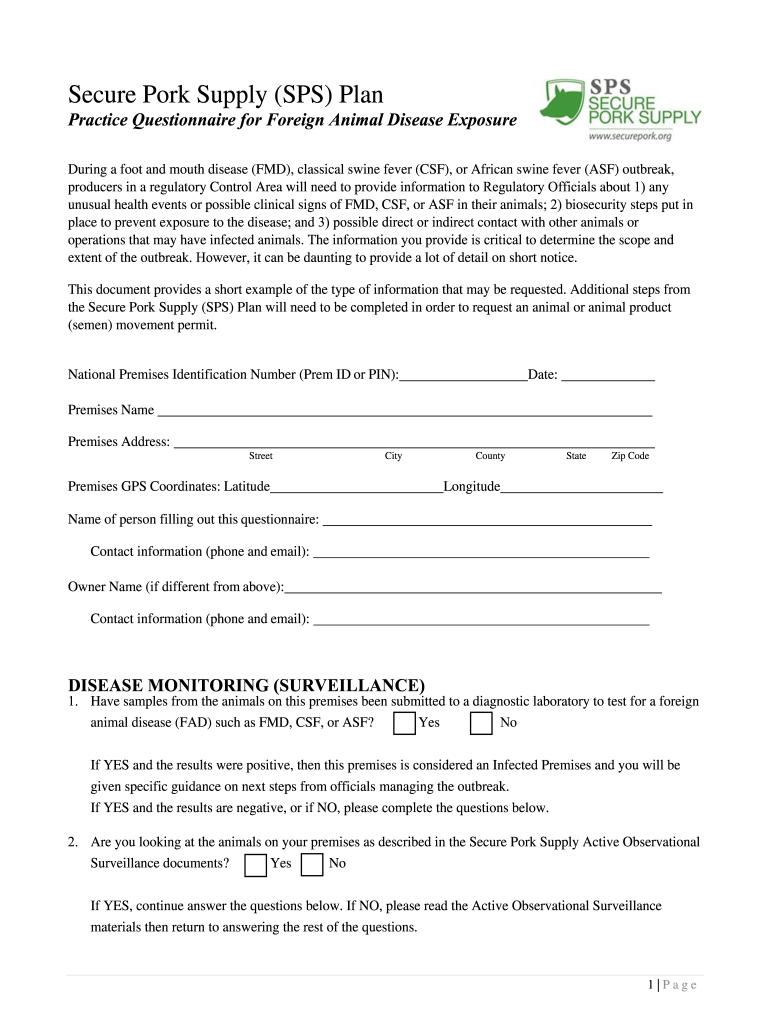
- Click ‘Get Form’ to open the SPS Practice Questionnaire in the editor.
- Begin by entering your National Premises Identification Number (Prem ID or PIN) and the date at the top of the form. Fill in your premises name, address, GPS coordinates, and contact information.
- In the 'DISEASE MONITORING' section, answer questions regarding any diagnostic tests conducted on your animals. If applicable, provide details about clinical signs observed.
- Proceed to the 'BIOSECURITY' section. Indicate whether you have a Biosecurity Manager and if your site-specific biosecurity plan is in place.
- In the 'CONTACT WITH OTHER PREMISES' section, record any external contacts that may have exposed your animals to disease over the past week. Be thorough in listing names and contact information as required.
- Review all entries for accuracy before submitting. Utilize our platform's features to save or share your completed questionnaire easily.
Start using our platform today to efficiently complete your SPS Practice Questionnaire for Foreign Animal Disease Exposure!
Fill out SPS Practice Questionnaire for Foreign Animal Disease Exposure online
It's free
It's free
See more SPS Practice Questionnaire for Foreign Animal Disease Exposure versions
We've got more versions of the SPS Practice Questionnaire for Foreign Animal Disease Exposure form. Select the right SPS Practice Questionnaire for Foreign Animal Disease Exposure version from the list and start editing it straight away!
| Versions | Form popularity | Fillable & printable |
|---|---|---|
| 2020 | 4.8 Satisfied (91 Votes) |
Got questions?
We have answers to the most popular questions from our customers. If you can't find an answer to your question, please contact us.
Contact us
When there is a foreign animal disease incursion confirmed in the United States, how does Woah get involved?
The World Organization for Animal Health (WOAH) gets involved in a foreign animal disease incursion in the U.S. by providing expertise, collaborating with national authorities, issuing alerts, and facilitating communication among affected nations.
Which of the following laboratories can receive samples and confirm a foreign animal disease in the US?
Diagnostic Testing at the NVSL. The National Veterinary Services Laboratories (NVSL) has laboratories in two locations: Ames, IA, and the Foreign Animal Disease Diagnostic Laboratory (FADDL) at Plum Island, NY.
Which of the following equine encephalitis virus is a foreign animal disease in the United States?
Venezuelan Equine Encephalitis (VEE) is caused by the arbovirus Venezuelan Equine Encephalitis Virus (arthropod-borne virus). VEEV, along with EEEV and WEEV, are alphaviruses in the family Togaviridae. In the United States, epizootic VEE is a foreign animal disease that was last reported in Texas in 1971.
What is the primary agency responsible for international animal health?
The World Organisation for Animal Health (WOAH) is a globally respected source for animal health and veterinary information. WOAH collects and shares information about animal diseases worldwide and develops science-based animal health standards that facilitate safe international trade in animals and animal products.
What is a woah listed disease?
WOAH defines listed diseases as a disease, infection or infestation listed in Chapter 1.3 of the Terrestrial and Aquatic Codes after adoption by the World Assembly of Delegates.
Security and compliance
At DocHub, your data security is our priority. We follow HIPAA, SOC2, GDPR, and other standards, so you can work on your documents with confidence.
Learn more


People also ask
What agency or jurisdiction has authority over foreign animal disease response incidents?
USDA APHIS Authorities for an FAD Incident APHIS (through the Secretary of Agriculture) receives its permanent and general regulatory authority to act in preventing, detecting, controlling, and eradicating any FAD or emerging disease through the Animal Health Protection Act (AHPA), 7 United States Code (U.S.C.)


