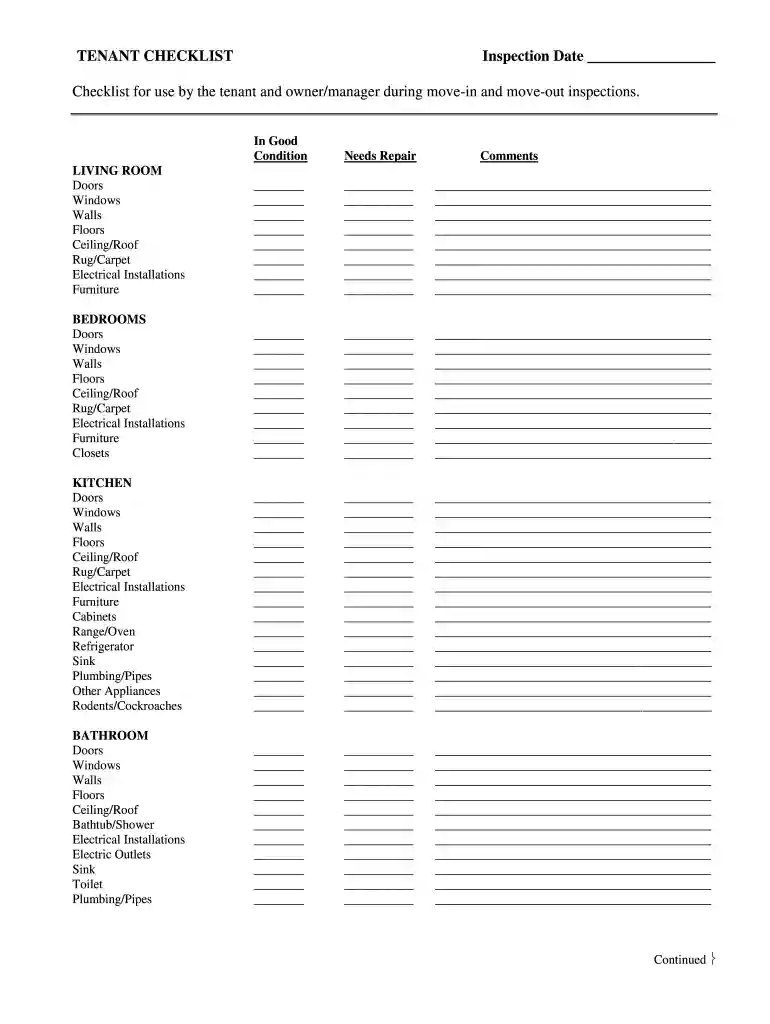
Checklist for use by the tenant and ownermanager during 2026

Get Form
Checklist for use by the tenant and ownermanager during Preview on Page 1

Here's how it works

01. Edit your form online
Type text, add images, blackout confidential details, add comments, highlights and more.

02. Sign it in a few clicks
Draw your signature, type it, upload its image, or use your mobile device as a signature pad.

03. Share your form with others
Send it via email, link, or fax. You can also download it, export it or print it out.

How to use or fill out Checklist for use by the tenant and owner/manager during inspections

Form edit decoration
9.5
Ease of Setup
DocHub User Ratings on G2
9.0
Ease of Use
DocHub User Ratings on G2
  1. Click ‘Get Form’ to open it in the editor.
  2. Begin with the 'Inspection Date' field at the top. Enter the date of your inspection to keep a record.
  3. Proceed to each section: Living Room, Bedrooms, Kitchen, Bathroom, and Other. For each item listed, mark whether it is 'In Good Condition' or 'Needs Repair' by checking the appropriate box.
  4. Use the comment sections provided under each category to note any specific issues or observations related to repairs needed.
  5. At the end of the checklist, ensure both tenant and owner/manager sign and date the document for verification.

Start using our platform today to streamline your document management process for free!

be ready to get more

Complete this form in 5 minutes or less

Get form

Got questions?

We have answers to the most popular questions from our customers. If you can't find an answer to your question, please contact us.
Contact us
Poor Communication: - Inconsistent or vague answers to questions. - Lack of responsiveness to messages or emails. Negative Attitude: - Complaining about previous landlords or properties. - Displaying entitlement or unrealistic expectations. Incomplete or Inaccurate Application:
You will also have to provide other paperwork to your tenant at the beginning of their tenancy, including: An Energy Performance Certificate. Deposit protection information. A current gas safety certificate. A copy of the property licence. How to Rent Guide (External PDF)
Tenant screening is the process landlords use to evaluate potential renters to determine their suitability for renting a property. This assessment involves several steps, including credit checks, criminal background checks, employment and income verification, rental history verification, and reference checks.
Contacting previous landlords: The most common method involves docHubing out to former landlords listed on the tenants rental application. This helps verify details such as payment consistency, property maintenance, and adherence to lease terms.
A tenant screening report examines the financial and rental pasts of prospective tenants after they have applied for a rental. This includes looking into their credit, eviction, and criminal history so that the landlord can be confident in the tenants ability to pay rent and fulfill all tenant responsibilities.

Security and compliance

At DocHub, your data security is our priority. We follow HIPAA, SOC2, GDPR, and other standards, so you can work on your documents with confidence.

Learn more
ccpa2
pci-dss
gdpr-compliance
hipaa
soc-compliance

People also ask

The tenant screening process involves evaluating rental applications, conducting thorough background checks, including financial, criminal, rental history, and employment verifications. It determines a prospective tenants ability to pay rent on time, engage in respectful tenancy, and honor lease agreements.
Locked Areas This includes locked closets, cabinets, or storage spaces. These areas are considered private space, and the landlord should respect tenants right to privacy by not intruding without proper authorization.

Related links