Usda vs 10 11 2026

Get Form
blank coggins form Preview on Page 1

Here's how it works

01. Edit your blank coggins form online
Type text, add images, blackout confidential details, add comments, highlights and more.

02. Sign it in a few clicks
Draw your signature, type it, upload its image, or use your mobile device as a signature pad.

03. Share your form with others
Send vs form 10 11 via email, link, or fax. You can also download it, export it or print it out.

Understanding the USDA Vs Form 10 11

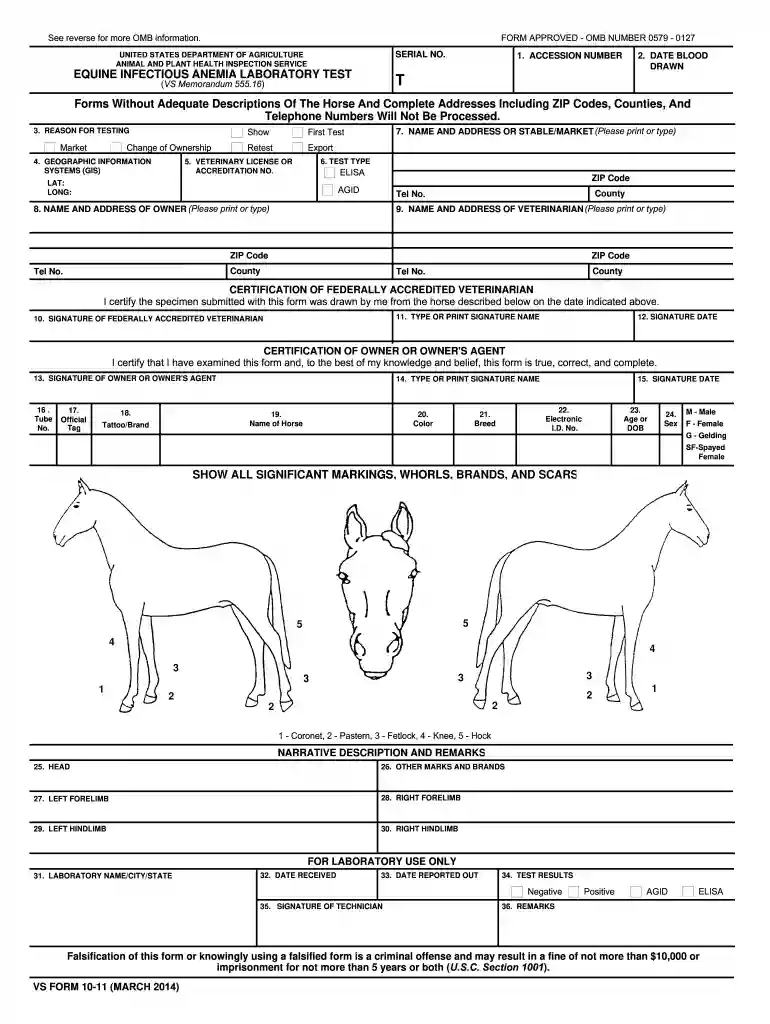
The USDA vs Form 10 11 is a critical document used primarily for equine health screening in the United States. This form is used to report the results of the Equine Infectious Anemia (EIA) test, a requirement for the movement of horses across state lines. Accurate completion and submission of this form are essential for compliance with federal and state regulations pertaining to horse health.

How to Use the USDA Vs Form 10 11

Utilizing the USDA vs Form 10 11 requires a clear understanding of its purpose and content. The form must be completed by a licensed veterinarian who conducts the EIA test on a horse. The information included must be precise, detailing the horse’s identification, the owner’s information, and the test results.

  • Gather Information: Ensure you have all necessary details concerning the horse, such as:

    • Registered name
    • Owner's contact information
    • Required veterinary details
  • Testing Documentation: The veterinarian will need to prepare and fill out the test results accurately using the form, ensuring to certify that the horse has tested negative for EIA.

Steps to Complete the USDA Vs Form 10 11

Completing the USDA vs Form 10 11 involves several key steps aimed at ensuring accurate documentation of the test results.

  1. Identify the Horse: Include essential identifying factors, such as:
    • Breed
    • Age
    • Color
    • Distinct markings or registration number
  2. Owner Information: Provide the complete name and address of the horse owner.
  3. Veterinary Section: The veterinarian conducting the EIA test must include their name, signature, and license number, confirming that the test was performed according to USDA guidelines.
  4. Testing Results: Clearly state the results, specifying that the horse is negative for EIA. Some forms may require a lab number or other specific data points.

Important Terms Related to the USDA Vs Form 10 11

Understanding terminology associated with the USDA vs Form 10 11 is essential for effective completion and compliance.

  • EIA (Equine Infectious Anemia): A viral disease affecting horses that can be fatal. Testing for EIA is mandatory for horse movement.
  • Veterinarian of Record: The licensed professional responsible for performing the EIA test and certifying the results on Form 10 11.
  • Certification: The act of attesting to the accuracy of the test results, which must be signed by the veterinarian.

Legal Use of the USDA Vs Form 10 11

The USDA vs Form 10 11 serves as a legal document that fulfills federal requirements for horse movement across state lines. Its accurate completion has significant implications for horse owners and veterinarians, including:

  • Compliance: Ensuring that both the horse owner and the veterinarian comply with USDA and state guidelines prevents potential fines and legal issues.
  • Record Keeping: Maintaining a valid record of test results helps protect horse owners from future claims about their horse's health status.

Who Typically Uses the USDA Vs Form 10 11

The primary users of the USDA vs Form 10 11 include:

  • Horse Owners: Those responsible for ensuring their horses are tested and can safely travel without risk of spreading EIA.
  • Veterinarians: Professional service providers who perform the necessary tests and fill out the form, providing certified results essential for the animal’s health documentation.

Overall, the USDA vs Form 10 11 plays a vital role in protecting equine health and ensuring compliance with agricultural regulations relating to horse transport and health management in the United States.


decoration image ratings of Dochub

See more usda vs 10 11 versions

We've got more versions of the usda vs 10 11 form. Select the right usda vs 10 11 version from the list and start editing it straight away!
Versions Form popularity Fillable & printable
2014 4.8 Satisfied (172 Votes)
be ready to get more

Complete this form in 5 minutes or less

Get form

Got questions?

We have answers to the most popular questions from our customers. If you can't find an answer to your question, please contact us.
Contact us
So, the average minimum temperature in zone 6a is -5F to -10F, and the average minimum temperature in zone 6b is 0F to -5F. You may have heard someone say they live in a cold zone 6, and that means they live in zone 6a, which is the colder half of USDA hardiness zone 6.
Dog breeders with a USDA license are licensed to breed dogs and produce puppies under the oversight of the United States Department of Agriculture (USDA).
USDA APHIS issues permits to ensure the safe import and transport of materials containing plant or animal material that may potentially harm US agricultural products including livestock, poultry and crops.
USDA Choice has less marbling than Prime but is of very high quality. USDA Select is very uniform in quality and normally leaner than the higher grades. It is fairly tender, but, because it has less marbling, it may lack some of the juiciness and flavor of the higher grades.
What Is a USDA-Accredited Veterinarian? A USDA-accredited veterinarian has completed formal training from the National Veterinary Accreditation Program (NVAP) in the State(s) they are licensed to practice medicine in. Accreditation is State-specific and voluntary (not all veterinarians are accredited).

Security and compliance

At DocHub, your data security is our priority. We follow HIPAA, SOC2, GDPR, and other standards, so you can work on your documents with confidence.

Learn more
ccpa2
pci-dss
gdpr-compliance
hipaa
soc-compliance

People also ask

A VS Form 16-6A United States Veterinary Permit for Importation and Transportation of Controlled Materials and Organisms and Vectors (usually referred to simply as a VS 16-6) is the actual permit that is issued to the permittee for import or transport of the regulated material.

coggins form pdf