Campus FormsAssessment Office 2026

Get Form
staar seating chart Preview on Page 1

Here's how it works

01. Edit your staar seating chart online
Type text, add images, blackout confidential details, add comments, highlights and more.

02. Sign it in a few clicks
Draw your signature, type it, upload its image, or use your mobile device as a signature pad.

03. Share your form with others
Send staar seating chart template via email, link, or fax. You can also download it, export it or print it out.

How to use or fill out Campus FormsAssessment Office with our platform

Form edit decoration
9.5
Ease of Setup
DocHub User Ratings on G2
9.0
Ease of Use
DocHub User Ratings on G2
  1. Click ‘Get Form’ to open the Campus FormsAssessment Office in the editor.
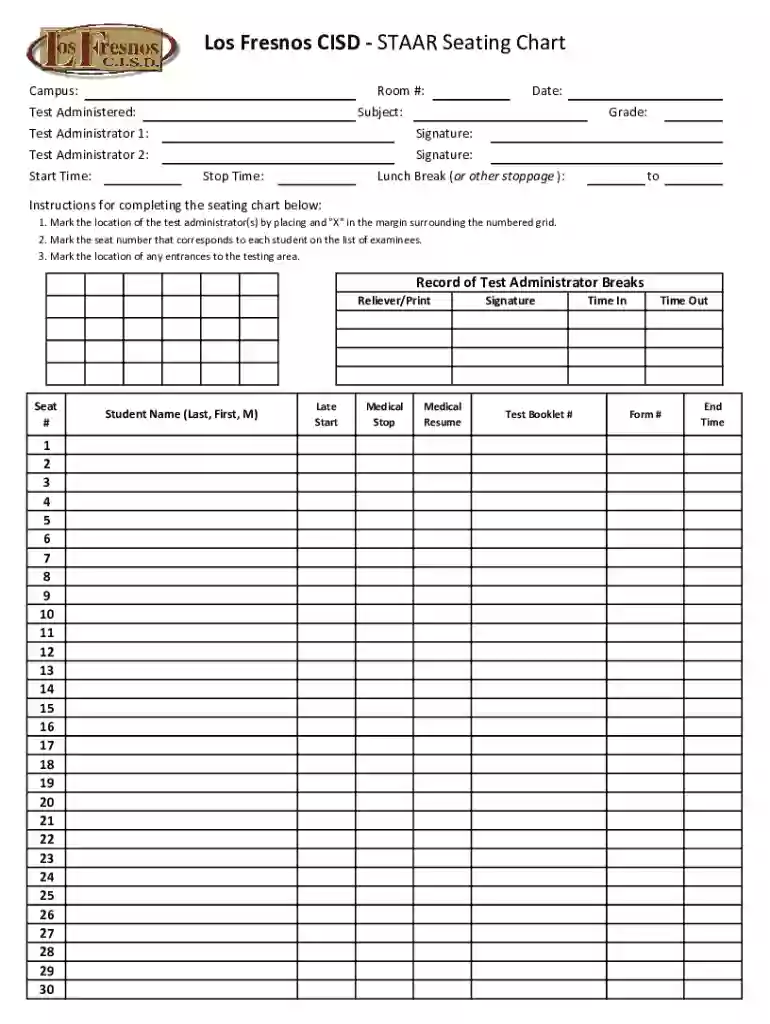
  2. Begin by entering the 'Campus' and 'Test Administered' details at the top of the form. This sets the context for your seating chart.
  3. Fill in the names of 'Test Administrator 1' and 'Test Administrator 2'. This is crucial for identifying who is overseeing the test.
  4. Record the 'Start Time', 'Room #', and 'Date' to ensure accurate documentation of testing conditions.
  5. In the grid provided, mark the location of test administrators with an 'X'. This helps visualize their positions during testing.
  6. Next, indicate each student's seat number corresponding to their name on the list of examinees. This organization is vital for tracking student placements.
  7. Document any entrances to the testing area within the grid for safety and accessibility considerations.
  8. Complete sections for recording test administrator breaks, including reliever information and printouts as necessary.

Start using our platform today to streamline your form completion process effortlessly!

See more Campus FormsAssessment Office versions

We've got more versions of the Campus FormsAssessment Office form. Select the right Campus FormsAssessment Office version from the list and start editing it straight away!
Versions Form popularity Fillable & printable
2023 4.9 Satisfied (47 Votes)
2015 4.8 Satisfied (49 Votes)
be ready to get more

Complete this form in 5 minutes or less

Get form

Got questions?

We have answers to the most popular questions from our customers. If you can't find an answer to your question, please contact us.
Contact us
Information about student learning can be assessed through both direct and indirect measures. Direct measures may include homework, quizzes, exams, reports, essays, research projects, case study analysis, and rubrics for oral and other performances.
Assessment is the systematic basis for making inferences about the learning and development of students. It is the process of defining, selecting, designing, collecting, analyzing, interpreting, and using information to increase students learning and development.
Examples of student self-assessment activities can include establishing goals, identifying strengths and weaknesses, and setting plans for improvement. Effective self-assessment means consistently showing students how to think about their own learning through the entire learning process.
Student assessment helps focus attention on what matters most in education: the learning progress and outcomes of each student. The primary purposes of student assessment are to determine what students know and can do, and to help students advance in their learning and make informed decisions on their next steps.
Student-generated assessments involve learners contributing somehow to the means of assessment, for example selecting work for a portfolio, writing test questions for other students, or using assessment criteria to give feedback on particular pieces of work.

Security and compliance

At DocHub, your data security is our priority. We follow HIPAA, SOC2, GDPR, and other standards, so you can work on your documents with confidence.

Learn more
ccpa2
pci-dss
gdpr-compliance
hipaa
soc-compliance
be ready to get more

Complete this form in 5 minutes or less

Get form