Form AU-67:4 11 - Tax NY 2026

Get Form
Form AU-67:4 11 - Tax NY Preview on Page 1

Here's how it works

01. Edit your form online
Type text, add images, blackout confidential details, add comments, highlights and more.

02. Sign it in a few clicks
Draw your signature, type it, upload its image, or use your mobile device as a signature pad.

03. Share your form with others
Send it via email, link, or fax. You can also download it, export it or print it out.

How to use or fill out Form AU-67:4 11 - Tax NY with our platform

Form edit decoration
9.5
Ease of Setup
DocHub User Ratings on G2
9.0
Ease of Use
DocHub User Ratings on G2
  1. Click ‘Get Form’ to open it in the editor.
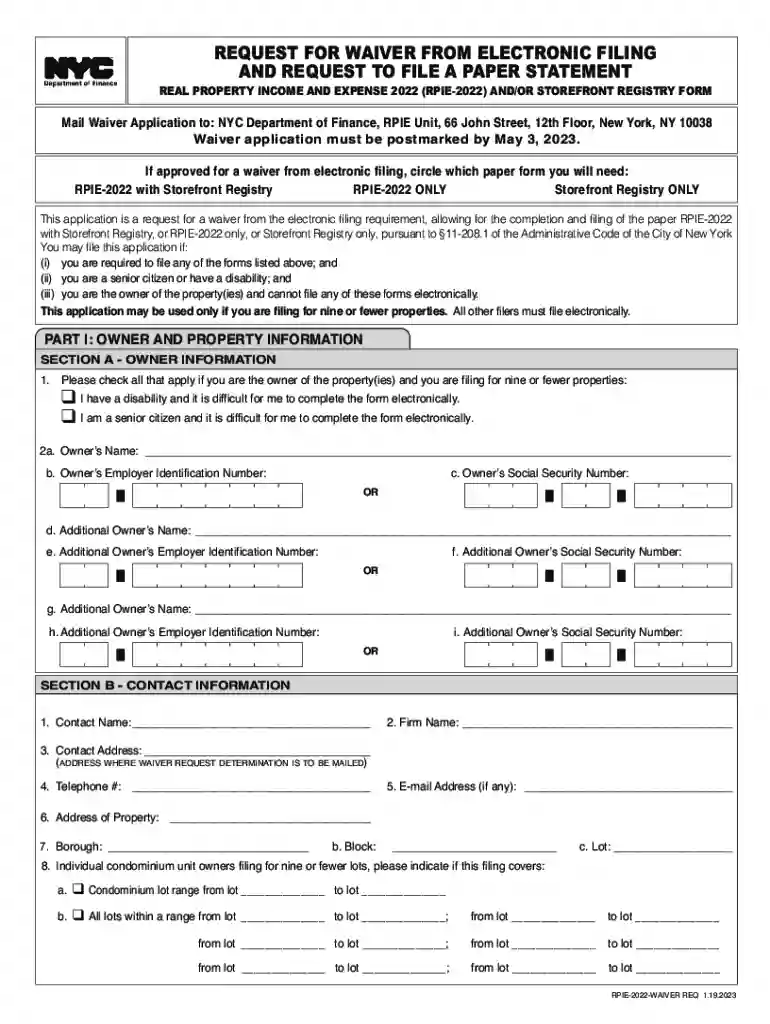
  2. Begin with Part I: Owner and Property Information. Fill in your name, Social Security Number, and Employer Identification Number as applicable. If there are additional owners, provide their details in the designated fields.
  3. In Section B, enter your contact information including name, firm name, address, telephone number, and email address. Ensure that the address is where you want the waiver request determination mailed.
  4. Complete the property details by filling in the address, borough, block, and lot numbers. If applicable, indicate if this filing covers specific condominium lots.
  5. Move to Part II: Basis for Waiver Request. Clearly state your reasons for requesting a waiver from electronic filing in the provided space.
  6. Finally, complete Part III: Certification by signing and dating the form to confirm that all information is accurate.

Start using our platform today to fill out your Form AU-67:4 11 - Tax NY easily and for free!

See more Form AU-67:4 11 - Tax NY versions

We've got more versions of the Form AU-67:4 11 - Tax NY form. Select the right Form AU-67:4 11 - Tax NY version from the list and start editing it straight away!
Versions Form popularity Fillable & printable
2023 4.1 Satisfied (38 Votes)
2019 4.8 Satisfied (151 Votes)
2019 4.5 Satisfied (20 Votes)
2015 4.9 Satisfied (21 Votes)
2015 4.2 Satisfied (54 Votes)
2014 4 Satisfied (55 Votes)
2013 4.8 Satisfied (48 Votes)
2003 4 Satisfied (28 Votes)
be ready to get more

Complete this form in 5 minutes or less

Get form

Got questions?

We have answers to the most popular questions from our customers. If you can't find an answer to your question, please contact us.
Contact us
Filing Requirements Residents: The estate of a New York resident must file a New York State estate tax return if the amount of the residents federal gross estate, plus the amount of any includible gifts, exceeds the basic exclusion amount applicable at the date of death.
When authorization is required for the release of personal property, it is usually referred to as an estate tax waiver or a consent to transfer. New York State does not require waivers for estates of anyone who died on or after February 1, 2000. For details, See Publication 603, Estate Tax Waivers.
You must file Form IT-203, Nonresident and Part-Year Resident Income Tax Return, if you: were not a resident of New York State and received income during the tax year from New York State sources, or. moved into or out of New York State during the tax year.
The exemption threshold represents an estates maximum value before being subject to estate tax. In 2024, New Yorks estate tax exemption threshold was $6.58 million. However, this threshold is adjusted annually for inflation. For the upcoming year, the threshold is set at $7.16 million.
Residents. The estate of a New York State resident must file a New York State estate tax return if the following exceeds the basic exclusion amount: the amount of the residents federal gross estate, plus. the amount of any includible gifts.

Security and compliance

At DocHub, your data security is our priority. We follow HIPAA, SOC2, GDPR, and other standards, so you can work on your documents with confidence.

Learn more
ccpa2
pci-dss
gdpr-compliance
hipaa
soc-compliance
be ready to get more

Complete this form in 5 minutes or less

Get form

People also ask

An estate tax return (Form 706) must be filed if the gross estate of the decedent (who is a U.S. citizen or resident), increased by the decedents adjusted taxable gifts and specific gift tax exemption, is valued at more than the filing threshold for the year of the decedents death, as shown in the table below.
Penalties for underpayment of estimated taxes The penalty is the federal short-term interest rate plus 5.5 percentage points. Both the federal interest rate plus the additional percentage rate change quarterly. However, the minimum penalty is 7.5%.

Related links