
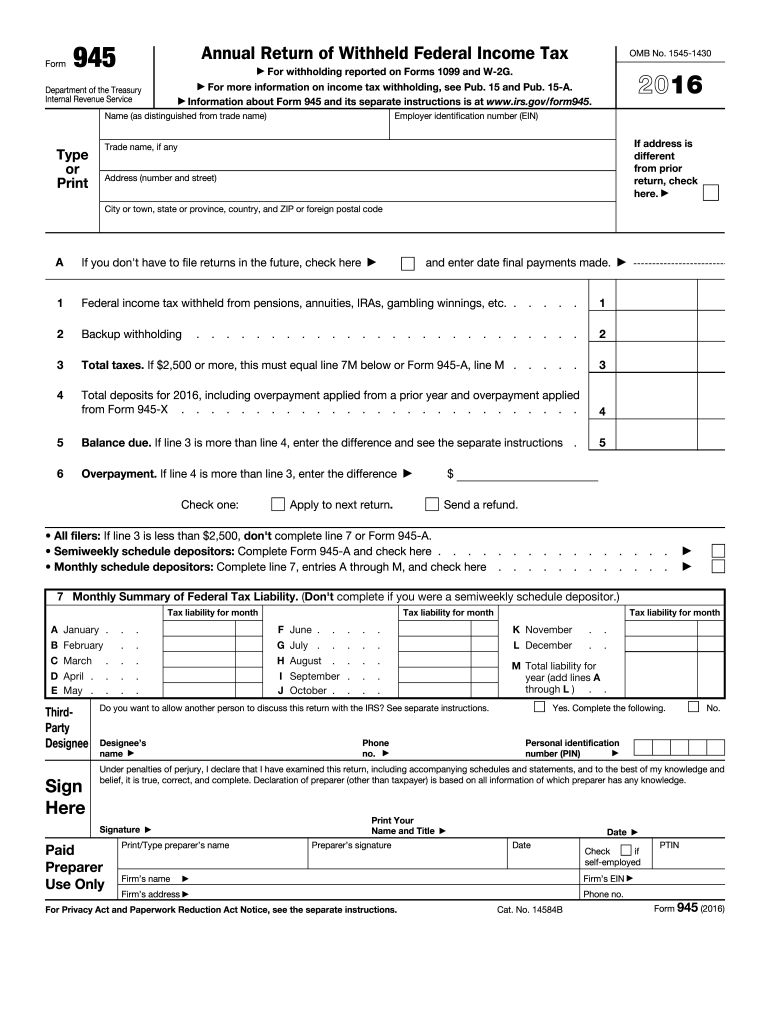







Definition and Purpose of 2016 Form 945
The 2016 Form 945 is designed for businesses and individuals who need to report federal income tax withheld from non-payroll payments. These include pensions, annuities, individual retirement accounts (IRAs), and gambling winnings. Understanding its purpose is crucial, as it differentiates these withholdings from payroll-related taxes, which are reported on Form 941.
Key Elements of the 2016 Form 945
Integral to the form are its sections that capture essential information. These elements include identifying information, total federal income tax withheld, and adjustments from previous years. Each section requires careful completion to ensure accurate reporting to the IRS.
Steps to Complete the 2016 Form 945
Completing Form 945 involves a series of methodical steps:
- Gather necessary documents including records of all non-payroll payments made.
- Fill in the business information section accurately.
- Calculate and report the total federal income tax withheld from all applicable payments.
- Make any necessary adjustments for previous years.
- Verify your entries before submission to avoid errors.
How to Obtain the 2016 Form 945
The 2016 Form 945 is accessible through multiple channels. You can download it from the IRS website, obtain it from a tax professional, or use tax preparation software that integrates IRS forms. Opting for digital retrieval ensures you have the most up-to-date version.
IRS Guidelines and Filing Deadlines
IRS guidelines dictate that Form 945 must be filed annually, with a deadline typically set for January 31 of the following year. Filers must adhere to these deadlines to avoid potential penalties. Additionally, it's essential to consult the IRS publication related to Form 945 for comprehensive instructions and updates.
Required Documents for Filing Form 945
Accurate filing requires specific documentation:
- Records of all payments subject to withholding
- Copies of related invoices or payment statements
- Previous years’ filed forms for reference, especially when making adjustments
These documents support the accuracy of the information provided on the form.
Penalties for Non-Compliance
Failure to file the 2016 Form 945 or incorrect filings can lead to penalties. The IRS imposes fines based on lateness or inaccuracy, emphasizing the importance of timely and accurate submission. Businesses must be vigilant to avoid these financial repercussions.
Electronic Versus Paper Filing
Form 945 can be submitted electronically or via traditional paper filing. Electronic filing is encouraged as it reduces processing time and errors. Those choosing paper must ensure adherence to IRS hard copy submission guidelines. Both methods have their advantages, but electronic submissions generally offer more efficiency.
Taxpayer Scenarios: Who Typically Uses Form 945
The form is used by various entities and individuals, including:
- Businesses making pension or annuity payments
- Casinos handling winnings
- Financial institutions managing IRAs
Understanding the scenarios in which Form 945 is applicable helps in identifying when and why it should be used.


State-Specific Rules and Considerations
While Form 945 is a federal requirement, certain states may have additional reporting requirements or specific tax considerations. Businesses must review state-specific rules to ensure comprehensive compliance. This may involve consulting with state tax authorities or professional services specializing in regional tax laws.
Legal Use and Compliance
Compliance with the legal use of Form 945 mandates accurate and honest reporting. Misuse or evasion can lead to legal repercussions, including audits and fines. It is crucial for filers to adhere strictly to the IRS instructions to maintain compliance and safeguard against complications.




