Type text, add images, blackout confidential details, add comments, highlights and more.

02. Sign it in a few clicks
Draw your signature, type it, upload its image, or use your mobile device as a signature pad.

03. Share your form with others
Send it via email, link, or fax. You can also download it, export it or print it out.

How to use or fill out West Virginia Breast and Cervical Cancer Screening Program Certificate
Ease of Setup
DocHub User Ratings on G2
Ease of Use
DocHub User Ratings on G2
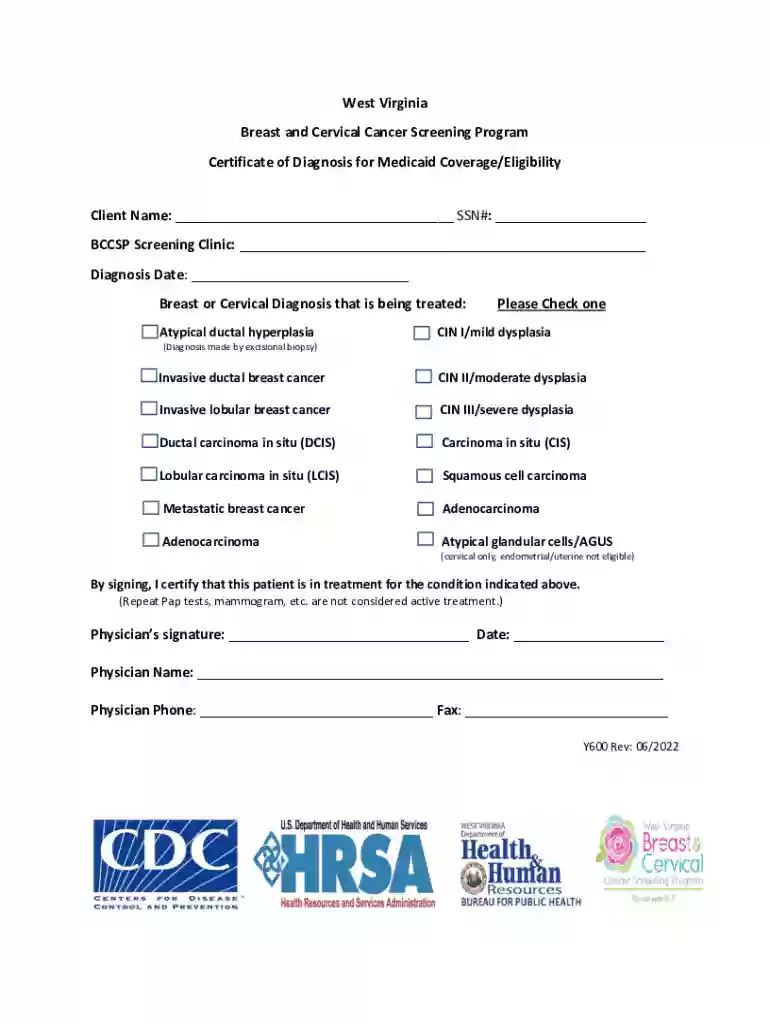
Click ‘Get Form’ to open the West Virginia Breast and Cervical Cancer Screening Program Certificate in our editor.
Begin by entering the client’s name and Social Security Number (SSN) in the designated fields at the top of the form.
Next, specify the BCCSP Screening Clinic by filling in the clinic's name where the diagnosis was made.
Indicate the diagnosis date by selecting or typing in the appropriate date format.
In the section for breast or cervical diagnosis, check one of the options provided that corresponds to the patient's condition. Ensure accuracy as this is crucial for treatment eligibility.
Finally, have the physician sign and date at the bottom of the form, along with their name and contact information to validate the certificate.
Start using our platform today to fill out your forms online for free!
Fill out West Virginia Breast and Cervical Cancer Screening Program Certificate online It's free
See more West Virginia Breast and Cervical Cancer Screening Program Certificate versions
We've got more versions of the West Virginia Breast and Cervical Cancer Screening Program Certificate form. Select the right West Virginia Breast and Cervical Cancer Screening Program Certificate version from the list and start editing it straight away!
Services provided by the WVBCCSP are free or low-cost for women who qualify. How do I apply for the program? Contact the West Virginia and Cervical Cancer Screening Program at 304.558. 5388 or 1.800.
Is a cervical cancer test free?
How much does the Cervical Screening Test cost? The test is free for many eligible women aged 25 to 74. However, your doctor or health provider may charge a small fee. What happens at a cervical screening appointment?
How much does a cervical cancer screening cost?
CDC offers free or low-cost cervical cancer screening tests through the National and Cervical Cancer Early Detection Program.
What age is the cervical screening program?
All women and people with a between the ages of 25 and 64 should go for regular cervical screening. Youll be invited for screening every 5 years from when youre 25 to 64 years old. Youll get your first invitation a few months before you turn 25.
Who is eligible for free cervical screening?
Te Whatu Ora funds free cervical screening for: People 30 years and over, with a , who are unscreened have never had a screening test. This includes people with a aged 70 to 74 years who have never been screened.
Related Searches
West virginia Breast and Cervical Cancer Screening Program wvbccspBreast and Cervical Cancer Program applicationWV Medicaid for Breast cancerFree mammograms in West VirginiaBCCSP formsWV Department of Health and Human ResourcesWV family Planning ProgramWest Virginia Department of Public Health
Security and compliance
At DocHub, your data security is our priority. We follow HIPAA, SOC2, GDPR, and other standards, so you can work on your documents with confidence.
Established by the Philippine Department of Health, the Cancer Control Program (BCCP) serves as the nationwide anti- cancer scheme, integrating public information, health education, and case finding and treatment into the community health structure (Ngelangel and , 2002), although its implementation
Can I get a free cervical screening?
Women and anyone with a can get free cervical screening.
Related links
Implementation Of Cervical Cancer Screening Protocol (CCSP)
by E Lenhart Hawk 2021 Hispanic women had the highest incidence rate of cervical cancer (10.6 per 100,000), followed by black (10.1 per 100,000) and white women (7.5.
This section discusses tetrachloroethylene toxicity on an organ-specific basis. For each of the major organ systems, human effects are presented first, followed
Cookie consent notice
This site uses cookies to enhance site navigation and personalize your experience.
By using this site you agree to our use of cookies as described in our Privacy Notice.
You can modify your selections by visiting our Cookie and Advertising Notice.