
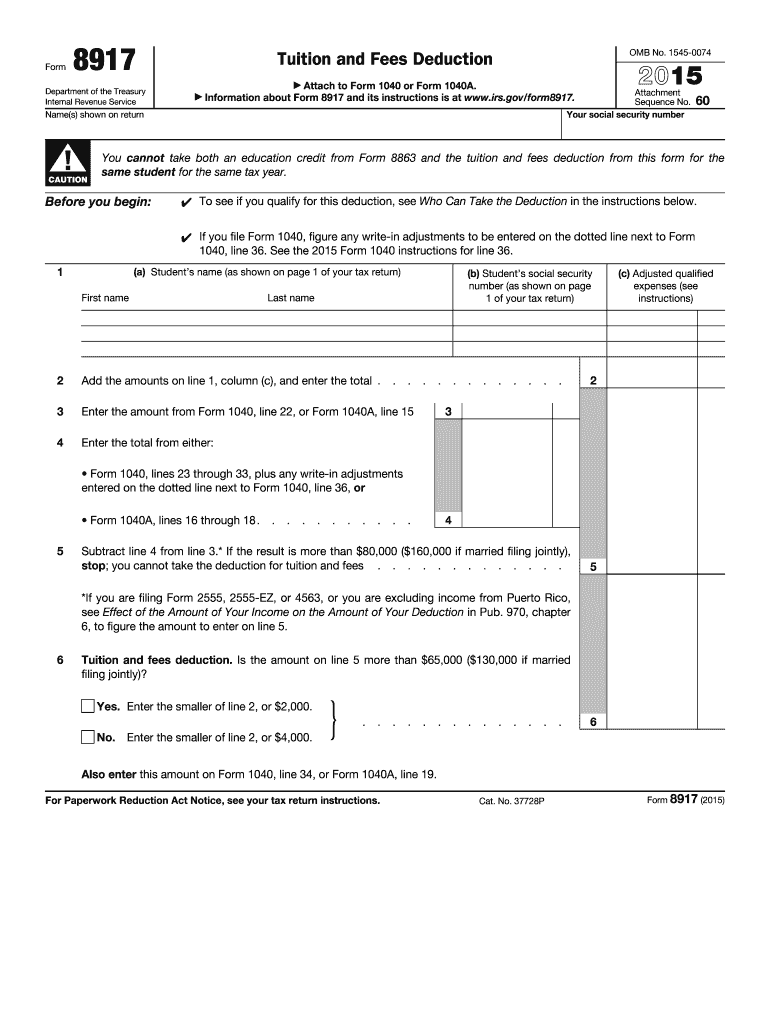







Definition and Purpose of IRS Form 8917
IRS Form 8917 is utilized by taxpayers to claim the tuition and fees deduction for qualified education expenses paid in 2015. This deduction helps reduce taxable income, which can lead to lower tax liability. The primary objective is to provide relief to students or those supporting students by acknowledging educational costs. The form outlines the types of expenses that qualify, such as tuition and mandatory fees required for enrollment. However, it excludes personal expenses, such as room and board or transportation, from its purview.
Eligibility Criteria for Form 8917
To determine if you can utilize Form 8917, several eligibility criteria must be met:
- Income Limits: Taxpayers must fall within specific modified adjusted gross income (MAGI) limits to qualify for the deduction.
- Education Expenses: Only qualified expenses paid to eligible educational institutions can be claimed.
- Dependency Status: The deduction cannot be claimed if the taxpayer is listed as a dependent on another person's tax return.
- Mutually Exclusive Claims: Taxpayers cannot claim both the tuition and fees deduction and certain education credits for the same student in the same year.


Obtaining and Accessing the 2015 IRS Form 8917
The 2015 IRS Form 8917 can be accessed through several means:
- IRS Website: Taxpayers can download the form directly from the Internal Revenue Service's official website.
- Tax Software: Many digital platforms like TurboTax and H&R Block include the form as part of their comprehensive tax filing solutions.
- Tax Preparation Services: Professional tax preparers typically provide the necessary forms as part of their service offerings.
Steps to Complete IRS Form 8917
Filling out Form 8917 follows a systematic process to ensure all fields are properly completed:
- Personal Information: Start with your full name and Social Security number.
- Educational Institution Details: Provide the name and address of the institution where tuition and expenses were incurred.
- Calculation of Expenses: Accurately calculate and enter the total qualified education expenses paid during 2015.
- Adjustment for Scholarships: Deduct any scholarships, fellowships, or grants received, as these should not be included as part of qualified expenses.
- Submit with Tax Return: Include the completed form with your annual tax return submission to the IRS.
Key Elements of the 2015 IRS Form 8917
Several critical components make up Form 8917:
- Eligibility Section: This part confirms that claimed expenses meet the IRS's criteria for deduction.
- Detailed Breakdown of Expenses: Taxpayers must itemize qualified expenses, ensuring accurate reporting.
- Calculation of Deduction: Proper computation is crucial to derive the allowable deduction amount.
- Signature: A taxpayer’s signature certifies the accuracy and honesty of the information provided.
Filing Deadlines and Important Dates
Adhering to deadlines is vital when filing Form 8917:
- Tax Return Deadline: Generally, taxpayers must submit their forms by April 15th, following the end of the tax year.
- Extensions: If an extension is filed, the deadline typically extends to October 15th. However, this does not delay any payment owed.
Common Scenarios and Case Studies
Different taxpayer scenarios reveal varied uses of Form 8917:
- Undergraduate Students: A typical case involves students or parents of students claiming expenses for undergraduate education.
- Half-Time or Full-Time Enrollment: Students enrolled at least half-time in a degree program are common candidates for the deduction.
- Families with Multiple Students: Those supporting more than one qualifying student may optimize tax savings by strategically classifying expenses.
IRS Guidelines and Compliance for Form 8917
The IRS provides guidance on correctly filling out and filing Form 8917:
- Publication 970: IRS guidelines detail how education tax benefits are applied and the rules surrounding them.
- Compliance Measures: Ensuring accurate and compliant filings helps avoid penalties and facilitates correct calculation of tax liabilities.
- Auditing Readiness: Proper documentation should be maintained to support claims in the event of an IRS audit.
Variations and Alternatives to Form 8917
There are other forms related to education tax benefits:
- Form 8863: Used to claim the American Opportunity Credit or the Lifetime Learning Credit, which offer alternative ways to claim educational tax benefits.
- Form 970: Though not directly an alternative, it is a critical resource for understanding qualification criteria and limitations for education-related deductions and credits.
Penalties for Non-Compliance with Form 8917
Failing to properly complete or file Form 8917 can lead to:
- Rejection of Deduction: Inaccuracies or omitted details may result in the disallowance of the deduction.
- Fines and Penalties: Incorrect filings can attract financial penalties, which underscore the importance of precise adherence to IRS rules.
- Compounded Liabilities: Non-compliance can result in interest on unpaid taxes, increasing overall financial burden.




