




Here's how it works
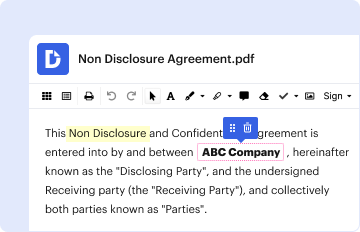
01. Edit your form online
Type text, add images, blackout confidential details, add comments, highlights and more.
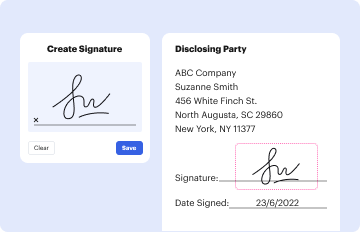
02. Sign it in a few clicks
Draw your signature, type it, upload its image, or use your mobile device as a signature pad.
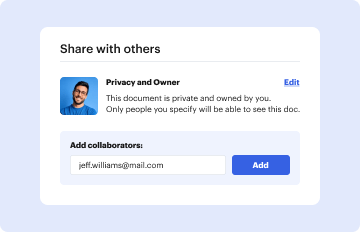
03. Share your form with others
Send it via email, link, or fax. You can also download it, export it or print it out.
How to use or fill out california mining location notice sample with our platform

- Click ‘Get Form’ to open the california mining location notice sample in the editor.
- Begin by entering your name and address in the designated fields at the top of the form. Ensure that you use blue ink or type for clarity.
- In section 1, provide the name of your lode mining claim. This is essential for identification purposes.
- For section 2, input the date when you erected a conspicuous monument for your claim. Be sure to format it as month/day/year.
- Describe your discovery monument in section 3, detailing its characteristics to ensure it can be easily identified.
- In sections 4 and 5, specify the quarter-sections, township, range, and meridian where your claim is located. Use checkboxes for clarity.
- Section 6 requires you to state the number of linear feet claimed along with width specifications. Make sure these measurements comply with legal limits.
- Complete sections 8A through 8C by confirming that you have marked your claim boundaries and providing details about each monument erected.
- Attach a U.S. Geological Survey topographic map as required in section 9 to visually represent your claim's outline.
- Finally, fill out locator information in sections 10 through 12 and ensure all signatures are collected before filing.
Start using our platform today to fill out your california mining location notice sample online for free!
Fill out california mining location notice sample online
It's free
It's free
Got questions?
We have answers to the most popular questions from our customers. If you can't find an answer to your question, please contact us.
Contact us
Can you sell a mining claim?
Permits from state agencies may be needed, especially if water resources are to be used in the mining operation. Mining claims may be sold, in whole or in part.
How to file a mining claim in California?
To record a mining claim, the claimant must file a copy of the location notice of the claim in the recorders office in the county which the claim lies and with the BLM State Office in Sacramento within 90 days of the location of the claim. The mining claim must be on Federally administered land open to mineral entry.
What is an example of a mining claim?
Examples include quartz or other veins bearing gold or other metallic minerals and large volume, but low-grade disseminated gold deposits. Descriptions are by metes and bounds surveys beginning at the discovery point on the claim and including a reference to natural objects or permanent monuments.
Can you live in a mining claim?
4. CAN I LIVE ON A MINING CLAIM? No, mining claims do not give you actual ownership over the land or rights to live on the site. Rather, a mining claim is a claim to the mineral rights on the land.
What does it mean if a property has a mining claim?
A mining claim is a parcel of land for which the claimant has a right to develop and extract a discovered, valuable, mineral deposit. It is not private property and does not carry the same rights as private property. Mining claims are recorded by the Bureau of Land Management (BLM).
Security and compliance
At DocHub, your data security is our priority. We follow HIPAA, SOC2, GDPR, and other standards, so you can work on your documents with confidence.
Learn more


People also ask
Do you own the land with a mining claim?
Your right to the property is restricted to exploration, development and extraction of a mineral deposit at the site. The surface of almost all unpatented mining claims is not private property; the ownership and management of the surface and surface resources remains with the United States.
Can you build a house on an unpatented mining claim?
Can I construct buildings or other improvements on my unpatented mining claim? You may not construct, place, or maintain any kind of building or other structure, road, trail, fence or enclosure, and place or store equipment without the prior approval of a plan of operation from the Forest Service.
What does a mining claim mean?
Mining claims are staked for locatable minerals on public domain lands. Locatable minerals include both metallic minerals (gold, silver, lead, etc.) and nonmetallic minerals (fluorspar, asbestos, mica, etc.). It is nearly impossible to list all locatable minerals because of the complex legal requirements for discovery.