
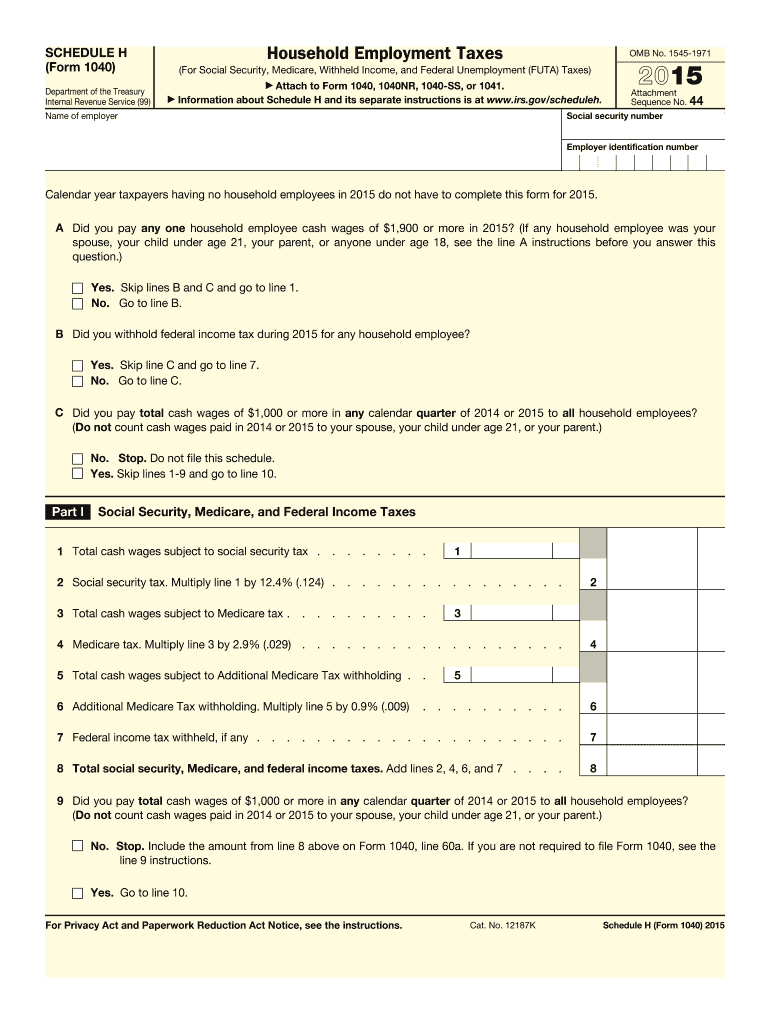







Definition and Purpose of the 2015 IRS Schedule H Form
The 2015 IRS Schedule H, formally known as the Household Employment Taxes form, is a tax document used by household employers in the United States to report wages paid to household employees. These employees may include individuals such as nannies, home health aides, or gardeners. The form is used to compute and report Social Security, Medicare, and Federal Unemployment Taxes (FUTA) on behalf of the employees. Schedule H is typically attached to the employer's Form 1040 during the annual tax filing process. This ensures that employers comply with federal tax obligations regarding household employee wages, preventing underpayment of taxes and potential penalties.
Steps to Obtain and Use the 2015 IRS Schedule H Form
-
Obtaining the Form: The form can be downloaded directly from the IRS website. As it pertains to the 2015 tax year, ensure that you select the appropriate year's version to accurately file your taxes.
-
Filing Requirements: If you paid cash wages exceeding $2,000 to any household employee in 2015, you are required to file Schedule H.
-
Completing the Form: Gather necessary information, including employee wages, your employer identification number, and details of any taxes already paid. Follow IRS provided instructions carefully to fill out each section accurately.
-
Submission Process: Attach Schedule H to your personal income tax return (Form 1040) and submit it before the annual filing deadline. Make sure all details are correctly filled out to avoid penalties.
Key Elements Found in the 2015 IRS Schedule H Form
-
Employer and Employee Information: The first section necessitates details such as your name, Social Security Number, and any employment identification numbers.
-
Wage Reporting: Include detailed figures on the amount of cash wages paid to household employees throughout the year.
-
Tax Computation: Calculate applicable Social Security, Medicare, and FUTA taxes based on reported wages.
-
Prior Payments and Credits: Document any prior payments or overpayments already remitted to the IRS for household employment taxes.
Important IRS Guidelines and Filing Deadlines
-
Filing Deadline: Schedule H must be filed with your federal income tax return by the standard IRS filing deadline, typically April 15th.
-
Quarterly Estimated Taxes: If household employment taxes exceed a certain limit, they might be subject to the quarterly estimated tax payment requirements.
-
Record Keeping: Maintain employment and wage records for at least four years. This includes copies of Schedule H and any payment receipts or records.
Legal and Compliance Considerations
-
Eligibility Criteria: Eligible employers include those who pay more than a threshold amount in wages to a household employee within a calendar year and do not operate as business entities.
-
Penalties for Non-Compliance: Failing to file or inaccurately reporting wages on Schedule H can lead to penalties, interest charges, and further investigation by the IRS.
Digital vs. Paper Versions of the 2015 IRS Schedule H Form
-
Online Filing: Employers often choose to file electronically for quicker processing and instant receipt confirmation. Platforms like TurboTax and QuickBooks are commonly used.
-
Paper Filing: Employers who prefer traditional filing methods can paper file the form. Ensure all attachments are included and mail it to the IRS address listed in the instructions.
Software Compatibility for Filing Schedule H
Compatible tax software such as TurboTax or H&R Block simplifies the filing process by guiding users through each step of completing Schedule H. These tools automatically calculate taxes and fill out corresponding fields, reducing the risk of errors and saving time.
Example Scenarios of Using the 2015 IRS Schedule H Form
-
Scenario 1: A family employing a full-time nanny who earned $30,000 in 2015 would require filing Schedule H to report Social Security, Medicare, and FUTA taxes.
-
Scenario 2: An individual with multiple household employees who were each paid wages surpassing $1,000 in one quarter is responsible for additional FUTA tax requirements.
Understanding the intricacies and obligatory compliance of the 2015 IRS Schedule H form is crucial for any household employer in the U.S. Proper completion aids in fulfilling federal tax obligations and helps avoid any potential legal issues.




