




01. Edit your key holder agreement template word online
Type text, add images, blackout confidential details, add comments, highlights and more.

Type text, add images, blackout confidential details, add comments, highlights and more.

Draw your signature, type it, upload its image, or use your mobile device as a signature pad.

Send employee key agreement form via email, link, or fax. You can also download it, export it or print it out.
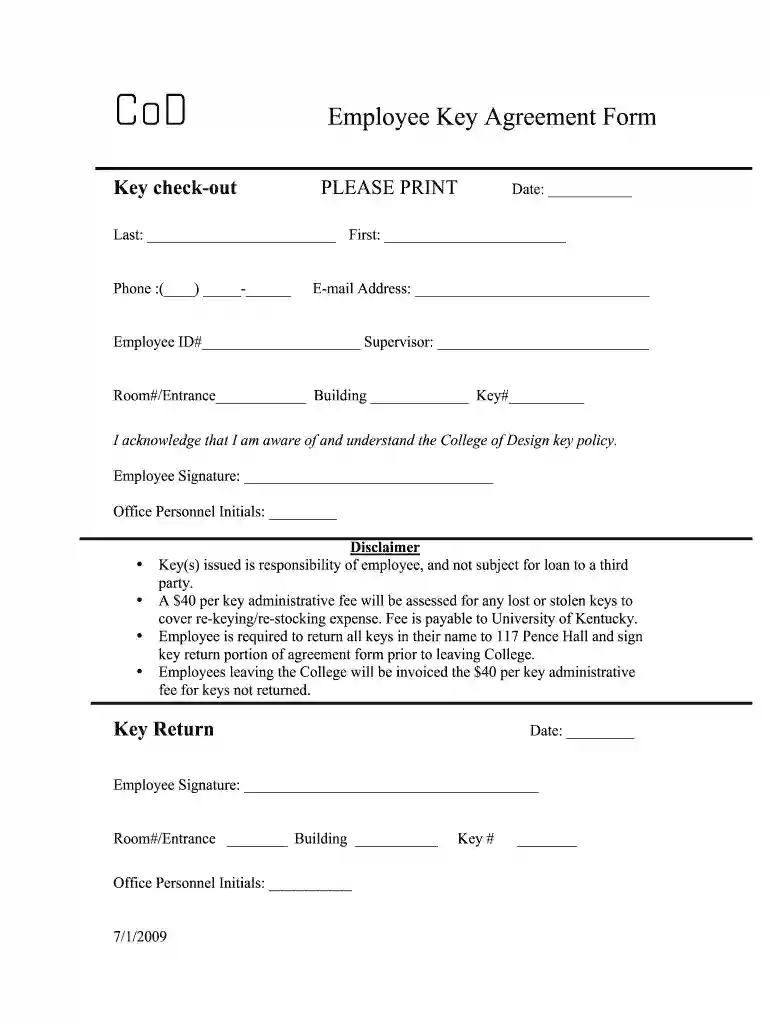
The employee key agreement form is a crucial document that outlines the responsibilities and obligations of employees regarding the issuance, return, and management of keys within an organization. This agreement serves to protect both the employer and the employee by clearly defining the terms related to key access. Below, we explore the core components and functionalities of this form.
An employee key agreement form typically includes several significant elements that are essential for its effectiveness. These components are tailored to ensure that all parties understand their responsibilities clearly.
Personal Information Section: This section captures the employee's name, job title, department, and contact details. It is critical for the organizational record-keeping and serves as a reference for accountability.
Key Issuance Acknowledgment: Here, employees acknowledge receipt of specific keys. This part of the form often lists each key issued, including its location (e.g., office, storage) and corresponding access permissions.
Key Return Policy: The form outlines the procedure for returning keys. Employees must affirm that they will return all keys upon termination or transfer, reinforcing the importance of maintaining security.
Responsibility Clause: Employees agree to uphold the organization's key policy, acknowledging that they are responsible for any keys issued to them. This includes safeguarding against loss or theft.
Financial Liability: The form may stipulate a fee for lost or stolen keys. For example, an organization might require employees to pay a $40 fee if they fail to return a key.
The employee key agreement form is widely utilized across various industries, particularly in settings where access to secured areas is critical, such as educational institutions, corporate offices, and healthcare facilities.
Organizational Security: By requiring employees to sign a key agreement, organizations can establish clear protocols to limit unauthorized access. This is essential in maintaining the security and integrity of sensitive areas.
Record Keeping: The form aids in maintaining accurate records of key distribution, which is fundamental for audits and compliance checks.
Completing the employee key agreement form involves several important steps to ensure compliance and accuracy.
Initial Documentation: The employee should receive the document at the time of employment or when key access is proposed.
Filling Out Personal Information: Employees fill out their details accurately to assist with identification and accountability.
Reviewing Key Policies: Employees must review the organization’s key policy, particularly focusing on their responsibilities regarding key security and return.
Sign and Date: The employee signs and dates the form to confirm their understanding and agreement to the terms outlined.
Submission: The completed form should be submitted to the HR department or the designated key control officer for record-keeping.
Adhering to the terms of the employee key agreement form is crucial for several reasons:
Legal Protection: Enforcing the agreement protects the organization legally in case of key mismanagement or security breaches.
Accountability: The form establishes that employees are informed of their responsibilities, promoting accountability within the workplace.
Trust and Security: Employees signing the agreement affirm their commitment to organizational policies, fostering a culture of trust and security.
Depending on the organization's needs, variations of the employee key agreement form can exist. These may include:
Key Holder Agreement Form: Similar to the employee key agreement form, but specifically focuses on individuals who have been assigned keys for specific roles only.
Key Checkout Form: This variant is used for temporary key assignments, detailing when, to whom, and under what circumstances a key is being borrowed.
Key Release Form for Employees: This form provides formal written consent for key distribution, ensuring proper guidelines are followed during the key release process.
By understanding these components and uses, both employers and employees can better navigate the responsibilities tied to key management in the workplace.
We've got more versions of the key holder agreement template word form. Select the right key holder agreement template word version from the list and start editing it straight away!
| Versions | Form popularity | Fillable & printable |
|---|---|---|
| 2009 | 4.8 Satisfied (102 Votes) |
Of course, electronically drawing your signature is acceptable, but only if you utilize a tool that complies with industry laws and regulations. Try DocHub, which ensures eSignature validity under ESIGN and UETA requirements. All you need to approve your employee key sign out form electronically is an account with DocHub and an internet connection. When you open your document in our editor, click Sign and choose the Draw option.
As a comprehensive document editing service, DocHub is accessible on mobile phones. Open DocHub in your choice of mobile internet browser and use our smart mobile-friendly toolset to complete your key release form for employees.
At DocHub, your data security is our priority. We follow HIPAA, SOC2, GDPR, and other standards, so you can work on your documents with confidence.


Employees who request and are issued keys for gaining access into College facilities, are subject to pre-approval by the department head, the Director ofRead more
To complete. Form 990 fully and accurately, we need each officer, director and key employee to disclose the information requested in this Part II. A conflictRead more


