Earth's interior worksheet answers 2026

Get Form
earth's interior worksheet answers Preview on Page 1

Here's how it works

01. Edit your earth's interior worksheet answers online
Type text, add images, blackout confidential details, add comments, highlights and more.

02. Sign it in a few clicks
Draw your signature, type it, upload its image, or use your mobile device as a signature pad.

03. Share your form with others
Send earth's interior worksheet via email, link, or fax. You can also download it, export it or print it out.

Definition and Purpose of Earth’s Interior Worksheet Answers

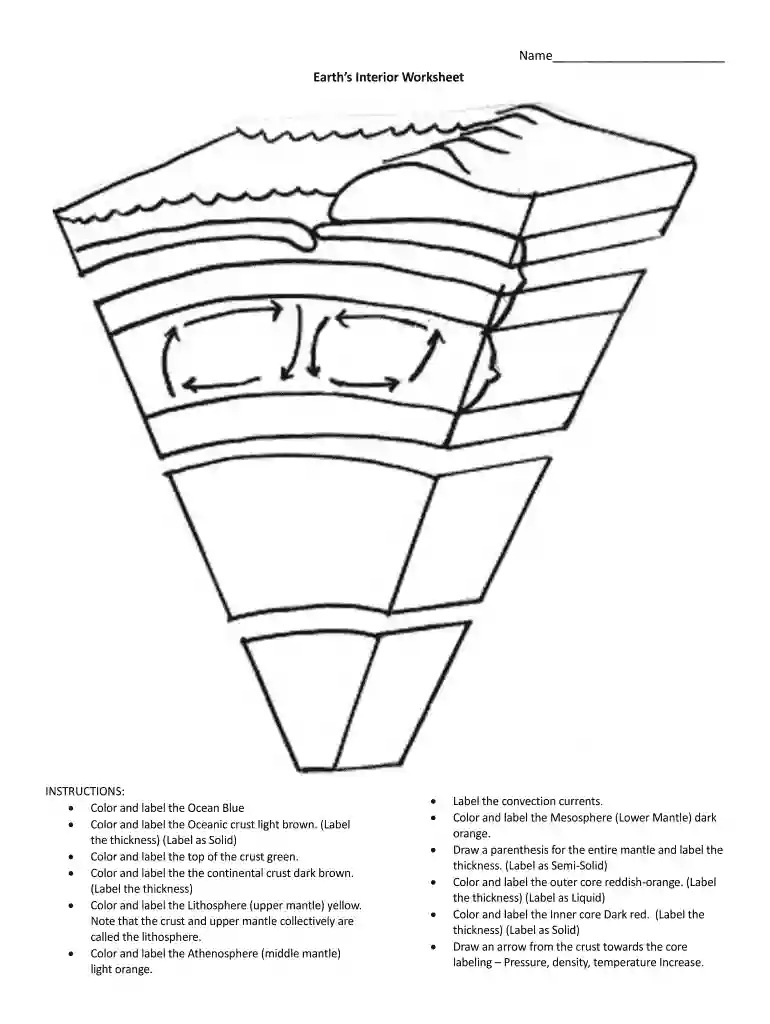
The Earth's interior worksheet answers refer to a comprehensive set of responses designed to help students understand the structure and composition of the Earth. The worksheet typically covers the Earth's layers, including the crust, mantle, outer core, and inner core, along with activities that facilitate learning through visual aids, fill-in-the-blanks, and true/false questions. This document is an educational tool aimed at enhancing students' comprehension of geological processes and the characteristics of each of Earth's layers.

The primary goals of the worksheet are to:

  • Encourage Active Learning: By engaging with the material through coloring and labeling exercises, students reinforce their understanding of Earth's interior.
  • Facilitate Information Retention: Interactive tasks help learners retain complex concepts related to geology and Earth's composition.
  • Support Diverse Learning Styles: The worksheet caters to visual, auditory, and kinesthetic learners, ensuring that all students can engage with the content in a way that resonates with them.

How to Use the Earth’s Interior Worksheet Answers

Using the Earth’s interior worksheet answers involves several practical steps that can facilitate a smooth learning experience:

  1. Download the Worksheet: Obtain a copy of the Earth’s interior worksheet, which is usually available in PDF format for easy printing and distribution.
  2. Review the Instructions: Before starting, familiarize yourself with the worksheet's structure and the specific tasks assigned, such as coloring layers and labeling key features.
  3. Engage with the Content:
    • Coloring Task: Use appropriate colors to differentiate between the layers of the Earth. This activity visually reinforces the concept of the Earth's structure.
    • Labeling Activity: Identify and label each layer—ocean, crust, mantle, outer core, and inner core—to deepen understanding of their arrangement and characteristics.
  4. Complete True/False Statements: Answer the true/false questions to test comprehension of critical concepts related to Earth’s interior.
  5. Participate in Discussions: If the worksheet is used in a classroom setting, engage with peers and instructors to discuss findings and clarify any misunderstandings.

By following these steps, students can effectively leverage the Earth’s interior worksheet answers for a better educational experience.

Steps to Complete the Earth’s Interior Worksheet Answers

Completing the Earth’s interior worksheet answers involves several methodical steps that students can follow to ensure they fully grasp the material:

  1. Prepare Your Materials:

    • Gather coloring materials (colored pencils or markers).
    • Have a pencil or pen ready for labeling and answering questions.
  2. Identify the Earth’s Layers:

    • Look at the diagram provided in the worksheet that outlines the Earth's layers. Understand the differences in thickness, composition, and temperature.
    • Review any notes or textbooks that discuss Earth's composition for context.
  3. Color the Diagram:

    • Systematically color each layer according to the instructions, ensuring each layer is distinct from the others.
    • Consider using:
      • Blue for the ocean
      • Light brown for the crust
      • Darker tones for the mantle
      • Orange or yellow for the outer core
      • Red for the inner core
  4. Label Each Layer:

    • Once colored, label each layer accurately, ensuring clarity in your handwriting.
    • Include key characteristics of each layer next to the labels, such as "mantle – thickest layer" or "inner core – solid state."
  5. Answer the True/False Questions:

    • Scale through the questions at the end of the worksheet, applying your knowledge from the diagram and your studies.
    • Write down your answers clearly, ensuring that they reflect your understanding.
  6. Review Your Work: After completing the worksheet, review your answers and coloring to ensure accuracy and correctness.

By systematically approaching the worksheet, students can effectively absorb the information contained in the Earth’s interior worksheet answers.

Who Uses the Earth’s Interior Worksheet Answers

The Earth’s interior worksheet answers are primarily utilized by various educational audiences, including:

  • K-12 Students: Young learners in elementary and middle schools often use such worksheets to engage with basic geology concepts in an interactive manner.
  • Educators: Teachers utilize the worksheets as teaching aids to reinforce lessons on Earth science and geology, facilitating group work or individual study.
  • Home Schoolers: Parents who manage home-schooling curriculums may incorporate this worksheet as a fundamental resource for teaching their children about the Earth's layers and composition.
  • Tutors: Educational professionals often use these worksheets as part of tutoring sessions to help students who need additional support in understanding scientific concepts.
  • Educational Institutions: Schools and universities may adopt this worksheet for introductory geology or Earth science courses to simplify complex information for students.

This collaborative use across various educational settings highlights the worksheet’s versatility as a learning tool.

Important Terms Related to Earth’s Interior Worksheet Answers

Understanding key terminology related to the Earth's interior is crucial in enhancing comprehension of the subject matter. Some important terms include:

  • Crust: The outermost layer of the Earth; solid and relatively thin compared to other layers.
  • Mantle: The layer beneath the crust; composed of semi-solid rock and responsible for tectonic activity.
  • Outer Core: A liquid layer composed mainly of iron and nickel, generating the Earth's magnetic field due to its flow.
  • Inner Core: The innermost layer; extremely hot and composed of solid iron and nickel.
  • Tectonic Plates: Large sections of the Earth's crust that move and interact with one another, often leading to earthquakes and volcanic activity.
  • Convection Currents: The movement of fluid (magma in the mantle) caused by differences in temperature, playing a significant role in plate tectonics.

Familiarity with these terms helps students accurately fill out the Earth’s interior worksheet answers and engage in productive discussions about Earth science topics.

Examples of Using the Earth’s Interior Worksheet Answers

Practical application of the Earth’s interior worksheet answers showcases its effectiveness in various learning scenarios. Here are some examples:

  • In-Class Activities: Teachers may assign the worksheet during a unit on geology to allow students to explore Earth's layers while providing immediate feedback by reviewing completed worksheets.
  • Homework Assignments: Instructors can assign the worksheet as homework to reinforce concepts learned in class, encouraging independent study and retention of knowledge.
  • Review Sessions: Students preparing for a test may use the worksheet as a study guide, ensuring they can recall and apply terms and concepts related to Earth’s structure.
  • Interactive Learning Stations: In a science fair or educational workshop, the worksheet can be a part of a hands-on learning station, allowing students to learn both independently and collaboratively.
  • Integration with Technology: Digital versions of the worksheet may be incorporated into learning management systems, providing a versatile option for remote or hybrid learning environments.

Using the Earth’s interior worksheet answers in these varied contexts demonstrates its applicability and support for diverse learning experiences across educational settings.

See more earth's interior worksheet answers versions

We've got more versions of the earth's interior worksheet answers form. Select the right earth's interior worksheet answers version from the list and start editing it straight away!
Versions Form popularity Fillable & printable
2014 4.7 Satisfied (27 Votes)
be ready to get more

Complete this form in 5 minutes or less

Get form

Got questions?

We have answers to the most popular questions from our customers. If you can't find an answer to your question, please contact us.
Contact us

With DocHub, you can easily sign your earth interior worksheet or any other document on iOS, even without installing additional programs. You can access your DocHub account from any web-connected browser and fill out and sign your form in any way you like with just a couple of clicks.

Apart from an extensive toolset for editing PDFs on mobile devices, DocHub enables you to sign your earth's interior worksheet pdf answers along the way. Open our editor in your browser, make modifications using DocHub’s toolset, and finish your editing by eSigning the finished form.

The Outer Core The outer liquid has a depth of 2890 to 5000km from the surface of the Earth. It makes up 30.8% of Earths mass. Its temperature is around 3700 degrees Celcius.
The outer core officially begins at a depth of 2550 km below the earths surface, down to a final depth of 4750 km at the boundary between the inner and outer core. As you move through this depth, the temperature increases from 4500 degrees Celsius to a final temperature of 5500 C.
Temperatures in the lower mantle the docHub around 3,000-3,500 degrees Celsius and the barometer reads about 125 gigapascals, about one and a quarter million times atmospheric pressure.

Security and compliance

At DocHub, your data security is our priority. We follow HIPAA, SOC2, GDPR, and other standards, so you can work on your documents with confidence.

Learn more
ccpa2
pci-dss
gdpr-compliance
hipaa
soc-compliance
be ready to get more

Complete this form in 5 minutes or less

Get form

People also ask

The interior of Earth is very hot (the temperature of the core docHubes more than 5,000 degrees Celsius) for two main reasons: The heat from when the planet formed, The heat from the decay of radioactive elements.
The interior of the Earth is made up of three parts: crust, mantle, and core. The inner core is found to be in a solid state, and the outer core is in a liquid state. The outermost layer of Earth is called the crust. The crust is relatively cold, thin, and brittle.
Answer: The Earth is made up of several layers. While the crust is its outermost layer, the interior of the Earth consists of the mantle, which is a 2,900-km-thick layer lying beneath the Earths surface. The core is the innermost layer of the Earth, which lies below the mantle.
The interior of the earth can be divided into 3 different layers crust, mantle, and core. The crust is the outermost layer of the earth, and the core is the innermost layer of the earth, located at a depth of 2900 Km.
​​The earth is made up of three different layers: the crust, the mantle and the core.

interior of the earth worksheet