




01. Edit your 2018 1040 instructions online
Type text, add images, blackout confidential details, add comments, highlights and more.

Type text, add images, blackout confidential details, add comments, highlights and more.

Draw your signature, type it, upload its image, or use your mobile device as a signature pad.

Send schedule h instructions via email, link, or fax. You can also download it, export it or print it out.
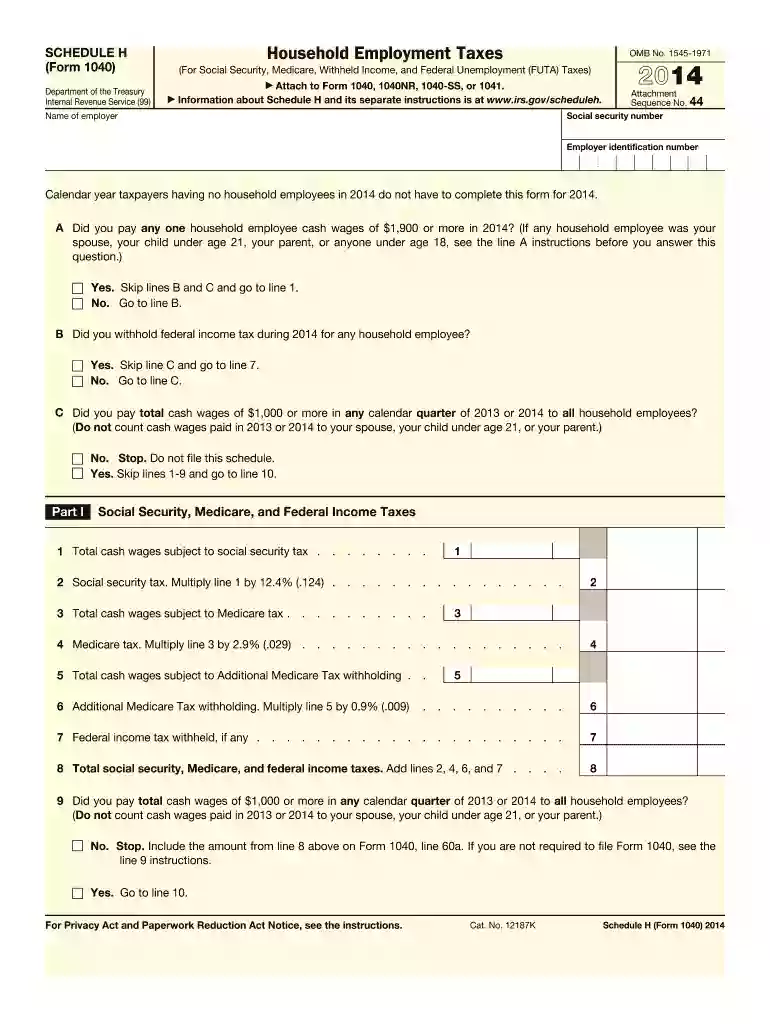
The Schedule H, part of Form 1040, is designed for household employers to report and pay important taxes for their household employees. It specifically addresses Social Security, Medicare, and Federal Unemployment Taxes (FUTA) on cash wages paid throughout the year. Household employers use this form to align with federal taxation requirements, ensuring that tax obligations for any employee hired to perform domestic work, such as nannies or housekeepers, are properly documented and paid. This form is integral in maintaining compliance with federal employment tax laws.
To assist in correctly completing the Schedule H, the 2018 Instructions can be accessed through several methods:
Using Schedule H supports compliance with federal laws regarding household employment taxes. Not filing when required or filing incorrectly can result in penalties, interest on unpaid taxes, and potential legal action. These legal obligations mandate accurate and complete reporting and contribute to Social Security and Medicaid financing.
Understanding critical terminology is vital for accurate filing:
The IRS provides extensive guidelines to help in the proper completion and submission of Schedule H. These include:
While Schedule H covers federal taxes, employers should also be aware of any state-specific obligations that may apply. States may have different requirements or offer credits against state unemployment taxes if corresponding federal taxes are paid. It's essential for household employers to check their respective state's Department of Revenue sites for particular rules and regulations that might impact their tax filings.
We've got more versions of the 2018 1040 instructions form. Select the right 2018 1040 instructions version from the list and start editing it straight away!
| Versions | Form popularity | Fillable & printable |
|---|---|---|
| 2025 | 4.2 Satisfied (49 Votes) | |
| 2024 | 4.6 Satisfied (41 Votes) | |
| 2023 | 4.6 Satisfied (40 Votes) | |
| 2022 | 4.5 Satisfied (52 Votes) | |
| 2021 | 4.8 Satisfied (145 Votes) | |
| 2020 | 4.4 Satisfied (225 Votes) | |
| 2019 | 4.3 Satisfied (110 Votes) | |
| 2018 | 4.4 Satisfied (69 Votes) | |
| 2017 | 4.3 Satisfied (80 Votes) | |
| 2016 | 4.4 Satisfied (45 Votes) | |
| 2015 | 4 Satisfied (21 Votes) | |
| 2014 | 4.3 Satisfied (68 Votes) | |
| 2013 | 4 Satisfied (26 Votes) | |
| 2011 | 4.2 Satisfied (33 Votes) | |
| 2010 | 4.2 Satisfied (61 Votes) |
At DocHub, your data security is our priority. We follow HIPAA, SOC2, GDPR, and other standards, so you can work on your documents with confidence.
The Property Tax Deferral Loan. Program provides loans to help people age 65 or older pay their property taxes. See page 4 of. Schedule H for more information.Read more
Jan 2, 2018 Household employment taxes. But if you are filing a return only because you owe these taxes, you can file. Schedule H (Form 1040) by itself.Read more
Jan 31, 2019 We have been asked: Do I need to pay household employment taxes for 2018? If you have a household employee, you need to withhold and payRead more


