
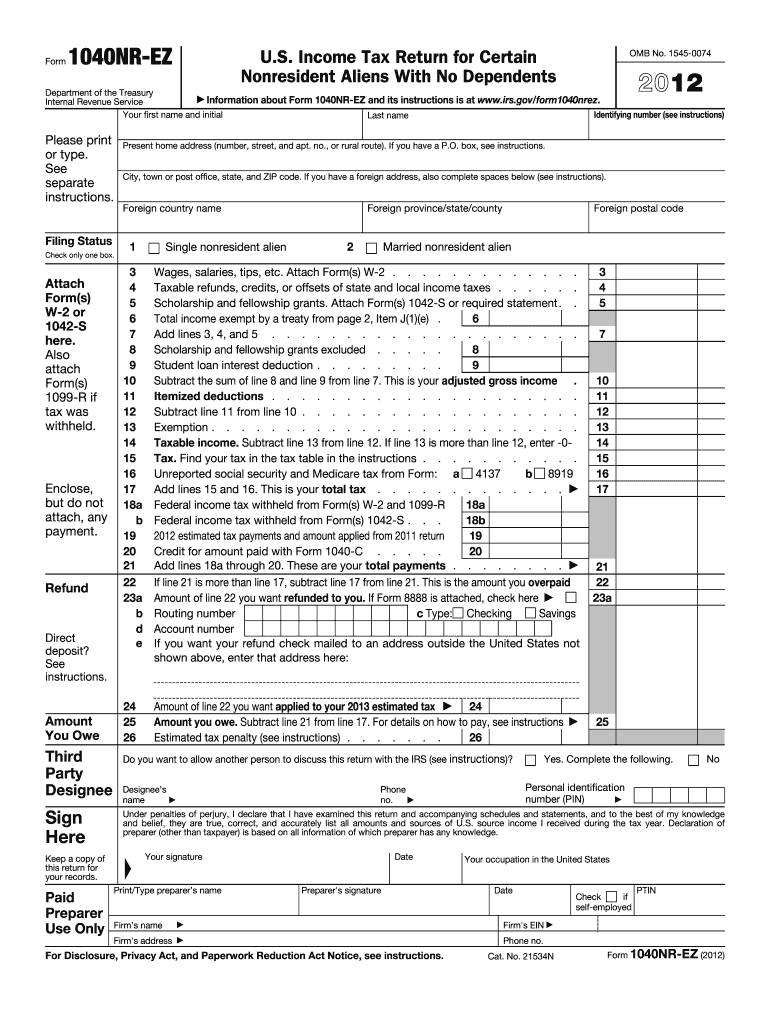







Definition and Purpose of the 1040NR-EZ Form
The 1040NR-EZ form, officially known as the U.S. Income Tax Return for Certain Nonresident Aliens With No Dependents, is specifically designed for nonresident aliens with straightforward tax situations. This form is intended for individuals who are not U.S. citizens or residents but have U.S. income to report. Its simplicity makes it preferable for those who do not have dependents and require straightforward income reporting without complex deductions or credits. When structured accurately, it enables nonresident aliens to comply with U.S. tax regulations while avoiding unnecessary filing complications.
Eligibility Criteria
To utilize the 1040NR-EZ form for the 2012 tax year, you must meet specific eligibility requirements. The criteria include:
- Being a nonresident alien for tax purposes.
- Having no dependents to claim.
- Being able to report only certain types of income, such as wages, salaries, and tips subject to withholding.
- Not claiming any tax credits or deductions other than the Exemption for the personal exemption.
- Being used only for income that is not an independent business activity.
Understanding whether you meet these criteria is essential to ensure accurate filing and avoid potential issues with the IRS.


Steps to Complete the 1040NR-EZ Form 2012
Filing the 1040NR-EZ for the 2012 tax year involves several steps:
- Gather Required Documents: Ensure you have all necessary documents, such as your identification details, income statements like W-2s, and any documents related to eligible deductions.
- Fill in Personal Information: This includes your name, address, and identification number. Ensure accuracy to avoid processing delays.
- Report Income: Enter your annual wages, salaries, and any applicable tip income.
- Calculate Tax: Use the instructions provided to determine your total tax liability based on reported income.
- Review and Sign: Before submitting, review to ensure all information is correct. Your signature is required to authorize the filing.
Required Documents
Successfully filing your 1040NR-EZ form requires a collection of specific documents. These typically include:
- W-2 Form: Showing your wages and the amount of tax withheld.
- Identification Documentation: Such as a passport or U.S. tax identification number.
- Documentation of any tax treaty benefits if claiming.
- Records of any additional income subject to tax.
Having these documents ready simplifies the filing process and aids in accurate completion.
Important IRS Guidelines
Adhering to IRS guidelines when using the 1040NR-EZ form ensures compliance with federal tax laws. Key guidelines include:
- Filing by the IRS deadline, typically April 15th of the following year.
- Keeping records of the form and all submitted documentation for at least three years.
- Being aware of any tax treaty benefits that may impact your tax responsibility.
Following these guidelines helps prevent issues with your tax return and ensures a smooth filing process.
Filing Deadlines and Important Dates
The standard deadline to file the 1040NR-EZ form is April 15th of the subsequent year. However, if you are outside the United States during the filing period, an automatic extension of two months is typically granted, making the deadline June 15th. Regardless of the deadline, it is crucial to file early and avoid last-minute complications.
Submission Methods
You can file your completed 1040NR-EZ form using one of the following methods:
- Mail: Send your paper form and accompanying documents to the IRS address specified in the form instructions.
- Online: There are electronic filing options, though these are less commonly used by nonresident aliens than paper forms.
- In-Person: Filing in person at an IRS Taxpayer Assistance Center is an option for additional filing assurance.
Penalties for Non-Compliance
Failure to file the 1040NR-EZ form or submitting incorrect information can result in penalties. These may include:
- Late Filing Penalty: Charged if the form is not submitted by the deadline.
- Accuracy-Related Penalty: Applicable if the IRS finds errors or intentional misstatements.
- Interest on Unpaid Taxes: If your taxes are not paid on time, interest accrues on the amount owed.
Understanding these penalties underscores the importance of accurate and timely filing.
Software Compatibility
The 1040NR-EZ form for 2012 can be completed using various tax preparation software, such as TurboTax or H&R Block, though availability may vary. Ensure the software is updated for the 2012 tax year and offers specific support for nonresident aliens to aid in error-free completion and submission.




