




01. Edit your new york city form 1127 online
Type text, add images, blackout confidential details, add comments, highlights and more.

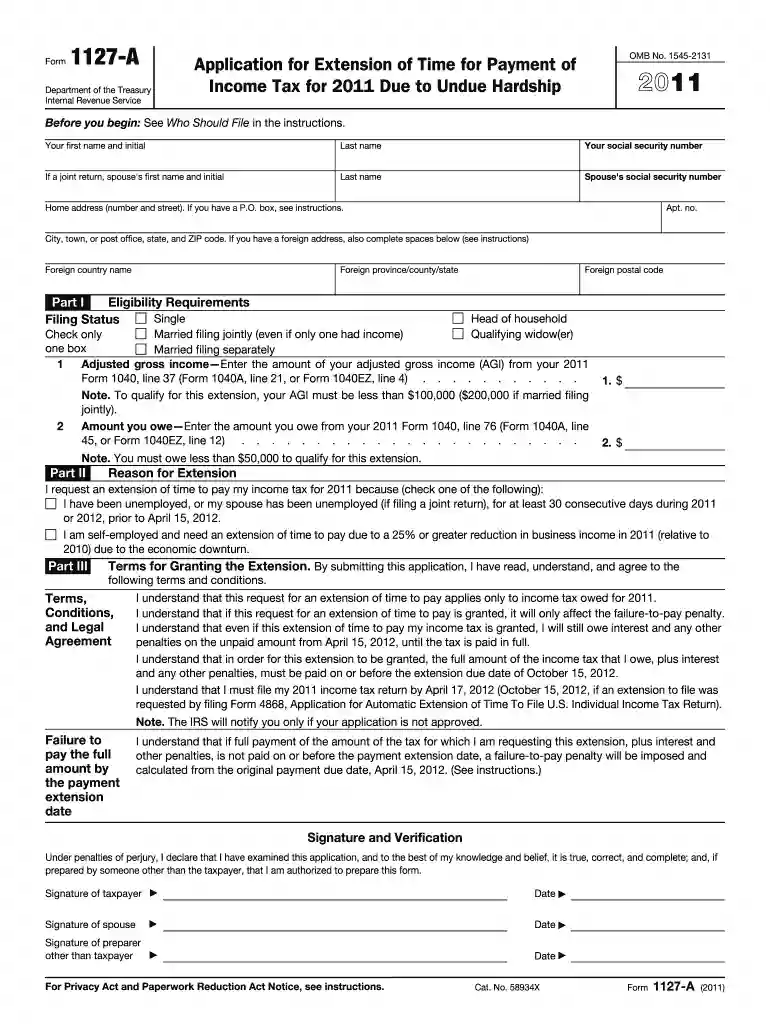
Type text, add images, blackout confidential details, add comments, highlights and more.

Draw your signature, type it, upload its image, or use your mobile device as a signature pad.

Send new york city 1127 via email, link, or fax. You can also download it, export it or print it out.
Form 1127-A serves as an application that individuals can use to request an extension of time to pay their income tax for the 2011 tax year due to undue hardship. This form is specifically designed to address situations where taxpayers are unable to meet their tax obligations by the original due date. It focuses on providing temporary relief by allowing applicants to defer the payment without incurring the failure-to-pay penalty, provided they comply with specific payment conditions by October 15, 2012. However, it's important to note that while the penalty may be deferred, interest and other penalties will still apply to any unpaid tax amounts.
Form 1127-A can be acquired through multiple channels to accommodate a variety of preferences and access capabilities. Primarily, the form is available directly from the Internal Revenue Service (IRS) website, where taxpayers can download a digital copy for print. Local IRS offices also provide physical copies for those who prefer or require in-person interactions. Tax preparation software frequently includes access to the form, integrating it into their processing systems, providing a seamless experience for users of these programs. The form's availability through these diverse means is designed to ensure that all taxpayers, regardless of their technological capabilities or preferences, can easily obtain it.
Completing Form 1127-A requires careful attention to detail and a clear understanding of the information being requested. Here is a step-by-step guide to completing the form:
Personal Information: Begin by filling out your full name, address, and Social Security Number (SSN) at the top of the form.
Income Details: Clearly outline your current income status, including any recent changes that could impact your financial situation.
Reason for Hardship: Provide a comprehensive explanation of the circumstances causing undue hardship. Examples might include job loss, significant medical expenses, or unexpected financial emergencies.
Payment Plan Proposal: Specify how you intend to manage the deferred payment. This could involve a proposed timeline for when you plan to commence payments and complete them.
Supporting Documentation: Attach any necessary documents that substantiate your claims of financial hardship and support your application for an extension.
Review and Submission: Double-check all the information for accuracy before submitting the form through one of the approved methods detailed below.
Applicants have several options for submitting completed Form 1127-A to ensure flexibility and convenience.
Online Submission: Some tax software platforms support the electronic submission of this form directly to the IRS, which is often the quickest method.
Mail: Forms can be sent via traditional mail to designated IRS processing centers, with addresses provided in the form instructions.
In-Person: Visiting a local IRS office can be a preferred option for detailed inquiries or to receive assistance with submission.
These varied methods ensure that taxpayers have accessible means for filing the form based on their specific needs and preferences.
Form 1127-A is intended for individuals who meet certain eligibility criteria related to financial hardship and inability to pay taxes. Potential applicants should consider the following:
Income Levels: Typically, there are specific income thresholds that determine eligibility, with lower-income individuals often prioritized.
Financial Hardship Evidence: Applicants must convincingly demonstrate their financial challenges, such as unemployment or substantial income reduction.
Repayment Ability: Consideration is given to those who can feasibly manage to pay the deferred tax amount within the timeframe stipulated by the IRS.
Careful evaluation of these criteria is crucial for determining whether the form can appropriately address the taxpayer's situation.


Form 1127-A must be used in accordance with legal standards and IRS guidelines to avoid issues of non-compliance. Applicants should:
Ensure Accuracy: Provide exact and truthful information throughout the form.
Meet Deadlines: Compliance with deadlines is critical; late submissions can result in the rejection of the application.
Understand Penalties: While the form temporarily suspends the failure-to-pay penalty, taxpayers must be aware that other penalties and interest on unpaid taxes remain applicable until full payment.
Ensuring compliance with these legal aspects is vital for successfully utilizing the benefits of Form 1127-A.
Several components and requirements characterize Form 1127-A and must be addressed for proper completion:
Applicant Information: Accurate entry of personal data, including contact information.
Financial Documentation: Submission of relevant documentation that supports claims of financial status and hardship.
Requested Extension Details: Clear explanation of the requested extension duration and proposed repayment plan, including specific dates.
Certification: Signature and certification from the applicant confirming the truthfulness of the information provided.
Thorough attention to these details is critical in ensuring the IRS can adequately assess and process the application.
The IRS provides specific guidelines that direct how Form 1127-A should be completed and evaluated. It is essential that applicants adhere to these guidelines, which emphasize:
Accurate Input: Ensuring all information is factual and verified, requiring appropriate evidence for claims made.
Clear Reasoning: Providing detailed explanations for the financial hardship and how an extension would provide relief.
Timely Submission: Meeting the submission deadlines to prevent automatic penalties from being assigned.
Failure to follow these guidelines may result in application rejection or additional financial penalties, underscoring their importance for success in the process.
We've got more versions of the new york city form 1127 form. Select the right new york city form 1127 version from the list and start editing it straight away!
| Versions | Form popularity | Fillable & printable |
|---|---|---|
| 2011 | 4.9 Satisfied (59 Votes) |
At DocHub, your data security is our priority. We follow HIPAA, SOC2, GDPR, and other standards, so you can work on your documents with confidence.
Use Form 1127-A to ask for an extension of time to pay the income tax due, or to be shown as due, on your Form 1040, Form 1040A, or. Form 1040EZ for 2011. SeeRead more
The proponent of a plan may modify such plan at any time before confirmation, but may not modify such plan so that such plan as modified fails to meet theRead more
Date code is in the format of YYWW (YY=Year /. WW=Week) and ranges from 1120 through 1127 for affected product. Affected product is manufactured in India.Read more


