




01. Edit your form 56 instructions online
Type text, add images, blackout confidential details, add comments, highlights and more.

Type text, add images, blackout confidential details, add comments, highlights and more.

Draw your signature, type it, upload its image, or use your mobile device as a signature pad.

Send form 56 via email, link, or fax. You can also download it, export it or print it out.
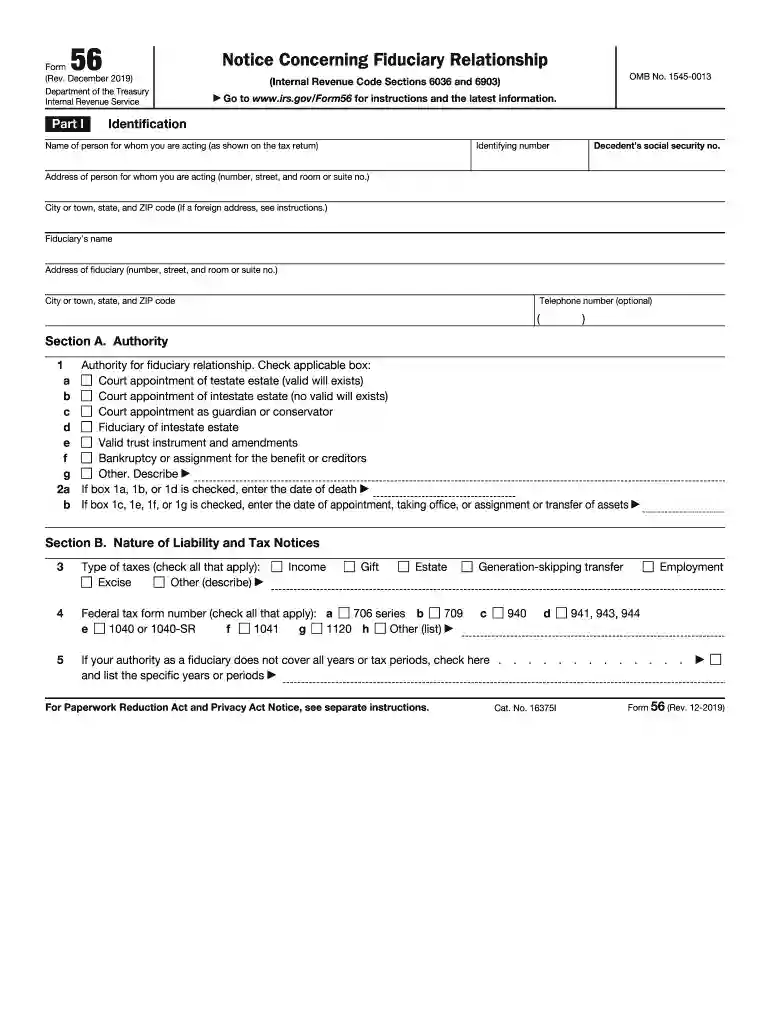
Form 56, issued by the Internal Revenue Service (IRS), is a Notice Concerning Fiduciary Relationship. It is used to inform the IRS when a fiduciary assumes a role managing the financial affairs of another person or entity. This form is crucial in identifying the fiduciary and the individual or entity they represent, as well as delineating the scope of authority the fiduciary holds. This ensures transparency and legal compliance when handling another party’s tax obligations.
To accurately fill out Form 56, follow these comprehensive steps:
Gather Necessary Information: Obtain details for both the fiduciary and the person or entity they represent. This includes personal identifiers and contact information.
Complete Sections I and II: Input fiduciary and taxpayer information, ensuring that identifiers match IRS records.
Define Fiduciary Role: Clearly specify under what capacity the fiduciary is acting and include relevant documentation or court orders if needed.
Specify Tax Types: Mark the applicable taxes the fiduciary will handle, accurately reflecting the associated fiscal responsibilities.
Fill Out Revocation Details: If replacing a previous Form 56, provide details of the form being replaced or revoked.
Submit Additional Documentation: Attach any required documentation that provides legal basis for the fiduciary’s role.
Review and Sign: Ensure all information is correct and sign the form. A second signature might be needed if revoking prior forms.
Form 56 is readily accessible through multiple channels:
Form 56 holds significant legal weight in the context of managing another’s tax responsibilities. By formalizing the fiduciary relationship, it ensures compliance with IRS regulations and grants the fiduciary necessary authority to act on behalf of the taxpayer. This is vital for effective financial management, particularly in cases involving estates or trusts.
Understanding specific terminology is essential for accurately completing Form 56:
Form 56 is predominantly used by individuals or entities acting in a fiduciary capacity, such as:
When submitting Form 56, certain supporting documents may be needed to validate the fiduciary’s authority:
The IRS provides specific guidelines for the preparation and submission of Form 56:
Selecting the most applicable sections ensures comprehensive understanding and assistance with Form 56 processes. This type of detailed breakdown helps users navigate fiduciary obligations within the legal and tax framework effectively.
We've got more versions of the form 56 instructions form. Select the right form 56 instructions version from the list and start editing it straight away!
At DocHub, your data security is our priority. We follow HIPAA, SOC2, GDPR, and other standards, so you can work on your documents with confidence.


Jan 23, 2026 You may use Form 56 to: Provide notification to the IRS of the creation or termination of a fiduciary relationship under section 6903.Read more
Form 56, notice concerning fiduciary relationship : internal revenue code sections 6036 and 6903. ; United States. Internal Revenue Service.Read more
3. Carryforward of credits for qualified tax credit bonds and build America bonds to 2017 (see instructions) .Read more


