







Definition and Meaning
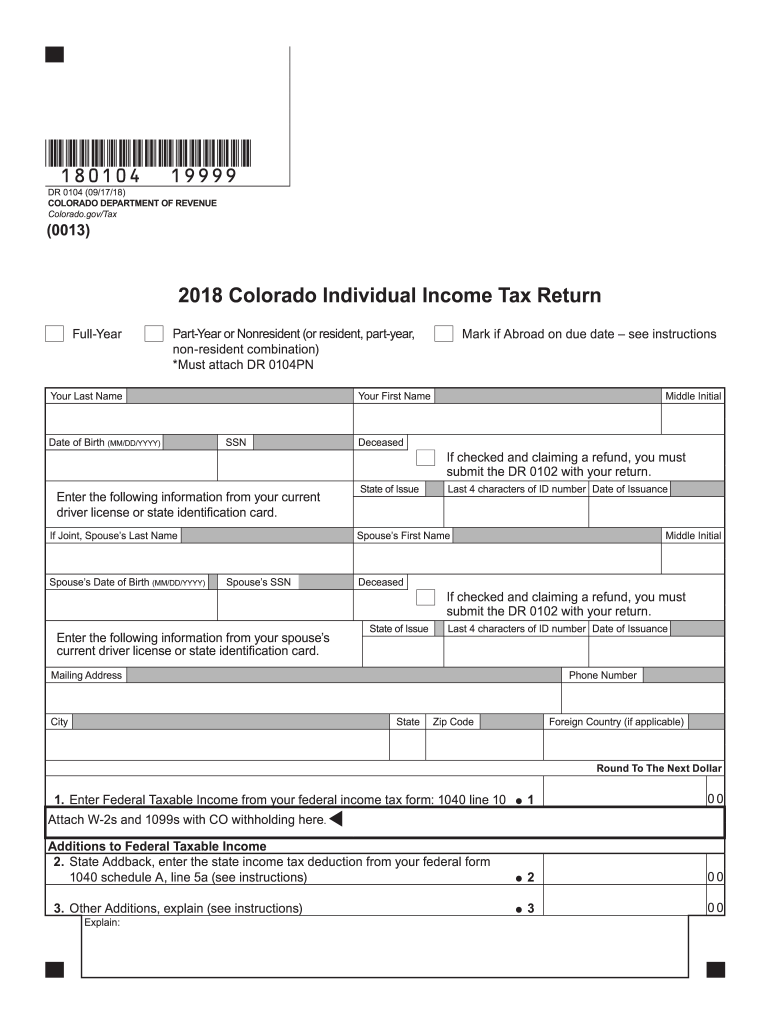
The "Colorado Income Tax Forms 2018" refers specifically to the documents required for filing state income taxes in Colorado for the tax year 2018. The primary form used is the DR 0104, which serves as the Individual Income Tax Return for full-year, part-year, and nonresident taxpayers. These forms are central to accurately reporting income earned within or related to Colorado, calculating state tax obligations, and claiming any relevant deductions or credits.
How to Use the Colorado Income Tax Forms 2018
To effectively utilize the Colorado income tax forms for 2018, taxpayers should:
-
Gather Necessary Information: Begin by assembling all relevant financial documents, such as W-2s, 1099s, and federal tax returns. Accurate data ensures proper completion of income and deduction sections.
-
Fill Out Personal Details: Enter personal information, including name, address, and Social Security number, in the appropriate sections of the DR 0104.
-
Report Income: Input income figures accurately. This should include federal taxable income as found on your federal return, adjusted for any state-specific modifications.
-
Calculate Deductions and Credits: Utilize available worksheets to apply any eligible deductions or credits, such as those for dependents, education expenses, or renewable energy contributions.
-
Complete Calculation Sections: Work through the form’s tax computation segments to determine total state tax owed or refund due.
-
Review and Verify Entries: Double-check all entries for accuracy to prevent errors that could delay processing or result in penalties.
Steps to Complete the Colorado Income Tax Forms 2018
Filing the Colorado income tax forms 2018 involves the following procedural steps:
-
Download or Obtain the Form: Access the DR 0104 form online via Colorado’s Department of Revenue website or obtain a physical copy from authorized distribution points.
-
Complete Identification Sections: Provide accurate personal information as requested. This includes employing the same filing status as your federal return to maintain consistency.
-
Detail Income Sources: Include all streams of income, ensuring that both federal and state adjustments are accurately recorded.
-
Apply Adjustments: Utilize state-specific deductions and credits. Be sure to include all relevant schedules that support these adjustments.
-
Final Tax Calculation: Accurately compute the total tax obligation and verify whether withheld taxes cover this amount.
-
Prepare for Submission: If a balance is due, arrange for payment. Ensure all necessary documentation accompanies the form if filing via mail.
-
Submission: Choose between mailing the completed form to the appropriate address or submitting electronically through approved online services.
Filing Deadlines and Important Dates
Understanding filing deadlines ensures compliance and avoids penalties:
-
April 15: The standard deadline for filing state and federal income tax returns, any variation due to weekends or holidays should be noted for adjustments.
-
October 15: The deadline for extensions if successfully filed before the April deadline. Extension applies to filing time, not payment, which may incur interest.
Regular updates or exceptions can be checked through the Colorado Department of Revenue’s platform for any annual adjustments.
Required Documents
Having all required documentation before starting the filing process simplifies completion:
- W-2 Forms: Document wages and taxes withheld.
- 1099 Forms: Report additional income types, including freelance work and dividends.
- Federal Tax Returns: Provide the basis for state tax calculations.
- Receipts for Deductions: Support claims for expenses like medical costs, education fees, and mortgage interest.
- Proof of Residency or Nonresidency status: Essential for accurate tax calculations and to confirm eligibility for credits or deductions specific to nonresident filings.
State-Specific Rules for the Colorado Income Tax Forms 2018
Colorado may have particular adjustments and rules affecting taxpayers:
-
TABOR Refunds: Colorado’s Taxpayer Bill of Rights (TABOR) may impact refunds and should be reviewed to determine eligibility or the necessity to report excess refunds.
-
Local Tax Additions: Certain cities impose additional taxes, which may require special forms or adjustments to state filings.
Ensure that all state amendments are reviewed to apply any applicable changes.
Penalties for Non-Compliance
Awareness of penalties ensures timely and accurate filing:
- Late Filing Penalty: A percentage of the tax owed calculated per month or partial month the return is late.
- Underpayment: Interest and penalties may apply if taxes owed aren’t paid by the due date, irrespective of extensions.
Understanding these potential penalties encourages timely and correct filings, mitigating additional costs.
Digital vs. Paper Version
Choosing an appropriate submission method can ease the filing process:
-
Digital Submission: Offers faster processing times and immediate confirmation of receipt. Online filing often incorporates error-checking functionalities.
-
Paper Submission: May appeal to those preferring physical documentation or lacking consistent internet access. However, it typically involves longer processing times.
Each method has its merits, and the choice may depend on individual circumstances or preferences.




