
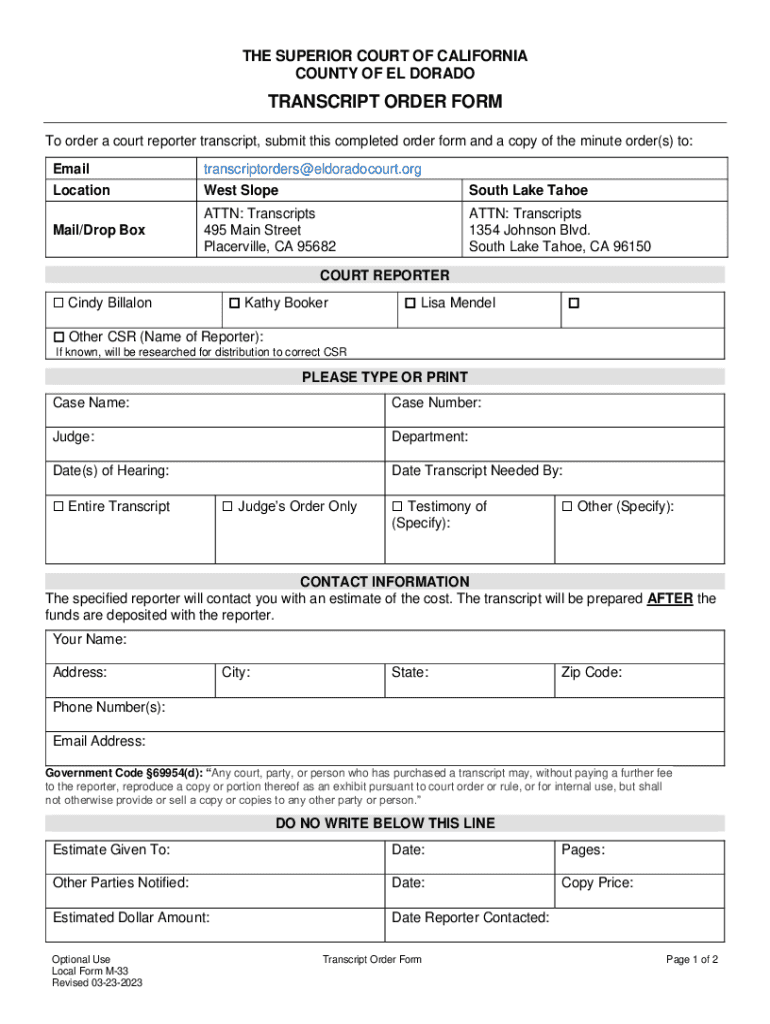







Definition and Purpose of the Reporter Transcript Request
The "Reporter Transcript Request - Superior Court of California" is a formal document used to request written records of oral court proceedings. These transcripts are vital for legal professionals, individuals involved in litigation, and others needing a detailed account of what transpired during a court session. They serve various purposes, such as appeals, case reviews, and legal research.
Key Elements of the Request Form
The transcript request form requires several essential details:
- Case Information: This includes the case number, the names of the parties involved, and the specific dates of the proceedings for which transcripts are requested.
- Contact Information: The requestor must provide their full contact details, including name, address, phone number, and email.
- Transcript Specifications: Requestors need to specify the type of transcript, such as full, summary, or specific excerpts, and the format in which they wish to receive it, such as print or digital.
How to Obtain the Reporter Transcript Request
Accessing the Form
The request form can typically be obtained directly from the Superior Court of California's official website or by visiting the courthouse in person. It's essential to check for the most recent version of the form to ensure compliance with any changes in court procedures.
Steps to Complete the Reporter Transcript Request Form
Filling Out the Form
- Download the Form: Start by downloading the latest version from the Superior Court of California's website.
- Enter Case Details: Fill in the relevant case number, party names, and hearing dates precisely.
- Provide Personal Details: Complete the sections with your contact information to ensure you receive updates and correspondence.
- Specify Transcript Details: Clearly state the type of transcript and format needed. Include any additional instructions if partial or specific passages are required.
- Submit the Form: Once completed, the form can be submitted either via email, mail, or in person, adhering to the court's guidelines.
Why the Reporter Transcript Request is Important
Accurate court transcripts play a pivotal role in the legal process. They provide:
- Evidence for Appeals: Transcripts are crucial for appeals, as they provide a verbatim record of the court proceedings.
- Case Analysis: Lawyers and involved parties use transcripts to analyze previous hearings, helping them prepare for future legal strategies.
- Historical Records: They offer a written record of court history, which can be critical for future legal and scholarly research.
Who Typically Uses the Reporter Transcript Request


User Groups
- Attorneys: To examine courtroom dialogue for case-building or appeals.
- Litigants: Individuals directly involved in a case who need records for personal reference or future legal actions.
- Journalists and Academics: For reporting or research that requires precise court records.
Legal Use and Considerations
When and How to Use the Form Legally
- Proper Submission: Ensure the form is filled out completely and accurately to avoid delays.
- Court Deadlines: Be aware of submission deadlines that might affect the ability to use the transcript in ongoing proceedings.
State-Specific Rules for California
Procedures and Compliance
- Court Specifics: Each county within California may have slight variations in processing transcript requests. It's crucial to adhere to instructions specified by the county where the case was heard.
- Payment Requirements: Most courts require payment before processing transcript requests. Check the local court's fee schedule.
Examples of Using the Reporter Transcript Request
Practical Scenarios
- Example for an Appeal: A lawyer files a transcript request to review a trial's proceedings, pinpointing errors for an appeal case.
- Research Use: A university professor requests transcripts to study patterns in class action lawsuits over a decade.
Form Submission Methods
Options for Delivery
- Email: Submitting forms electronically can expedite processing, provided the court allows digital submissions.
- Mail: Hard copies can also be sent directly to the court's designated address. Be sure to follow any specific mailing instructions.
- In-Person: Delivering the request form to the courthouse personally is a viable option for ensuring it reaches the correct department.
Important Terms Related to the Form
Definitions and Explanations
- Verbatim Report: The transcript delivered is an exact word-for-word record of what was said during the court proceedings.
- Certifying Official: A court reporter or clerk who validates the accuracy and authenticity of the transcripts.
This in-depth coverage of the Reporter Transcript Request provides an extensive guide on understanding, accessing, and effectively utilizing the form for your needs within the Superior Court of California.




