
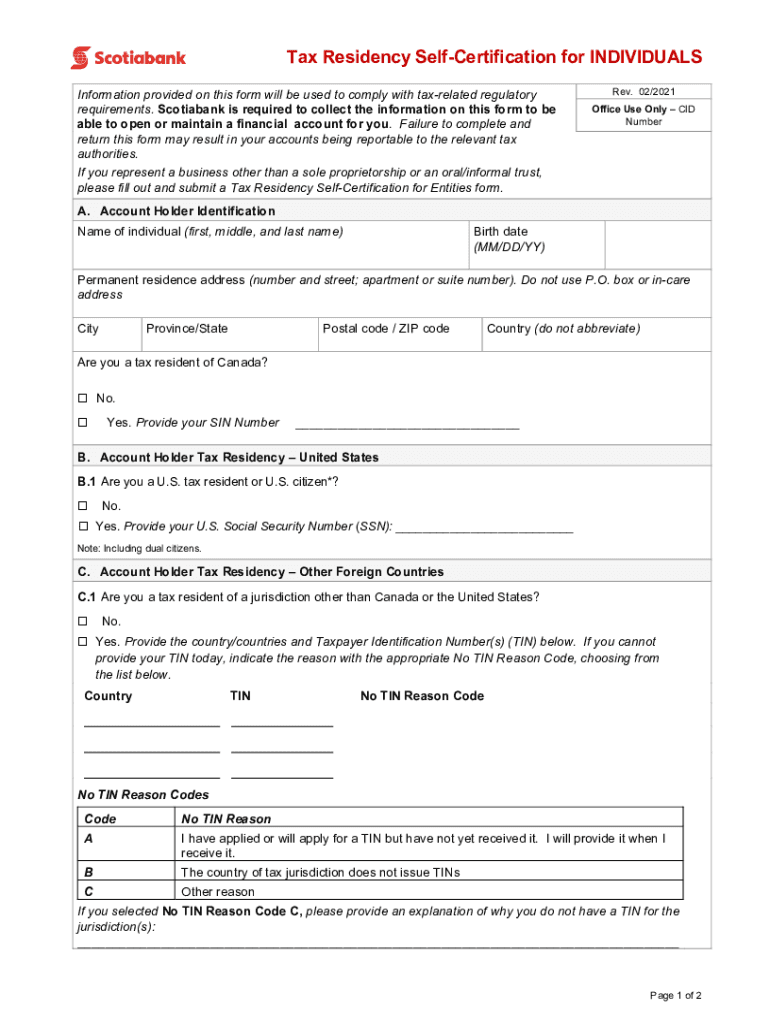







Definition & Meaning
The "Self-Certification of Residency for Tax Purposes" is a formal declaration used by individuals to state their tax residency status. This document is critical for complying with international tax laws and is typically required by financial institutions to determine an individual's tax obligations in various jurisdictions. The self-certification involves providing personal information and answering specific tax residency questions, helping to establish where individuals are liable for tax purposes. This ensures that the reporting of financial accounts is accurate and aligns with the relevant tax authority requirements.
How to Use the Self-Certification of Residency for Tax Purposes
Using the Self-Certification of Residency for Tax Purposes involves several steps:
- Obtain the Form: Typically provided by the financial institution with which you have an account, as part of their compliance measures.
- Complete Personal Information: Fill in sections regarding your full name, date of birth, and address.
- Determine Residency Status: Answer questions that identify your tax residency status, including details of any foreign jurisdictions where you might be considered a resident.
- Certification Statement: Agree to and sign a statement certifying the accuracy of the supplied information.
Financial institutions often include this form as part of their onboarding process for new account holders or during periodic reviews for existing customers.
Steps to Complete the Self-Certification of Residency for Tax Purposes
Completing the form involves careful attention to detail:
- Read Instructions: Begin with understanding the instructions and terms used within the form.
- Fill Out Personal Details: Ensure that the information regarding your identity matches official records such as your passport or government-issued ID.
- Tax Residency Questions: Respond to questions that determine your tax residency. This typically involves providing details of any tax identification numbers (TIN) and jurisdictions of residence.
- Review and Sign: Double-check entries for accuracy. Any inconsistencies might lead to legal complications or rejected submissions.
- Submit the Form: Return the completed form to your financial institution either digitally or via mail, based on their specified requirements.
Who Typically Uses the Self-Certification of Residency for Tax Purposes
This form is primarily utilized by:
- Individual Account Holders: In both domestic and international banking contexts, especially when maintaining accounts that might be subject to reporting to foreign tax authorities.
- Non-U.S. Residents with U.S. Accounts: To detail their foreign tax residence and prevent involuntary withholding on U.S.-sourced income.
- Expatriates: Individuals living abroad who need to clarify their tax liabilities in multiple countries.
- Dual Residents: Those who hold tax residency status in more than one jurisdiction.


Legal Use of the Self-Certification of Residency for Tax Purposes
The legal use of this form aligns with international tax compliance measures such as the Foreign Account Tax Compliance Act (FATCA) and the Common Reporting Standard (CRS):
- FATCA Compliance: U.S. citizens and residents need to declare foreign financial accounts to the IRS.
- CRS Regulations: For non-U.S. residents, it helps ensure systematic sharing of tax data between signatory countries.
It protects institutions from potential penalties associated with non-compliance and supports individuals by aligning their account information with international reporting standards.
IRS Guidelines
The IRS provides specific guidelines related to:
- Correct Reporting: Ensuring entities correctly report the information as stipulated under FATCA.
- TIN Requirements: The necessity of providing accurate Tax Identification Numbers for international reporting.
These guidelines are essential for financial institutions and individuals to understand the implications of inaccurate self-certification, ensuring they adhere to necessary reporting channels.
Penalties for Non-Compliance
Non-compliance with the requirements of the Self-Certification of Residency for Tax Purposes can lead to:
- Account Restrictions: Financial institutions may restrict account access until proper documentation is furnished.
- Financial Penalties: Both financial institutions and individuals could face penalties for incorrect submissions or failure to submit.
- Withholding Taxes: Incorrect certification might result in withholding of taxes at the source on certain financial accounts.
It is imperative to complete and submit the form accurately to avoid any such consequences.
Required Documents
To complete the form accurately, you should have the following documents on hand:
- Government-Issued Identification: Such as a passport or driver’s license for identity verification.
- Tax Identification Numbers (TINs): Any relevant TINs from countries where you may be considered a tax resident.
- Proof of Residency: For instance, a utility bill or lease agreement verifying your address may be necessary for certain submissions.
Ensuring these documents are readily accessible will expedite the completion process and enhance accuracy.




