Ursorg beneficiary designation form 2026

Get Form
ursorg beneficiary designation form Preview on Page 1

Here's how it works

01. Edit your form online
Type text, add images, blackout confidential details, add comments, highlights and more.
02. Sign it in a few clicks
Draw your signature, type it, upload its image, or use your mobile device as a signature pad.
03. Share your form with others
Send it via email, link, or fax. You can also download it, export it or print it out.

How to use or fill out ursorg beneficiary designation form with our platform

Form edit decoration
9.5
Ease of Setup
DocHub User Ratings on G2
9.0
Ease of Use
DocHub User Ratings on G2
  1. Click ‘Get Form’ to open the ursorg beneficiary designation form in the editor.
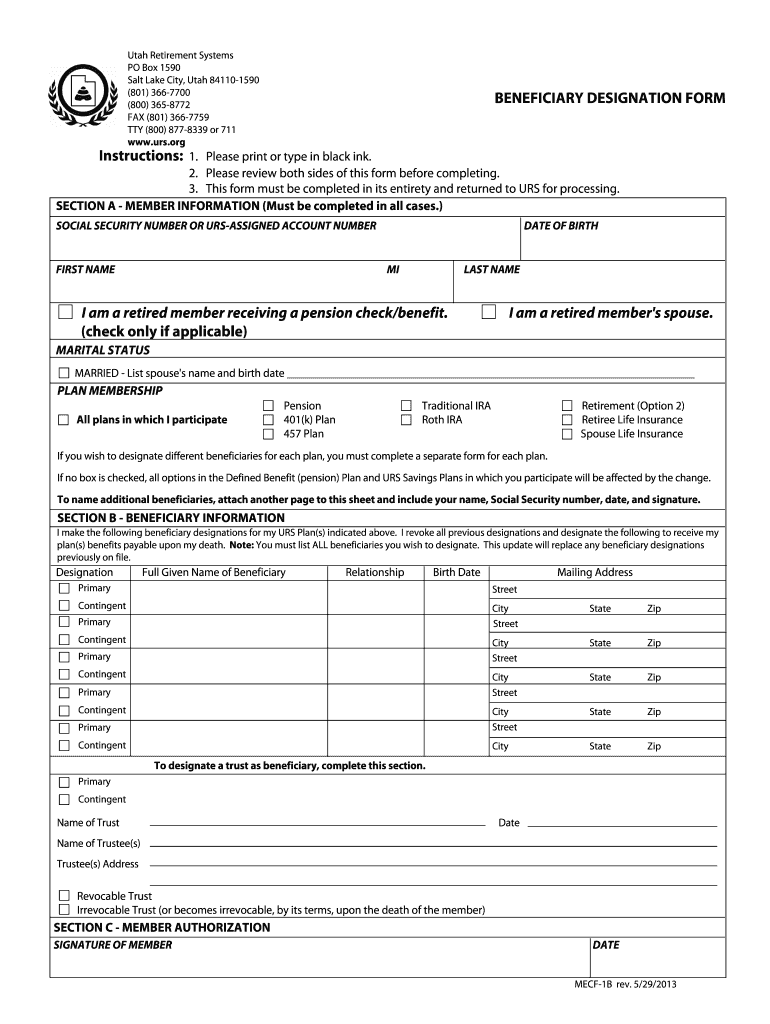
  2. Begin with SECTION A - MEMBER INFORMATION. Fill in your Social Security number or URS-assigned account number, first name, middle initial, last name, and date of birth. If applicable, indicate if you are a retired member receiving benefits or a spouse.
  3. Next, specify your marital status and list your spouse's name and birth date if married. Then select all plans in which you participate by checking the appropriate boxes.
  4. Move to SECTION B - BENEFICIARY INFORMATION. List all beneficiaries for each plan indicated above. Include their full names, relationships to you, birth dates, and mailing addresses. Ensure that you designate primary and contingent beneficiaries as needed.
  5. If designating a trust as a beneficiary, complete the relevant section with the trust's name, date, trustee(s), and their address.
  6. Finally, sign and date SECTION C - MEMBER AUTHORIZATION to validate your designations before submitting the form for processing.

Start using our platform today to easily fill out your ursorg beneficiary designation form for free!

See more ursorg beneficiary designation form versions

We've got more versions of the ursorg beneficiary designation form form. Select the right ursorg beneficiary designation form version from the list and start editing it straight away!
Versions Form popularity Fillable & printable
2020 4.2 Satisfied (32 Votes)
2013 4.8 Satisfied (21 Votes)
be ready to get more

Complete this form in 5 minutes or less

Get form

Got questions?

We have answers to the most popular questions from our customers. If you can't find an answer to your question, please contact us.
Contact us
Listing the beneficiaries of your wealth is an important first step in your estate plan. Generally, there are four classes of beneficiaries to consider: you and your spouse, friends and family, charity, and the government.
SF 3102: Designation of Beneficiary, FERS. This form is used to designate the beneficiary of a deceased FERS individuals FERS contributions upon the later of the death of the FERS annuitant or FERS survivor annuitant and should be submitted to OPM.
5 Ways You Can Fill Out a Beneficiary Designation Form (and Who You Can Nominate!) Name an Individual (Primary Beneficiary and Contingent Beneficiary) Best for: naming a spouse, children, or other loved ones. Divide Among Multiple Individuals. Name Your Trust as the Beneficiary. Name a Charity. Mix and Match!
Most beneficiary designations will require you to provide a persons full legal name and their relationship to you (spouse, child, mother, etc.). Some beneficiary designations also include information like mailing address, email, phone number, date of birth and Social Security number.
For example, the account owner could create a beneficiary designation stating that the funds will be distributed to the owners Trust upon the death of the owner. The Trustee of the owners Trust would then receive the funds and distribute the funds according to the terms of the Trust.

Security and compliance

At DocHub, your data security is our priority. We follow HIPAA, SOC2, GDPR, and other standards, so you can work on your documents with confidence.

Learn more
ccpa2
pci-dss
gdpr-compliance
hipaa
soc-compliance
be ready to get more

Complete this form in 5 minutes or less

Get form

People also ask

Typically, youll want to name your spouse, children, or other financial dependents as your beneficiaries. However, you may also consider naming siblings, other family members, a friend, or even a nonprofit organization, trust, or your estate to inherit your account.

Related links