PC-180 - Connecticut Probate Courts 2026

Get Form
pc 180 Preview on Page 1

Here's how it works

01. Edit your pc 180 online
Type text, add images, blackout confidential details, add comments, highlights and more.

02. Sign it in a few clicks
Draw your signature, type it, upload its image, or use your mobile device as a signature pad.

03. Share your form with others
Send it via email, link, or fax. You can also download it, export it or print it out.

Definition and Purpose of PC-180 Form

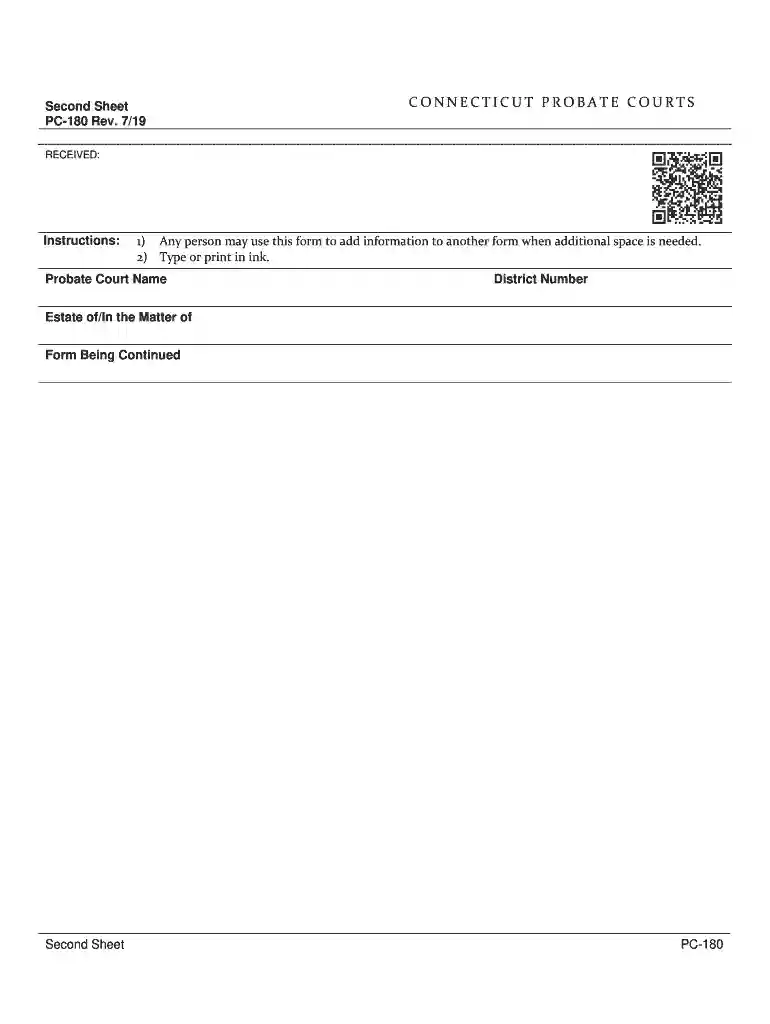
The PC-180 form, officially known as the Additional Probate Forms Space, is utilized within the Connecticut Probate Courts system. Its primary purpose is to provide users with additional space when completing other probate forms. When the standard forms offered by the probate courts are insufficient in capturing all necessary information, the PC-180 serves as a supplemental document to ensure that no critical details are omitted. This form can be pivotal in cases where the complexity of the information exceeds what the form's initial design could accommodate.

How to Use the PC-180 Form

The utilization of the PC-180 form is straightforward. When completing a probate form and additional space is required, individuals simply attach the PC-180 as an addendum. It is critical to reference the original form to which the PC-180 relates, ensuring seamless integration. By filling in the PC-180 with clear, concise information, users ensure that their submission remains organized and comprehensive.

Steps to Attach the Form

  1. Identify the primary probate form requiring additional space.
  2. Clearly mark the PC-180 with the related form's title and sections it addresses.
  3. Complete the PC-180 with the additional information, ensuring all fields are appropriately filled.
  4. Attach the completed PC-180 form to the original document before submission.

Obtaining the PC-180 - Connecticut Probate Courts

Securing a copy of the PC-180 form can be accomplished using multiple avenues. Individuals may download it directly from the Connecticut Probate Courts' official website, where it is available in PDF format for ease of use. Alternatively, hard copies can be requested in person at any local Connecticut probate court office.

Components and Key Elements of the Form

Understanding the elements of the PC-180 form is essential for effective utilization. This form comprises:

  • Identification Fields: Space to record personal or organizational details related to the primary probate form.
  • Continuation Sections: Multiple blank sections designed for inputting detailed text as needed.
  • Reference Boxes: Areas designated for cross-referencing the related form's sections.

These components ensure the form remains versatile and comprehensive, adaptable to various detailed requirements without altering the primary document structure.

Who Typically Uses the PC-180 Form

The PC-180 form is frequently employed by a diverse group of users:

  • Legal Practitioners: Attorneys managing complex probate cases needing additional documentation space.
  • Estate Executors: Individuals tasked with managing estates who encounter detailed informational requirements beyond standard forms.
  • Court Officials: Professionals within the courts facilitating the processing of detailed, multifaceted probate submissions.
decoration image ratings of Dochub

Legal Use and Compliance

The PC-180 form aligns with Connecticut's probate legal framework, ensuring that all additional submissions uphold the court's requirements and standards. Users should ensure that all added information is accurate and truthful to maintain compliance. Any misuse or inaccurate representation on the form can lead to legal ramifications, making careful attention to detail crucial.

State-Specific Rules Governing the PC-180 Form

Within Connecticut, specific rules govern the use and acceptance of the PC-180 form. These directives highlight the importance of:

  • Accuracy: All the additional information must be precise and mindful of legal stipulations.
  • Completeness: Incomplete forms or those lacking integration with the primary document may face rejection.
  • Filing Instructions: Users must follow specific filing routes, whether digitally or through mail, based on the primary form's requirements.

Important Terms and Their Implications

Understanding key terms associated with the PC-180 form enhances comprehension and accuracy:

  • Addendum: Used to describe the PC-180 when additional space is juxtaposed against limited initial forms.
  • Probate: Refers to the court-supervised process of authenticating a will and administering a decedent's estate.
  • Filing: The procedure of submitting completed forms to the appropriate court for processing and approval.

Utilizing the PC-180 form effectively requires a comprehensive understanding of its purposes, proper methods of acquisition, correct usage, and legal implications tied to its application within the Connecticut Probate Courts system.

See more PC-180 - Connecticut Probate Courts versions

We've got more versions of the PC-180 - Connecticut Probate Courts form. Select the right PC-180 - Connecticut Probate Courts version from the list and start editing it straight away!
Versions Form popularity Fillable & printable
2019 4.2 Satisfied (52 Votes)
2014 4 Satisfied (43 Votes)
1985 4.9 Satisfied (38 Votes)
be ready to get more

Complete this form in 5 minutes or less

Get form

Got questions?

We have answers to the most popular questions from our customers. If you can't find an answer to your question, please contact us.
Contact us
The courts take steps to move the process along, and the executor of an estate generally has 12 months to complete the probate process and pay heirs or beneficiaries from the estate. This payout can only happen once all debts have been paid.
Connecticut has a simplified and expedited probate process for settling small decedents estates. The entire process can be completed within 30 days, instead of six months or longer as is normally required for the regular probate process.
Connecticuts 54 Probate Courts are organized on a regional basis to provide convenient access for court users.
In general, the Executor may distribute assets five months after being appointed, except for the amount needed to pay claims, taxes and administration expenses. If necessary, payments can be made before that time for support of the decedents spouse and dependent children.
The Connecticut Probate Court system is a system of 54 individual probate courts located throughout the state of Connecticut. The jurisdiction of each court extends to the legal affairs of the deceased, estates, some aspects of family law, conservatorship, and several other matters requiring specific legal decisions.

Security and compliance

At DocHub, your data security is our priority. We follow HIPAA, SOC2, GDPR, and other standards, so you can work on your documents with confidence.

Learn more
ccpa2
pci-dss
gdpr-compliance
hipaa
soc-compliance
be ready to get more

Complete this form in 5 minutes or less

Get form

People also ask

In California, the executor of a will, also known as the personal representative, generally has about one year from their appointment to complete their duties. That includes paying creditors and distributing assets to beneficiaries. The timeline can be extended.

Related links