




01. Edit your schedule e 2020 tax form online
Type text, add images, blackout confidential details, add comments, highlights and more.

Type text, add images, blackout confidential details, add comments, highlights and more.

Draw your signature, type it, upload its image, or use your mobile device as a signature pad.

Send 2020 irs schedule e via email, link, or fax. You can also download it, export it or print it out.
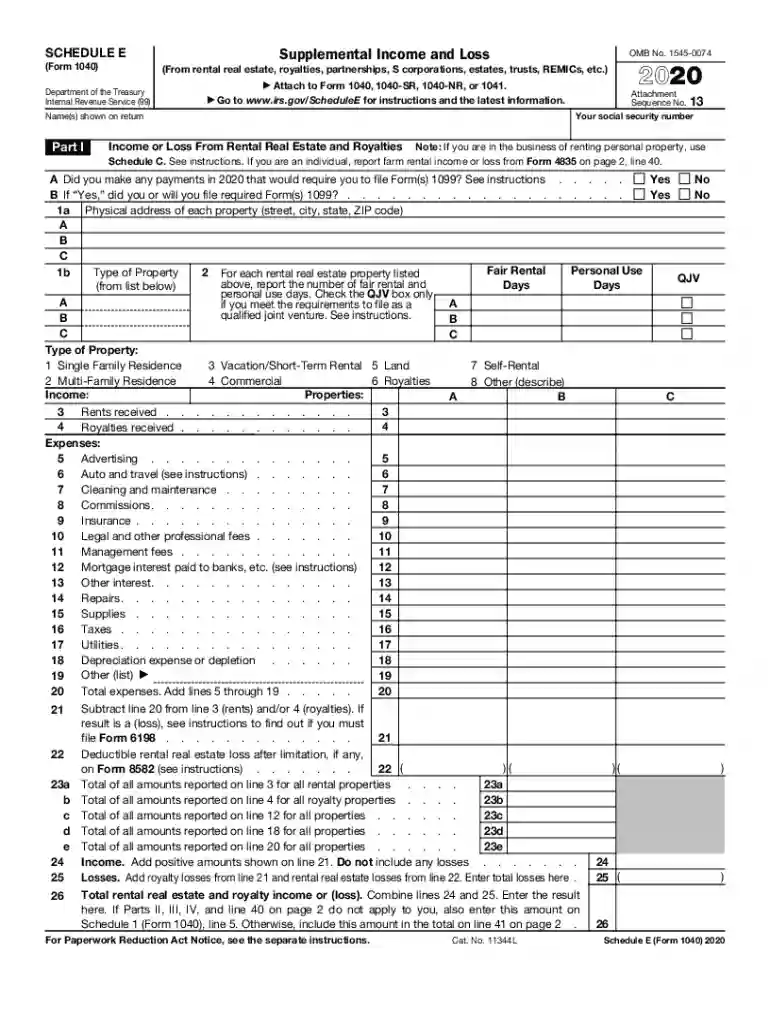
Schedule E (Form 1040) is a crucial tax form used by taxpayers in the United States to report supplemental income and loss from various sources. These include rental real estate, royalties, partnerships, and S corporations. The form plays a key role in accurately documenting income and expenses related to these activities, ensuring that taxpayers comply with federal tax obligations. Understanding Schedule E is essential for anyone who generates income beyond typical employment, as it directly impacts taxable income calculation.
Schedule E is divided into sections to capture different income types. The first section deals with rental real estate and royalties, while subsequent sections cover partnerships, S corporations, estates, trusts, and other supplemental income avenues. Each category has specified fields for income, expenses, and losses, allowing for detailed reporting and analysis.
Schedule E is used by taxpayers to accurately document income and losses from rental properties, royalties, and various business interests. This ensures that individuals pay the correct amount of taxes on their supplemental income. To effectively use this form, taxpayers must gather all relevant financial records, such as rental income statements, partnership K-1 forms, and any related expense receipts.
A systematic approach to filling out Schedule E involves identifying each income source, categorizing expenses, and accurately reporting both on the form. Income and losses from each source are detailed, allowing for a comprehensive view of all supplemental income streams.
Several critical components must be correctly addressed within Schedule E for effective reporting:
Taxpayers must gather specific documents for accurate completion of Schedule E:
Schedule E is primarily used by individuals and entities involved in rental property management, royalty income arrangements, or business partnerships and S corporations. It is designed for taxpayers needing to report non-traditional income streams that don't fall within typical employment income, providing an organized methodology for capturing detailed financial activities.
The IRS provides comprehensive guidelines for Schedule E to facilitate accurate reporting and compliance. These guidelines cover everything from the categorization of income and expenses to the limitations on passive activity losses.
Filing an inaccurate or incomplete Schedule E can result in penalties and interest from the IRS. It is crucial for taxpayers to ensure all information on the form is meticulously accurate.
Understanding the nuances of Schedule E is essential for any taxpayer earning supplemental income in the U.S. By adhering to best practices and IRS guidelines, individuals can ensure compliance and minimize the risk of penalties.
We've got more versions of the schedule e 2020 tax form form. Select the right schedule e 2020 tax form version from the list and start editing it straight away!
| Versions | Form popularity | Fillable & printable |
|---|---|---|
| 2025 | 4.6 Satisfied (25 Votes) | |
| 2024 | 4.9 Satisfied (60 Votes) | |
| 2023 | 4.3 Satisfied (56 Votes) | |
| 2022 | 4.5 Satisfied (34 Votes) | |
| 2021 | 4.8 Satisfied (109 Votes) | |
| 2020 | 4.3 Satisfied (99 Votes) | |
| 2019 | 4 Satisfied (73 Votes) | |
| 2018 | 4.3 Satisfied (109 Votes) | |
| 2017 | 4.3 Satisfied (239 Votes) | |
| 2016 | 4.4 Satisfied (694 Votes) | |
| 2015 | 4 Satisfied (45 Votes) | |
| 2014 | 4.2 Satisfied (43 Votes) | |
| 2013 | 4 Satisfied (50 Votes) | |
| 2012 | 4.4 Satisfied (53 Votes) | |
| 2011 | 4.2 Satisfied (63 Votes) |
At DocHub, your data security is our priority. We follow HIPAA, SOC2, GDPR, and other standards, so you can work on your documents with confidence.




Note: If you report a loss, receive a distribution, dispose of stock, or receive a loan repayment from an S corporation, you must check the box in column (e) on
Feb 23, 2018 If you make this election, you must report rental real estate income on Schedule E (or. Schedule C if you provide substantial services). You
Jan 21, 2025 Use Schedule E (Form 1040) to report income or loss from rental real estate, royalties, partnerships, S corporations, estates, trusts, and residual interests.


