
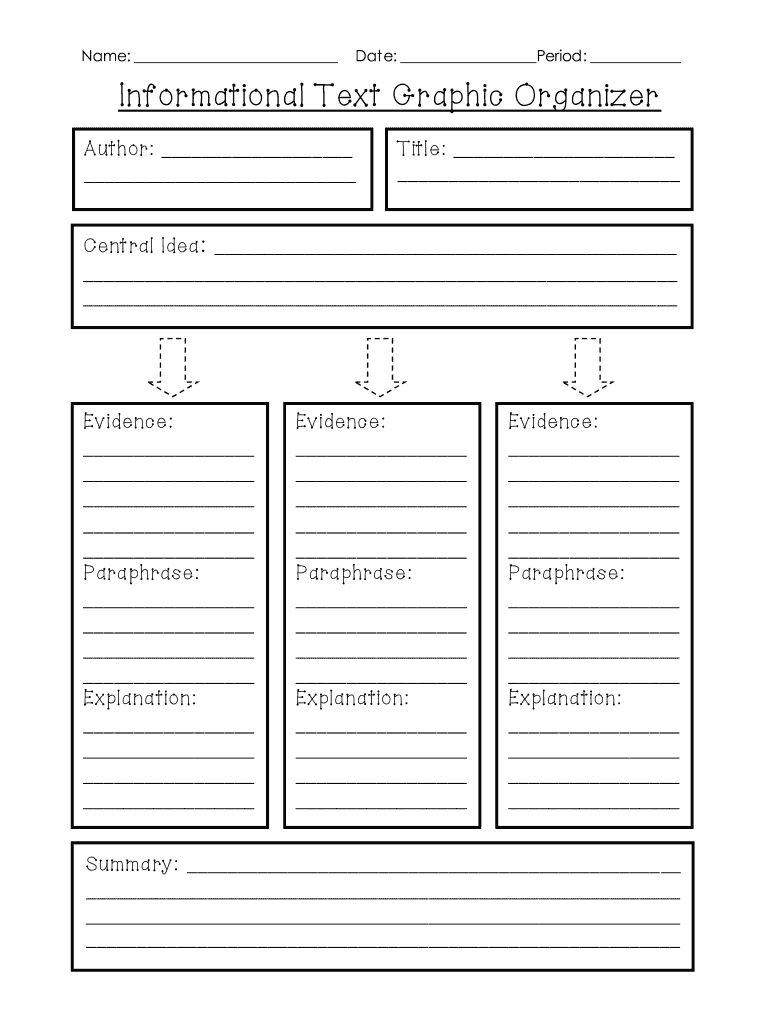







Definition & Meaning of the Informational Graphic Organizer
An informational graphic organizer is a visual tool designed to help users effectively summarize and categorize information from an informational text. It is structured to facilitate comprehension and retention of key concepts, making it particularly useful in educational settings. Typically, it includes designated sections for the author's name, title of the text, central idea, supporting evidence, paraphrases, and explanations. This organized format encourages users to articulate the main ideas and supporting details clearly, improving both understanding and communication skills.
When using an informational graphic organizer, it is essential to note the following:
- Focus on clarity: The purpose is to clearly delineate the relationship between different pieces of information.
- Visual representation: The organizer enhances learning through visual tools, assisting in making complex information more accessible.
- Customizable: Users can adapt the format to meet their specific needs or the requirements of the text being analyzed.
This clarity in organization not only supports learning but also aids in preparing for discussions, presentations, or writing assignments related to the content.
How to Use the Informational Graphic Organizer
Using an informational graphic organizer involves several straightforward steps that guide the user through the process of summarizing text effectively.
-
Choose the text: Identify the informational text you want to analyze, whether it's an article, report, or book chapter.
-
Identify key components:
- Author's name
- Title of the text
- Central idea
- Supporting details and evidence
- Personal reflections or paraphrases
-
Fill out the organizer: As you read the text, begin filling in the sections of the graphic organizer. This may include:
- Summarizing the main idea in your own words.
- Listing key supporting details and their relevance.
- Including direct quotes or paraphrased information.
- Adding your thoughts or questions in designated areas.
-
Review and revise: After completing the organizer, review it to ensure that all sections are filled accurately and clearly reflect the text's content. Make adjustments where needed for completeness and coherence.
By using an informational graphic organizer, users can better distill complex information into manageable parts, making it easier to comprehend and utilize during discussions or writing tasks.
Important Terms Related to Informational Graphic Organizers
Understanding specific terminology associated with informational graphic organizers is crucial. Some key terms include:
- Central Idea: The primary message or main point of an informational text.
- Supporting Evidence: Facts or examples that back up the central idea, providing validation and context.
- Paraphrase: Rewording a section of the text in your own words while maintaining its original meaning.
- Summary: A brief overview of the main ideas and points contained within the text.
- Nonfiction: A genre of writing based on factual information, which is often analyzed using graphic organizers.
These terms form the foundation of effective use and understanding of graphic organizers, enabling users to engage deeply with the material they are studying.
Key Elements of the Informational Graphic Organizer
An effective informational graphic organizer should encompass several essential elements that facilitate clarity and comprehension. Key components include:
- Title Section: This includes both the title of the text and the author's name, establishing context for the information presented.
- Central Idea Box: A clear articulation of the main idea that serves as the focal point for supporting details.
- Evidence Sections: Spaces designated for three to five main points along with their corresponding evidence—these can be quotes, statistics, or summaries.
- Paraphrase Section: An area to rephrase critical information in the user's own words.
- Reflection Area: This can include personal insights, questions, or implications of the information gathered, promoting deeper engagement with the content.
By incorporating these elements into an informational graphic organizer, users can ensure a comprehensive overview of the text being analyzed while highlighting significant details and their relationships.
Examples of Using the Informational Graphic Organizer
Practical applications of informational graphic organizers can vary widely based on the needs of users. Here are a few scenarios illustrating their use:
- Academic Setting: A fifth-grade teacher assigns students to read a historical article. Each student fills out a graphic organizer to identify the central idea and supporting details, which is then used to prepare for a class discussion.
- Business Context: In a corporate environment, a team reviews a market research report. They use a graphic organizer to extract the central points and relevant statistics to inform their strategy development.
- Personal Study: An individual studying for an exam uses an informational graphic organizer to summarize key concepts from a textbook chapter, aiding retention and recall.
These examples demonstrate the versatility of informational graphic organizers across various contexts, enhancing understanding, and facilitating communication of complex information.




