Oq45 2 pdf 2026

Get Form
oq 45 pdf Preview on Page 1

Here's how it works

01. Edit your oq 45 pdf online
Type text, add images, blackout confidential details, add comments, highlights and more.

02. Sign it in a few clicks
Draw your signature, type it, upload its image, or use your mobile device as a signature pad.

03. Share your form with others
Send oq45 2 via email, link, or fax. You can also download it, export it or print it out.

Definition and Meaning of OQ-45.2

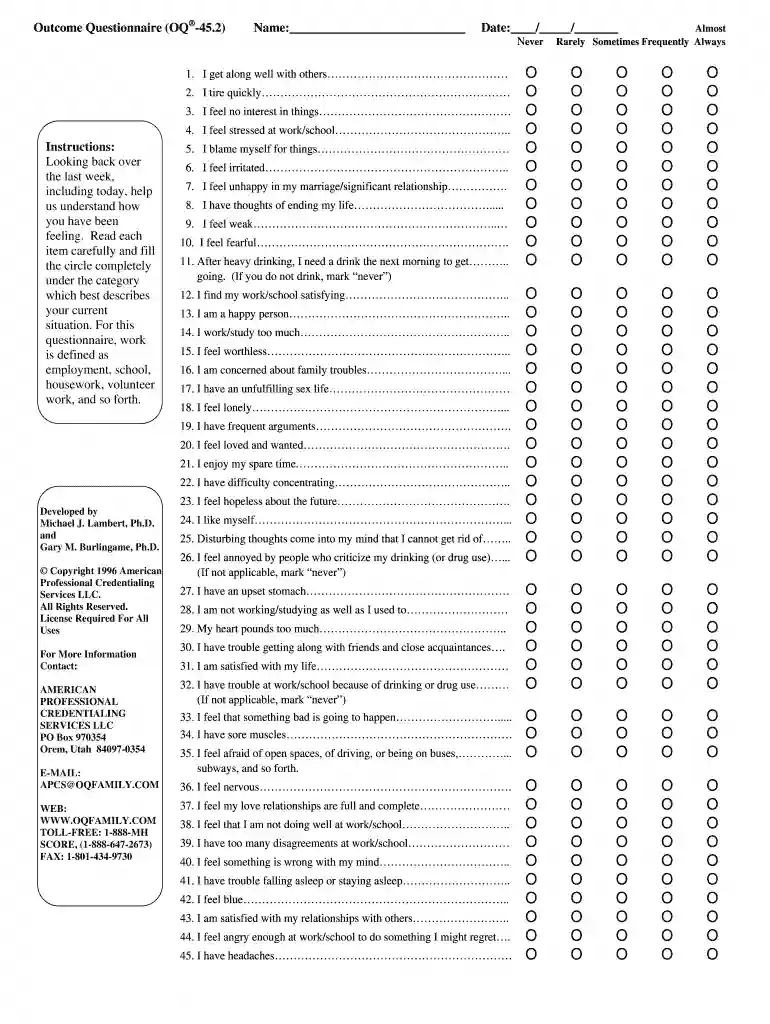
The OQ-45.2, or Outcome Questionnaire 45.2, is a validated self-assessment tool aimed at evaluating an individual's psychological and emotional health. Developed by Michael J. Lambert and Gary M. Burlingame, the questionnaire comprises forty-five statements regarding feelings, relationships, work and school satisfaction, and mental health symptoms. Respondents indicate their experiences on a frequency scale, allowing for quantifiable insights into their well-being over the preceding week. This information can play a vital role in clinical settings to help practitioners tailor treatment and monitor progress, making the OQ-45.2 essential for mental health evaluations.

Purpose and Utility of the OQ-45.2

The primary aim of the OQ-45.2 is to provide a reliable measure of an individual's mental health status. By facilitating a self-reflective assessment, it empowers respondents to better understand their challenges and track improvements over time. It is commonly used in psychotherapy and counseling, allowing clinicians to identify areas that may require further attention, enhance client engagement, and measure treatment outcomes effectively.

How to Complete the OQ-45.2

Completing the OQ-45.2 involves several key steps designed to capture accurate self-reported data:

  1. Access the Questionnaire:
    • Users can usually find the OQ-45.2 in a digital format, such as an OQ-45.2 PDF, or in paper format, depending on their preference or clinical setting.
  2. Understanding the Statements:
    • The questionnaire consists of statements covering various aspects of functioning and emotional experience, each requiring a response based on recent experiences.
  3. Rating Frequency:
    • Respondents rate how often they have experienced the statements on a scale, typically ranging from zero (never) to four (always).
  4. Submitting Responses:
    • Once complete, the OQ-45.2 can be submitted to a mental health professional for analysis, scoring, and interpretation.

Example of Scoring Interpretation

Once the OQ-45.2 is filled out, responses are tallied to generate a total score. Higher scores may indicate more significant emotional distress or dysfunction. For example:

  • A score of 0-25 might indicate minimal issues.
  • A score of 26-63 may suggest moderate challenges.
  • Scores above 63 generally indicate severe distress and may necessitate immediate clinical attention.

OQ-45.2 Scoring Guidelines

The scoring process of the OQ-45.2 is integral to interpreting the results meaningfully. Each dimension measured by the questionnaire contributes to a comprehensive understanding of an individual's psychological health.

Key Components of the Scoring System:

  • Total Score:
    • The overall score reflects the respondent's mental health status, calculated by summing responses to all statements.
  • Subscale Scores:
    • The OQ-45.2 is divided into three subscales: Symptom Distress, Interpersonal Relationships, and Social Role Functioning, allowing for deeper insights into specific areas of concern.
  • Clinical Cutoffs:
    • Specific cutoff scores help clinicians categorize the severity of symptoms, guiding intervention strategies.

Implications of Scoring

Understanding these scores allows mental health professionals to track changes over time and adjust treatment plans accordingly. For instance, a decrease in symptoms reflected in a lower score across subsequent assessments can signal positive therapeutic progress.

Applications in Therapeutic Settings

The OQ-45.2 is widely used in various therapeutic contexts, contributing significantly to clinical efficacy. Mental health practitioners leverage its data for both individual and group therapy sessions.

Benefits of Using the OQ-45.2

  • Client Engagement:
    • By involving clients in the assessment process, the OQ-45.2 fosters a collaborative therapeutic relationship.
  • Treatment Monitoring:
    • Routine use of the questionnaire helps track client progress and adapt treatment plans as necessary.
  • Outcome Measurement:
    • Practitioners can measure pre- and post-treatment outcomes effectively, providing data to evaluate therapeutic effectiveness.

Legal and Ethical Considerations

The use of the OQ-45.2 raises various legal and ethical considerations that practitioners must navigate carefully.

Confidentiality and Data Protection

  • Patient Privacy:
    • All data collected through the OQ-45.2 should be treated as confidential, following HIPAA regulations and ensuring that sensitive information is protected.
  • Informed Consent:
    • Clinicians should inform clients about how their data will be used and obtain their consent before administering the questionnaire.

Appropriate Usage in Practice

  • Cultural Sensitivity:
    • Practitioners should consider cultural context when interpreting the results of the OQ-45.2, as responses may vary significantly across different populations.

Variations and Alternatives

In addition to the OQ-45.2, various alternative tools may serve similar purposes, catering to diverse populations and needs.

Other Evaluation Tools

  • Beck Depression Inventory (BDI):
    • A tool focused explicitly on depression, providing more targeted insight into that specific area.
  • Symptom Checklist-90-Revised (SCL-90-R):
    • A broader assessment instrument that measures psychological symptoms across multiple domains.

Limitations of the OQ-45.2

While the OQ-45.2 is valuable, it is essential to note its limitations. The subjective nature of self-assessment may lead to response biases, and it is best used as part of a comprehensive assessment strategy along with clinical interviews and other diagnostic tools.

Conclusion

The OQ-45.2 is a robust tool for measuring emotional wellbeing, providing valuable insights that can inform treatment approaches and enhance mental health outcomes. With its straightforward structure and scoring procedures, it remains a popular choice among mental health professionals throughout the United States.

be ready to get more

Complete this form in 5 minutes or less

Get form

Got questions?

We have answers to the most popular questions from our customers. If you can't find an answer to your question, please contact us.
Contact us
Content that assesses functional level and change over time: The OQ-45.2 measures functioning in 3 domains, enabling clinicians to assess functional level and change over time Symptom Distress (heavily loaded for depression and anxiety), Interpersonal Functioning, and Social Role.
Information gleaned from the Y-OQ 30.2 may be helpful in treatment/discharge planning. administered to a child ages 12- 18 and the Y-OQ 30.2 PR to the parents/guardian of a child ages 4-17. Cutoffs differ. Encourage respondents to answer every question as accurately as possible.
The Change Metric is the Baseline Score Follow Up Score A difference of 14 or more points between the Baseline and follow up on the OQ 45.2 reflects a reliable change. An RCI that is -14 or lower (i.e., -14, -15, etc.) means the client is doing reliably worse. An RCI that is 14 or higher (i.e., 14, 15, etc.)
Outcome Questionnaire-45.2 The OQ45. 2 provides a total score and three subscale scores. The three subscales are operationalizations of the three aspects of a clients life functioning social role, symptom distress, and interpersonal relationships.
THE OQ-ANALYST IS DESIGNED TO MEASURE CHANGE, PREDICT TREATMENT FAILURES AND ALERT CLINICIANS TO PREVENT DETERIORATION IN THERAPY IN ORDER TO IMPROVE AND REPORT OUTCOMES.

Security and compliance

At DocHub, your data security is our priority. We follow HIPAA, SOC2, GDPR, and other standards, so you can work on your documents with confidence.

Learn more
ccpa2
pci-dss
gdpr-compliance
hipaa
soc-compliance
be ready to get more

Complete this form in 5 minutes or less

Get form

People also ask

The Outcome Questionnaire-45.2 (OQ-45.2) is purported to measure important areas of functioning (symptoms, interpersonal problems social role functioning and quality of life) that are of central interest in mental health.

oq45 2 scoring