




01. Edit your form online
Type text, add images, blackout confidential details, add comments, highlights and more.

Type text, add images, blackout confidential details, add comments, highlights and more.

Draw your signature, type it, upload its image, or use your mobile device as a signature pad.

Send it via email, link, or fax. You can also download it, export it or print it out.
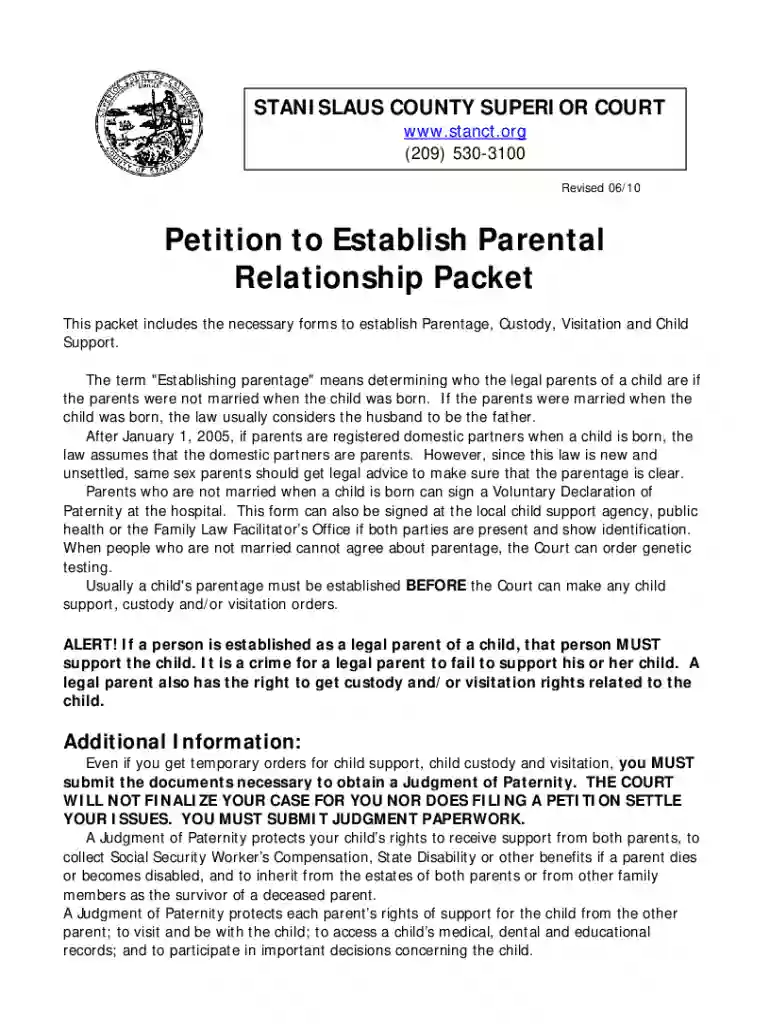
The "Form PacketsParental RelationshipSuperior Court of CA" is a comprehensive document provided by the Superior Court of California. It serves as a structured legal framework for establishing parental relationships, covering areas such as parentage, custody, visitation, and child support within family law cases. This standardized packet is crucial for individuals looking to formalize their parental rights and responsibilities, ensuring that all necessary legal procedures are followed to protect the interests of parents and children involved. The form packet is an essential resource for petitioners and respondents alike, offering a detailed guide on the required steps and documentation for family law proceedings.
Gather Required Documents: Before starting the form, make sure you have all necessary documents ready. These may include personal identification, birth certificates, previous court orders, and any existing agreements regarding custody or support.
Download the Form Packet: Access the Superior Court of California’s official website to download the relevant form packet. Ensure you have the latest version to comply with current legal standards.
Fill Out the Necessary Sections: Carefully read through and complete each section of the form packet. Pay close attention to required fields and instructions.
Provide Detailed Information: Include detailed information about both parents, the child or children involved, and any pertinent circumstances affecting custody or support arrangements.
Review and Attach Supporting Documents: Double-check the filled form for accuracy and completeness. Attach any required supporting documents, such as financial statements or proof of residency.
Sign and Notarize: Sign the completed documents and, if required, have them notarized to verify their authenticity.
Submit the Form: Submit the completed packet to the clerk of the Superior Court of California. You can do this in person, or check if your local court accepts electronic submissions.
Keep Copies for Your Records: Ensure you retain copies of the submitted forms and any supporting documents for your personal records and future reference.
Parental Information: Sections that capture detailed information about both the petitioner and the respondent, including contact information and employment status.
Child Details: Comprehensive fields specific to each child, including names, birth dates, and current living arrangements.
Custody Arrangement Proposals: Areas where parties outline their proposed custody schedules and responsibilities.
Child Support Specifications: Requires precise financial details, including income, expenses, and any pre-existing child support agreements.
Visitation Schedules: Specific proposals for visitation schedules, ensuring both parties are clear on time-sharing and responsibilities.
Legal Declarations: Sections where individuals declare the truthfulness of their statements under penalty of perjury, providing legal weight to the document.
This form packet is legally binding and crucial for formalizing custody and support agreements under California family law. It provides a structured approach to resolving matters concerning parental rights and responsibilities, ensuring compliance with state-specific legal requirements. In family law disputes or agreements, this form serves as an official document submitted to the court, thereby influencing legal outcomes and enforcement. The packet assists in safeguarding the rights of all parties involved, including the best interests of the child.
Petitioner: The individual initiating the court proceedings who seeks to establish or modify a parental relationship.
Respondent: The individual who is responding to the petition filed in court.
Parentage: The legal identification of a child’s parent(s), often requiring proof or acknowledgment.
Custody: Legal and physical rights and duties concerning a child’s upbringing and care.
Visitation: Non-custodial parent’s right to spend time with their child under defined conditions.
Child Support: Financial support that the non-custodial parent is typically required to provide to assist with the child’s living expenses.
The Superior Court of California mandates compliance with specific state laws and guidelines when completing the form packet. The state has distinct statutes regarding child custody, support, and visitation that influence court decisions. California prioritizes the child's best interest, considering factors like the health, safety, and welfare of the child, the nature of parental relationships, and any history of abuse or neglect. Understanding these rules ensures that completed forms align with legal expectations, significantly impacting the resolution of parental relationship cases.
One common scenario involves a parent seeking to establish legal custody following a separation. By completing the form packet, they officially request court assistance to define custody terms, potentially in conjunction with mediation services. Another example might be a non-custodial parent wishing to revise visitation rights or adjust child support obligations due to changes in financial circumstances. In each case, the successful submission and processing of this form packet help resolve disputes and adapt existing arrangements to better suit the child’s needs.
The typical users of this form packet are parents undergoing separation or divorce, individuals seeking to establish paternity or parentage, and those requiring formal modification of existing custody or support orders. Legal representatives, such as family law attorneys and paralegals, frequently assist in preparing and submitting these forms. Additionally, court-appointed mediators and counselors may utilize the packet to guide clients through the legal intricacies associated with establishing parental rights in California.


We've got more versions of the Form PacketsParental RelationshipSuperior Court of CA form. Select the right Form PacketsParental RelationshipSuperior Court of CA version from the list and start editing it straight away!
At DocHub, your data security is our priority. We follow HIPAA, SOC2, GDPR, and other standards, so you can work on your documents with confidence.
Sep 1, 2021 Petitioner asks the court to make the determinations indicated below. c. Petitioner requests genetic testing to determine whether the.Read more
A parenting plan is a document that states when the children will be with each parent (parenting time) and how major decisions will be made (legal decision‐Read more


