




01. Edit your form online
Type text, add images, blackout confidential details, add comments, highlights and more.

Type text, add images, blackout confidential details, add comments, highlights and more.

Draw your signature, type it, upload its image, or use your mobile device as a signature pad.

Send it via email, link, or fax. You can also download it, export it or print it out.
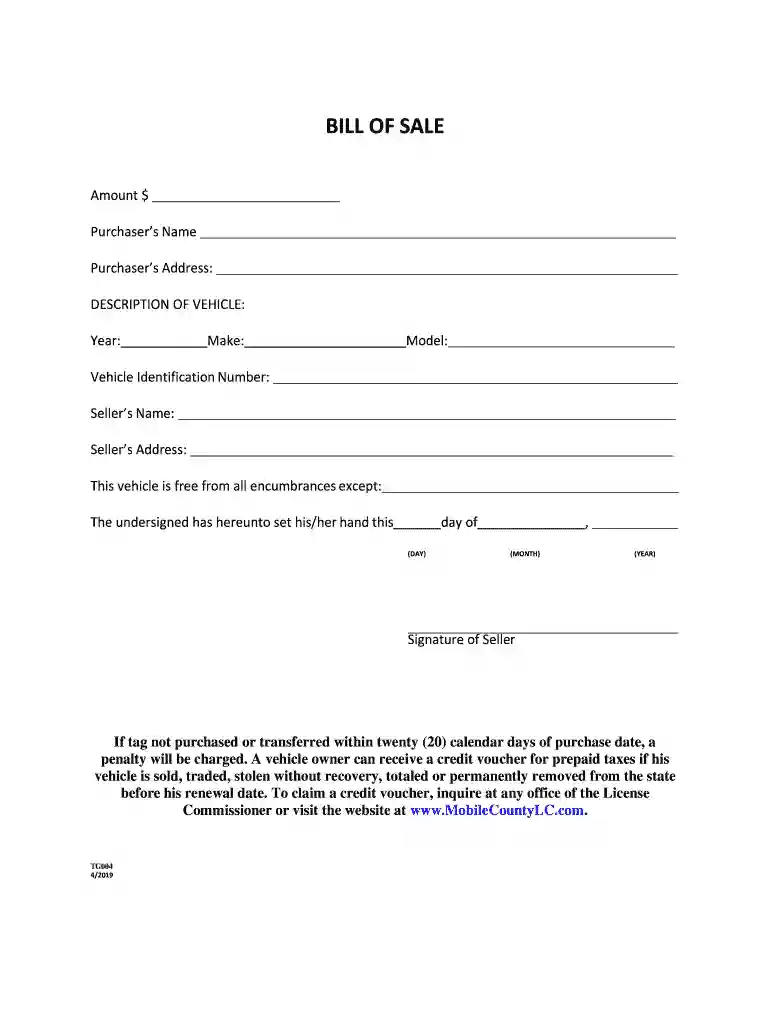
A blank bill of sale is a versatile legal document that records the transfer of ownership from a seller to a buyer. Typically, it is used for vehicles but can apply to other types of personal property, such as boats or equipment. It serves as a receipt for the transaction, confirming that the buyer now holds ownership rights over the item in question. As an essential tool for formalizing sales, a blank bill of sale provides protection and a record for both parties involved by clearly stating the terms of the agreement.
To effectively use a blank bill of sale, both buyer and seller must accurately complete its fields. Each section of the document should be filled out with details such as the buyer's and seller's information, a description of the item being sold, and the agreed-upon sale price. Additionally, both parties should be present during this process to verify the information. Once filled out, both the buyer and the seller should sign the document to legalize the transaction, ensuring that future property claims can be resolved based on the documented agreement.
Completing a blank bill of sale involves a series of straightforward steps:
The blank bill of sale should encompass several critical components to ensure clarity and legality:
Understanding the terminology used in a blank bill of sale will aid both parties in completing the document:
While a generic form can be used across various states, specific regulations may apply depending on the jurisdiction. Each state may have unique requirements regarding notarization, additional disclosures, or specific information that must be included on the bill of sale. For example, states like California and Florida have distinct stipulations for vehicle sales that must be adhered to, such as emissions testing documentation or odometer disclosures. It is crucial for both buyer and seller to verify local laws to ensure compliance.
The legal validity of a blank bill of sale is contingent upon the correct execution of its completion requirements. It should be used to formalize ownership changes and can be introduced as legal evidence in disputes over ownership. Additionally, bills of sale may be required for title transfers at the Department of Motor Vehicles (DMV) to register a vehicle legally.
Consider the following scenarios to illustrate the practical application of a blank bill of sale:
By understanding and employing a blank bill of sale, parties involved in a transaction can ensure a protected and legally recognizable exchange of ownership.
We've got more versions of the blank bill of sale form. Select the right blank bill of sale version from the list and start editing it straight away!
Of course, it is possible with DocHub. This trustworthy and compliant online service has a phone-based signing option. Once you log in to your DocHub account and import your blank bill of sale to our editor, fill out all empty areas and utilize the Sign feature on the top barf. Click on Create your signature and select Phone from the available choices. Here, you scan a QR code with your smartphone and draw your signature on your phone display, as you normally do when approving hard copies. If you access DocHub right from your mobile device, you can eSign your template by drawing your eSignature, uploading its image, or simply with a typed name.
If you are using Chrome, there are two simple ways to edit your blank bill of sale online. First, visit the DocHub site, add your file, and edit it utilizing our toolbar. You may also install our Chrome extension and edit any document by dragging and dropping it in your browser tab.
At DocHub, your data security is our priority. We follow HIPAA, SOC2, GDPR, and other standards, so you can work on your documents with confidence.
This date would always precede the Date of Sale / Transfer. It can also be blank when transfers involve only name changes on a deed. 12. Date of Sale / TransferRead more
in consideration of $. , do hereby sell, transfer and convey to the following vehicle: Clearly print or type all information, except signatures.Read more
CONTRACT AND BILL OF SALE FOR AUTOMOBILE the Buyer will pay Seller the total purchase price of the Vehicle on the day of the sale money order, or cash.


