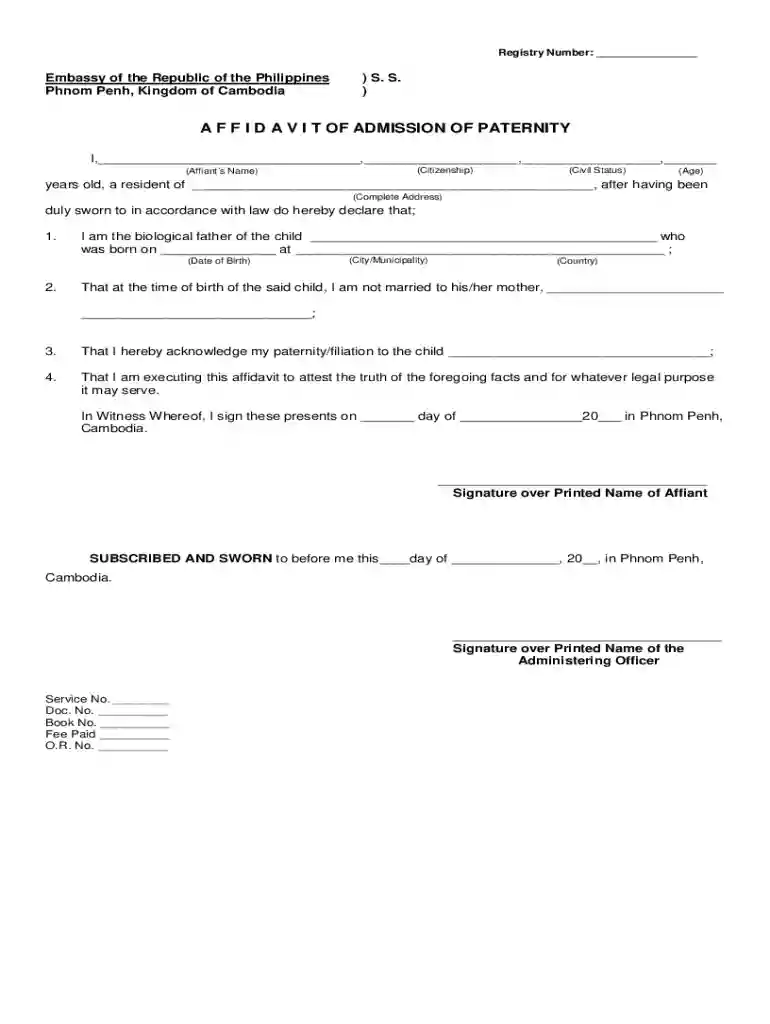
Consent use surname 2026

Get Form
consent use surname Preview on Page 1

Here's how it works

01. Edit your form online
Type text, add images, blackout confidential details, add comments, highlights and more.

02. Sign it in a few clicks
Draw your signature, type it, upload its image, or use your mobile device as a signature pad.

03. Share your form with others
Send it via email, link, or fax. You can also download it, export it or print it out.

Definition & Meaning

Consent to use a surname refers to the legal agreement where an individual allows the use of their surname by another party. This often arises in family law, where a child or spouse seeks to adopt a different last name. The process ensures that all parties involved are aware of and agree to the change, thereby avoiding identity disputes. This consent may be formalized through a signed document, which may be required to be notarized or witnessed, depending on jurisdictional requirements.

How to Obtain the Consent to Use a Surname

Obtaining consent to use a surname typically involves a formal written agreement between the involved parties. The process begins by expressing the desire to change a surname and providing a clear reason for the request. Once the intent is communicated, both parties must agree on the terms. The agreement should include:

  • Personal details of the parties involved
  • The specific surname to be adopted
  • Reason for the change

This document may need to be notarized to ensure its legitimacy and, in some cases, might require court approval, especially if it involves a minor. It's crucial to consult legal advice or local regulations to ensure compliance.

Steps to Complete the Consent Use Surname

  1. Identify the Need: Determine why the consent for surname use is required.

  2. Draft the Agreement: Include all necessary details such as names, the new surname, and reason for the change.

  3. Review Legal Requirements: Check state or local jurisdiction for any additional legal requirements or necessary documentation.

  4. Obtain Signatures: All parties must sign the document, confirming their agreement.

  5. Notarization: If required, have the document notarized to validate it legally.

  6. File if Necessary: Submit to appropriate legal or governmental bodies if filing is required.

Key Elements of the Consent Use Surname

Several key elements must be included to render a consent to use a surname valid and legally binding:

  • Identifying Information: Full legal names and contact information of all parties involved.
  • Consent Clause: A clear statement expressing consent to the surname change.
  • Signatures: Signatures of all consenting parties, potentially with witness signatories.
  • Date of Agreement: Clearly stated to mark the commencement of the agreement.
  • Legal Description: The purpose and legal implications of changing the surname.
  • Notarization/Witnessing: Legal confirmation where required.

These elements ensure the document's integrity and are pivotal for its acceptance in legal settings.

Who Typically Uses the Consent to Use Surname

The consent to use a surname is most commonly used in:

  • Blended Families: Where children from previous relationships adopt the new family’s surname.
  • Marriages and Divorces: Spouses deciding to retain or change surnames post-marriage or divorce.
  • Adoptions: Allowing an adopted child to assume the adopting family's surname.
  • Personal Preference: Individuals who choose to change their surname for personal reasons.

Each scenario has specific legal considerations, often driven by the individuals involved and state laws.


decoration image ratings of Dochub

Legal Use of the Consent Use Surname

The legal use of consent to use a surname varies based on jurisdiction but generally includes:

  • Court Filings: For minors, legal consent forms might be required when submitting court orders.
  • Official Identification: Updating identification documents such as social security cards, driver's licenses, or passports.
  • Public Records: Ensuring the surname change is reflected in public records and official databases.

The legal perspective focuses on preventing identity fraud and ensuring the name change is transparent and consensual, meeting all statutory requirements.

State-Specific Rules for the Consent Use Surname

Different states in the U.S. have distinct regulations surrounding consent to use a surname, affecting:

  • Age of Consent: Varies by state, typically requiring parental or guardian consent for minors.
  • Documentation Requirements: Some states may demand additional documentation or proof of consent.
  • Legal Proceedings: Certain states might call for a court appearance or filing.

It's crucial to consult specific state legislation or a legal professional to align with regional regulations, as these will influence the process and legality of surname changes.

Examples of Using the Consent Use Surname

Practical scenarios where consent to use a surname can be applied include:

  • A step-parent deciding the surname for their stepchild, agreed upon by all legal guardians.
  • A divorced individual choosing to revert to their maiden name with the ex-spouse’s consent.
  • A child from a previous relationship seeking to harmonize surnames within a new household.

These examples illustrate how consent to use a surname facilitates familial unity, identity continuity, and adherence to legal standards.

be ready to get more

Complete this form in 5 minutes or less

Get form

Got questions?

We have answers to the most popular questions from our customers. If you can't find an answer to your question, please contact us.
Contact us
3. General Requirements for the Affidavit to Use Fathers Surname Duly Accomplished Affidavit to Use the Surname of the Father (AUSF) Proof of Paternity. Identification Documents. Childs Existing Birth Certificate. Marriage Certificate (if applicable) Other Supporting Documents.
Therefore, it is important not to use any symbol or character that is clearly not a letter in the alphabet when writing your signature on a legal document. Next, it is important to make sure that your signature show your full name as it appears on any government issued identification. What is an Acceptable Signature for use on a US legal Wallis, Bowens, Averhart Associates, PLLC uncategorized what-is-an Wallis, Bowens, Averhart Associates, PLLC uncategorized what-is-an
A common question business owners, entrepreneurs, and creatives often ask is, Can a name be copyrighted? The short answer is nonames, titles, and short phrases cannot be protected by copyright law.
It can be handwritten, electronic, or even a unique mark-consistency is key. Certain documents require an independent witnesss signature to validate the signing process. Electronic signatures are legally binding when they capture intent, consent, and proper attribution. What Makes a Valid Signature? A Legal Guide for Businesses Sprintlaw articles what-makes-a-valid-s Sprintlaw articles what-makes-a-valid-s
Youll still need to sign all paperwork with both last names since its considered your legal last name. Each state has different laws about what is considered a marriage name change so you may need to go through a court-ordered name change to have two last names without a hyphen.

Security and compliance

At DocHub, your data security is our priority. We follow HIPAA, SOC2, GDPR, and other standards, so you can work on your documents with confidence.

Learn more
ccpa2
pci-dss
gdpr-compliance
hipaa
soc-compliance
be ready to get more

Complete this form in 5 minutes or less

Get form

People also ask

Does your signature have to be your name? Not necessarily. However, youll want to do your best to make it as unique to you as possible whether you opt to use your initials or your full designation.
However, your signature does not have to be your full name. You can use just your first or last name. It also doesnt need to be written in cursive despite how common this practice is. Print is perfectly fine for signing any kind of document. Can Your Signature Be Anything? We Investigate in 2024 - SignWell SignWell resources can-your-signatu SignWell resources can-your-signatu

Related links