




01. Edit your case management intake assessment form example online
Type text, add images, blackout confidential details, add comments, highlights and more.

Type text, add images, blackout confidential details, add comments, highlights and more.

Draw your signature, type it, upload its image, or use your mobile device as a signature pad.

Send case management intake form template via email, link, or fax. You can also download it, export it or print it out.
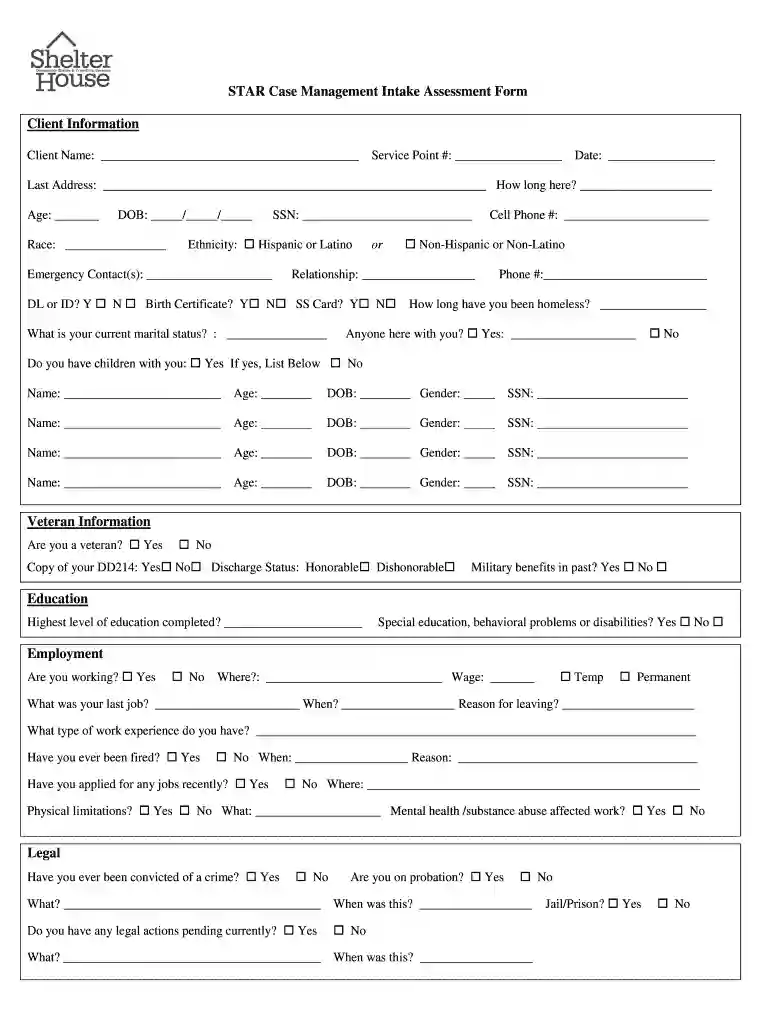
The STAR Case Management Intake Assessment Form is designed to help case managers gather vital information from clients seeking assistance. This form addresses the client’s current circumstances, which aids in aligning the right resources and support services effectively.
The purpose of this form is to collect a comprehensive set of data that reflects the client's background, needs, and challenges. The data captured through the intake process includes various sections such as client demographics, health assessment, employment history, and social support systems. With this structured approach, case managers can identify immediate needs and long-term goals for successful case planning.
Each section of the STAR Case Management Intake Assessment Form is crucial for constructing a holistic view of a client’s situation. The sections organized within the form typically include:
This section requests basic details about the client, facilitating identification and communication.
Including this information is important for tailoring services available to veterans and ensures compliance with specific eligibility requirements that may be applicable.
Gathering historical data on education and employment can illuminate barriers to success and access to services. It is useful for determining appropriate training or job assistance that might be needed.
A thorough health assessment section allows case managers to gauge the physical and mental health needs of the client, ensuring that any relevant issues are addressed in the case plan.
By including a substance abuse section, the form helps case managers identify if the client requires specialized support services in addition to general case management.
To effectively utilize the STAR Case Management Intake Assessment Form, case managers should familiarize themselves with the structure and requirements delineated in the form.
Using the STAR Case Management Intake Assessment Form effectively not only maximizes the utility of the data collected but also fosters a client-centered approach that respects and values the client’s voice in their care plan.
Case managers can obtain the STAR Case Management Intake Assessment Form through various channels:
Understanding where and how to secure this form is critical for case managers to ensure timely and effective service delivery to clients.
The STAR Case Management Intake Assessment Form must be used in compliance with applicable legal standards and confidentiality regulations, such as HIPAA in the United States.
Maintaining adherence to legal requirements is vital for fostering trust and ensuring ethical practice in case management.
The STAR Case Management Intake Assessment Form is typically utilized by a variety of professionals and organizations, including:
Understanding the primary users of the form reveals its significance in the broader context of community support and resource navigation.
The STAR Case Management Intake Assessment Form plays a crucial role in the case management process, serving as a structured tool that captures essential client information. By utilizing this form effectively, case managers can provide targeted and meaningful support to individuals navigating complex social, health, and legal challenges.
We've got more versions of the case management intake assessment form example form. Select the right case management intake assessment form example version from the list and start editing it straight away!
| Versions | Form popularity | Fillable & printable |
|---|---|---|
| 2013 | 4.5 Satisfied (64 Votes) |
At DocHub, your data security is our priority. We follow HIPAA, SOC2, GDPR, and other standards, so you can work on your documents with confidence.
Coordinates and facilitates patient care throughout hospitalization.Performs a case management intake assessment.Orients patient to the role of the case managerRead more
MHK provides payer care management and utilization management workflow software spanning case management, UM, quality, and provider collaboration. MHK logo. MHK
The assessment process should produce a case record that clearly documents the results of the caseworkers determination. All processes that can be performed inRead more


