Classroom observation tool form 2026

Get Form
classroom observation form pdf Preview on Page 1

Here's how it works

01. Edit your classroom observation form pdf online
Type text, add images, blackout confidential details, add comments, highlights and more.

02. Sign it in a few clicks
Draw your signature, type it, upload its image, or use your mobile device as a signature pad.

03. Share your form with others
Send classroom observation form via email, link, or fax. You can also download it, export it or print it out.

Definition of the Classroom Observation Tool Form

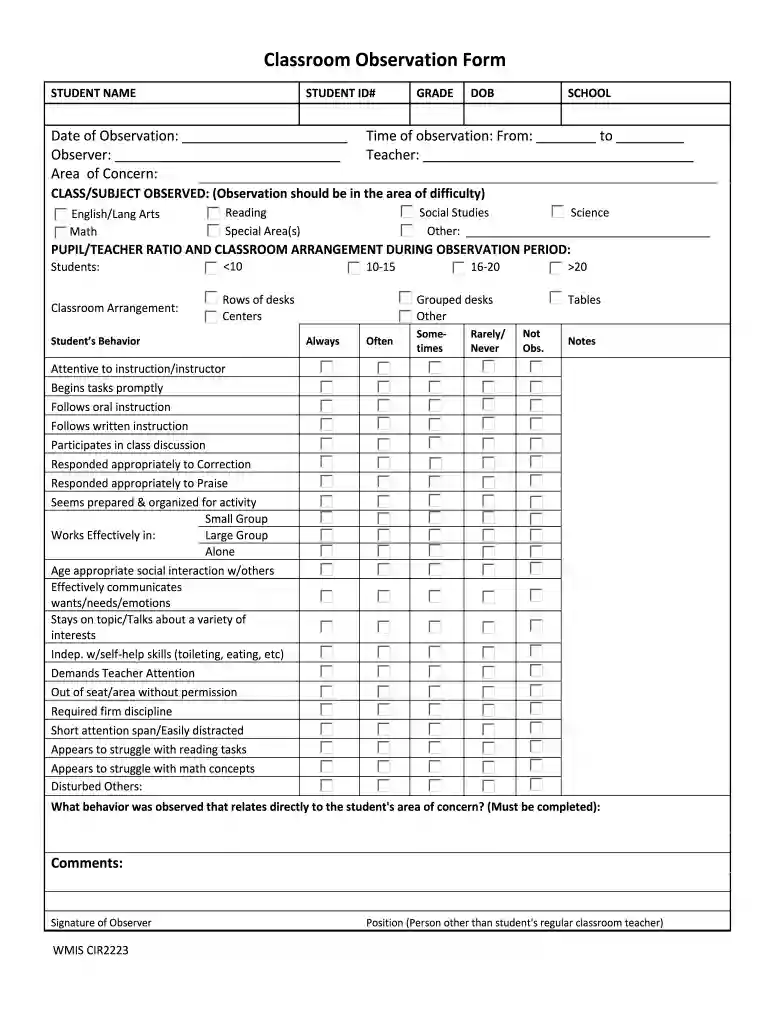
The classroom observation tool form is a structured document that educators use to assess and document student behavior and performance during specific observation periods. It is essential for both formative assessments and fostering a deeper understanding of individual student needs.

Core Components of the Form

  • Student Information Section: Captures essential details such as name, grade level, and date of observation to contextualize the assessment.
  • Observer's Information: Details about the observer, including name and role, help ensure accountability and clarity in the observation process.
  • Area of Concern: This section allows observers to identify specific issues or behaviors they aim to monitor, thereby focusing their assessment efforts.
  • Classroom Arrangement: Describing the setup of the classroom helps clarify the learning environment's influence on student behavior.
  • Pupil/Teacher Ratio: Documenting this ratio provides insight into potential challenges that may arise due to overcrowding or lack of attention.

How to Use the Classroom Observation Tool Form

Using the classroom observation tool form effectively involves systematic observation and critical analysis to ensure meaningful insights.

Step-by-Step Usage

  1. Preparation:

    • Understand the specific objectives of the observation.
    • Familiarize yourself with the form, noting any areas that require particular attention.
  2. Observation:

    • Conduct the observation according to the scheduled plan.
    • Remain as unobtrusive as possible to avoid influencing student behavior.
  3. Documentation:

    • Record observations in real-time, focusing on key behaviors and engagement levels.
    • Use specific language that describes what is seen rather than interpretations of those actions.
  4. Review and Reflection:

    • After the observation, review notes taken and complete the form.
    • Reflect on the documented behaviors and their implications for the student's learning experience.

By following these steps, educators can ensure that their observations are thorough and provide valuable insights into student performance.

Key Elements of the Classroom Observation Tool Form

A well-crafted classroom observation tool form includes several key elements critical for producing effective assessments.

Detailed Breakdown of Key Elements

  • Behavioral Categories: Clearly defined categories for observing behaviors such as participation, cooperation, and focus allow observers to classify student actions effectively.
  • Rating Scale: A consistent scale (e.g., 1-5) helps quantify observed behaviors, giving a structured approach to assessment.
  • Comments Section: This space permits observers to elaborate on particular observations, providing context and additional details that are not captured in numerical ratings.
  • Follow-Up Actions: Suggested actions based on observations can guide teachers in addressing any learning challenges identified during the observation.

Importance of Each Element

  • Behavioral Categories provide a framework for systematic assessment, improving the clarity and focus of observations.
  • Rating Scale facilitates quantitative analysis, enabling educators to track changes over time and across different periods.
  • Comments Section adds qualitative depth, which is crucial for understanding nuanced student behaviors and contextual factors affecting learning.
  • Follow-Up Actions serve as a bridge between observation and intervention, allowing educators to implement responsive strategies tailored to student needs.

Steps to Complete the Classroom Observation Tool Form

Completing the classroom observation tool form systematically is vital to capturing precise and actionable data.

Detailed Completion Steps

  1. Fill in Student and Observer Information:

    • Start with accurate data about the student and the observer to maintain a record of who was observed and by whom.
  2. Identify Areas of Concern:

    • Specify the behaviors or skills you intend to focus on during the observation period. Clearly articulated areas help in guiding the observation process.
  3. Document Observations Throughout the Observation Period:

    • As you conduct the observation, detail specific instances of behavior and engagement. Be objective and record incidents that stand out.
  4. Rate Observed Behaviors:

    • Use the rating scale to assess behaviors, ensuring consistency in scoring to aid future comparisons.
  5. Provide Comments and Analyze Data:

    • Complete the comments section, summarizing key observations and suggesting possible interventions. Ensure that your analysis leads to actionable insights for improving learning.

By following these steps, users can ensure a comprehensive and standardized approach to classroom observation.

Examples of Using the Classroom Observation Tool Form

Practical examples illustrate how to use the classroom observation tool form effectively in different educational contexts.

Scenarios Illustrating Use

  • Identifying Engagement Levels:

    • An observer notes during a math lesson that a student frequently raises their hand to answer questions. This behavior indicates high engagement, which can be recorded on the form.
  • Monitoring Participation:

    • In a group activity, the observer might document that a student is hesitant to join discussions. This observation can be detailed in the comments section, prompting potential interventions that foster participation.
  • Behavioral Patterns Over Time:

    • Using the form repeatedly over several weeks allows teachers to identify trends. For example, a student may initially struggle with peer interactions but show improvement in subsequent observations, giving valuable feedback on social skills development.

These examples highlight the practical application of the tool in various scenarios, showcasing its versatility as an educational resource.

Important Terms Related to the Classroom Observation Tool Form

Understanding critical terminology associated with classroom observation is essential for effective application and analysis.

Key Terms and Their Significance

  • Observation Period: The specific timeframe during which the observer monitors student behavior, crucial for contextual relevance.
  • Engagement: Refers to how actively students participate in activities, a central focus of any observation.
  • Intervention Strategies: Actions taken based on observations, aimed at improving student outcomes, highlighting the tool's role in enhancing teaching efficacy.
  • Formative Assessment: The practice of assessing student understanding during the learning process rather than at the end, helping educators adjust teaching approaches dynamically.

Familiarity with these terms enhances the observer's ability to communicate findings effectively and develop targeted interventions for students.

be ready to get more

Complete this form in 5 minutes or less

Get form

Got questions?

We have answers to the most popular questions from our customers. If you can't find an answer to your question, please contact us.
Contact us

Managing your forms with DocHub this way is very straightforward after you have downloaded its extension for Google Chrome. Go to the Chrome Web Store and install DocHub - Sign PDF from Gmail to obtain it. Give our tool access to your Google account, and then open an email with the observation sheet for teachers attached and point to the file with your cursor - the DocHub extension button will automatically appear there. Click on it to open your form in our editor. Make any necessary modifications, fill out the blanks, and click Sign to create your legally-binding eSignature.

You may find and modify your classroom observation tool template online with the help of DocHub. Its straightforward but feature-rich design enables you to start productive work right after you sign up your account. Create your profile and add your file, then our interface will guide you via our stress-free form completion experience.

Briefly, the AOSI is a 19-item direct observational measure designed to detect and monitor signs of autism in infants aged 618 months. This is accomplished through a standard set of semi- structured activities, administered by an examiner who is both skilled at interacting with infants and knowledgeable about ASD.
The classroom observation tool can serve multiple purposes. At a systems level, it can help countries track changes in teaching practices, target professional learning and inform associated investments and policies. At a school level, the tool can be used for teacher support and development.
Use a camera, laptop, tablet, or smartphone to record observations and take pictures. Ask a child to dictate a story and you can type it up on a computer or use an audio recorder.

Security and compliance

At DocHub, your data security is our priority. We follow HIPAA, SOC2, GDPR, and other standards, so you can work on your documents with confidence.

Learn more
ccpa2
pci-dss
gdpr-compliance
hipaa
soc-compliance

People also ask

CLASS is scored by trained and certified observers using a specific protocol. Following their observations of teacher-child interactions, CLASS observers rate each dimension on a 7-point scale, from low to high. Scores of 1-2 mean the quality of teacher-child interactions is low.
Classroom observations generally fall into two categories, informal observations, and formal observations. Informal observations tend to be shorter (3 to 20 minutes) and go by many names.
This user-friendly 13-item Classroom Observation Scale enables teachers and healthcare workers with little or no clinical training to identify, with reliable and valid results, preschoolers more likely than their peers to have autism spectrum disorder.
First, you record your observations of a particular setting or situation--that is, take field notes. Next, you interpret those notes according to relevant criteria. Finally, you write a well organized paper that presents your observations and interpretations, usually with the aim of answering a research question.
The COT rubric is an assessment tool that is used to measure classroom performance of teachers. The rubric for each classroom observable indicator of the PPST is designed to assess the classroom performance of teachers across learning areas and grade levels. The indicators in the rubric are rated independently.

classroom management observation tool