




01. Edit your design award rubric online
Type text, add images, blackout confidential details, add comments, highlights and more.

Type text, add images, blackout confidential details, add comments, highlights and more.

Draw your signature, type it, upload its image, or use your mobile device as a signature pad.

Send it via email, link, or fax. You can also download it, export it or print it out.
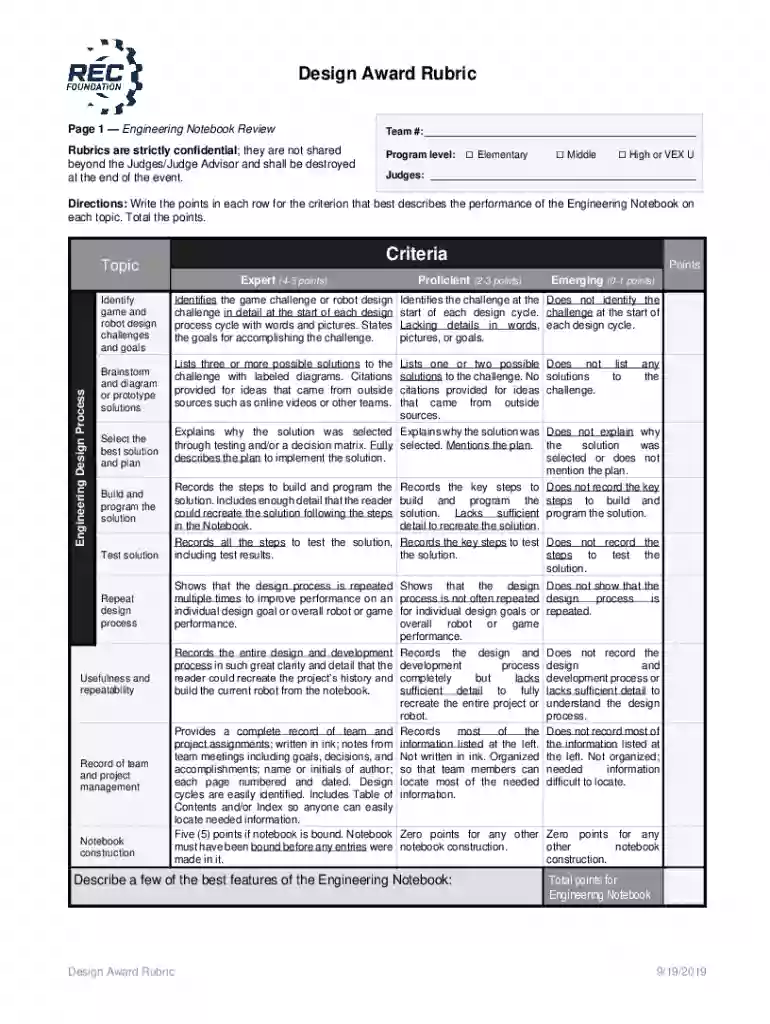
The Vex Design Award Rubric is a specific evaluation tool used in robotics competitions to assess the design and engineering capabilities of participating teams. It focuses primarily on the quality of the Engineering Notebooks and the effectiveness of team interviews. By employing a structured approach to evaluation, the rubric ensures that teams are judged based on a consistent set of standards. The criteria in the rubric cover several aspects such as the engineering design process, project management skills, teamwork, and communication effectiveness. Each criterion is scaled from 'Expert' to 'Emerging,' allowing judges to rate the performance of teams in a detailed manner.
The rubric comprises multiple criteria that guide judges in evaluating the overall performance of teams. Some of the critical elements evaluated include:
Several real-world scenarios illustrate how these components can be applied. For example, a team with a well-documented design process and clear communication among members tends to score higher.
The transition to digital formats like those offered by DocHub for filling out and signing documents has several advantages:
While paper versions have their charm and do not rely on technology, digital versions have become the standard due to their convenience and security features.
Utilizing the Vex Design Award Rubric must adhere to certain legal considerations. These include compliance with privacy laws when handling team data and ensuring the fairness and transparency of evaluations. DocHub, for instance, ensures that all documents processed through its platform are encrypted, meeting the requirements of relevant data protection regulations. This legal assurance is important for maintaining the integrity of the competition evaluation process.
The rubric is typically utilized by competition judges accountable for assessing the performance of teams. These judges often have backgrounds in engineering, education, or robotics, allowing them to provide a fair evaluation of each team's capabilities. Additionally, team mentors might use the rubric to prepare their teams for competitions by aligning their efforts with the evaluation criteria. This user profile maximizes the rubric’s effectiveness by concentrating on individuals who understand the nuances of assessing technical and team performance.


DocHub’s platform integrates well with several software solutions, ensuring a seamless workflow when dealing with documents like the Vex Design Award Rubric. Integration with Google Workspace, for example, allows documents to be imported from Google Drive and Gmail, edited within DocHub, and then exported back seamlessly. This compatibility reduces the need for manual file transfers and offers a streamlined experience for users.
In practical terms, the rubric can be an invaluable resource in a robotics competition. For instance, consider a scenario where two teams have similar technical achievements, but different documentation quality. The team with a well-documented design process and clear project management strategies would score higher because the rubric allows judges to see beyond the physical robot to the systematic approach taken in its creation. This approach encourages all teams to value process and planning along with technical prowess.
We've got more versions of the design award rubric form. Select the right design award rubric version from the list and start editing it straight away!
At DocHub, your data security is our priority. We follow HIPAA, SOC2, GDPR, and other standards, so you can work on your documents with confidence.
We provide the opportunity for students interested in the Aerospace Industry to get hands on experience. This teams goal is to design, construct, and fly anRead more
by GL Goldberg 2017 Cited by 2 This article examines the use of an engineering design rubric by judges for three different stu- dent competitionsone regional, one national, and one globaltoRead more
Sep 15, 2009 7.3.3 FIRST TECH CHALLENGE PTC DESIGN AWARD. This judged award recognizes design elements of the Robot that are both functional and aesthetic.Read more


