




01. Edit your demlr monitoring form online
Type text, add images, blackout confidential details, add comments, highlights and more.

Type text, add images, blackout confidential details, add comments, highlights and more.

Draw your signature, type it, upload its image, or use your mobile device as a signature pad.

Send demlr monitoring via email, link, or fax. You can also download it, export it or print it out.
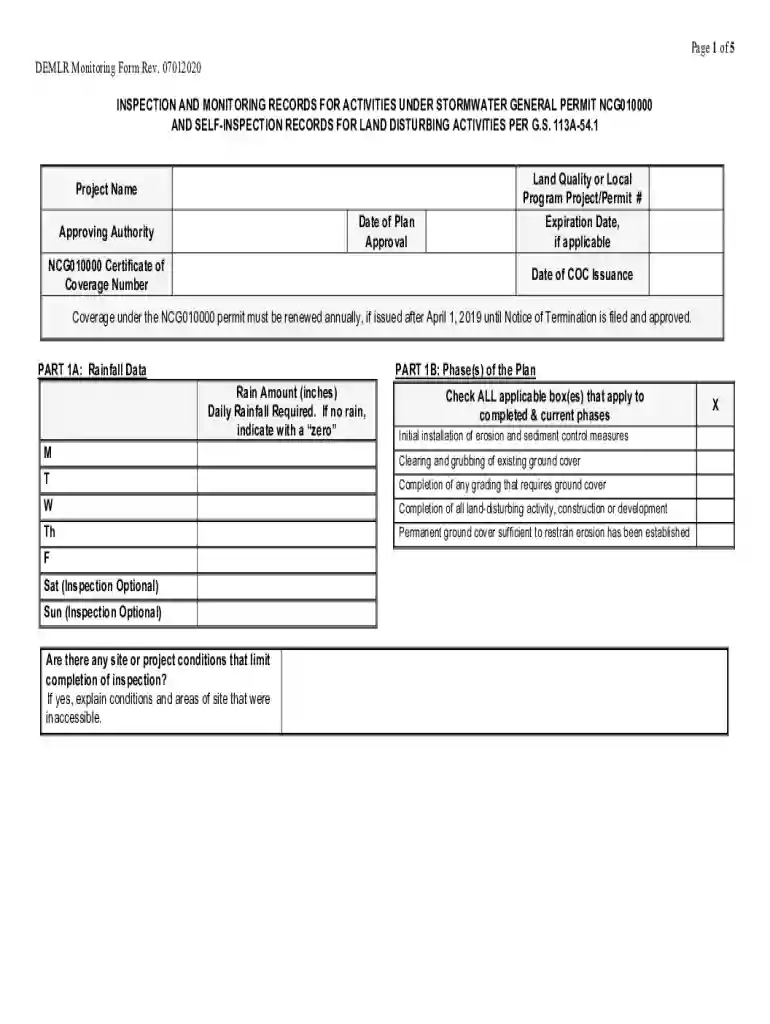
The DEMLR Monitoring Form is a critical document used to document inspections and monitoring activities under the Stormwater General Permit NCG010000. Primarily, it serves as a tool for self-inspection of land-disturbing activities. This form encompasses essential sections such as rainfall data, stormwater management plans, erosion and sediment control measures, outfalls for stormwater discharge, ground stabilization efforts, and any new or modified measures implemented to maintain compliance with regulatory mandates. Its role is pivotal in ensuring that the activities adhere strictly to permit conditions, with a comprehensive account of necessary corrective actions, thus playing a vital role in environmental conservation efforts.
The form is meticulously structured to capture all pertinent data necessary for comprehensive monitoring and inspection under the NCG010000 permit. Key elements include:
Filling out the DEMLR Monitoring Form requires accuracy and attention to detail to ensure compliance. The steps involved include:
To access the DEMLR Monitoring Form, several pathways exist:
The primary users of the DEMLR Monitoring Form are professionals involved in construction and land development projects subject to stormwater permits. These include:


Using the DEMLR Monitoring Form is essential for:
The form encapsulates specific legal requirements tied to the NCG010000 Stormwater General Permit. Legally:
Understanding key terminology aids in accurate completion:
These elements ensure the form meets its purpose of guiding conscientious and legally compliant land disturbance activities, ultimately safeguarding natural environments through structured oversight and documentation.
We've got more versions of the demlr monitoring form form. Select the right demlr monitoring form version from the list and start editing it straight away!
Most eSignature services require users to have a paid subscription. With DocHub, there are two ways for you to add an electronic signature to your demlr form at no cost:
The second option, though, has restrictions on the number of signatures, sign requests, emails, and documents for editing available per month. You can check for full information here.
If your go-to email service is Gmail, you can easily incorporate your DocHub editor into your work. Modify your demlr monitoring form with DocHub tools and connect it to your drafts in Gmail. See how effortless it can be to exchange files and work together with a swift PDF editing solution at hand.
At DocHub, your data security is our priority. We follow HIPAA, SOC2, GDPR, and other standards, so you can work on your documents with confidence.
INSPECTION AND MONITORING RECORDS FOR ACTIVITIES UNDER STORMWATER GENERAL PERMIT. FOR LAND DISTURBING ACTIVITIES
Jan 9, 2023 Use the NCDEQ form DEMLR Monitoring Form Rev. 07012020. Always document daily rainfall on regular workdays, even when rainfall is 0.0Read more


