







Definition and Meaning
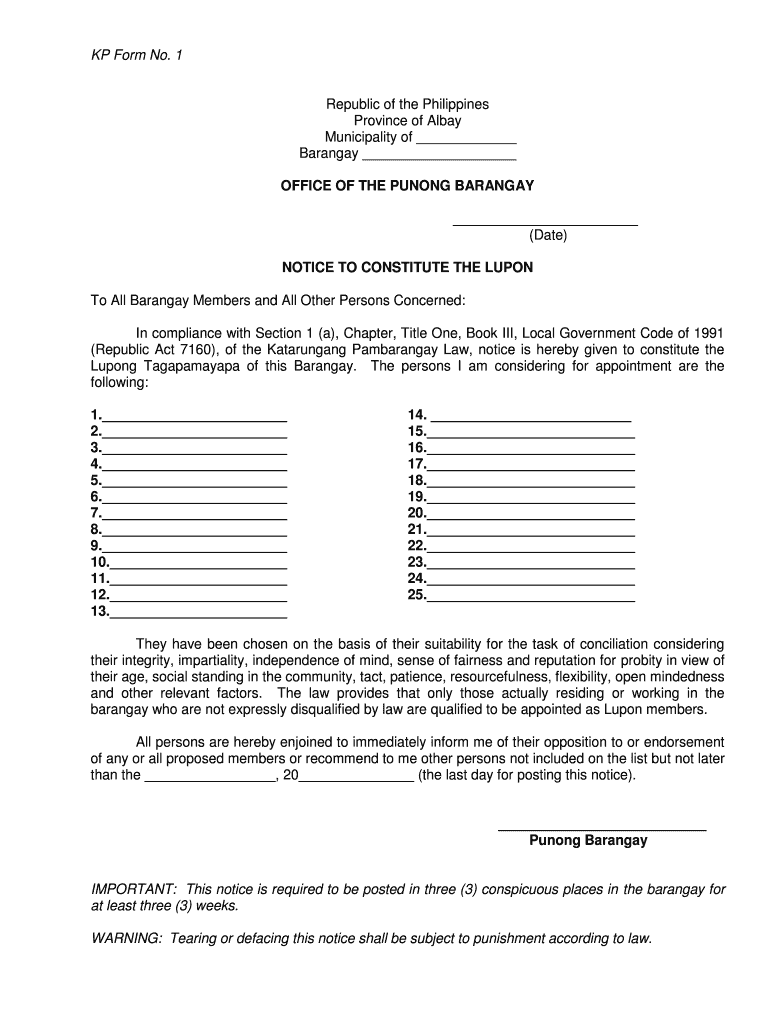
"Kp forms," also known as "Katarungang Pambarangay" forms, are documents used within the barangay justice system of the Philippines. These forms facilitate the legal processes involved in resolving community disputes through mediation and arbitration. The purpose of kp forms is to ensure compliance with local government laws, particularly in community-level conflict resolution and enhancing the peace and order within a barangay.
The Katarungang Pambarangay system aims to enforce laws at a local level, allowing community members to resolve disputes without escalating to the formal court system. This method fosters an environment where conflicts can be settled amicably and efficiently.
How to Use the Kp Forms
Using kp forms is quite straightforward and often involves several key steps. The primary purpose of these forms is to record the proceedings of conflict resolution meetings, known as Lupon hearings. These forms are designed to document who is involved, the nature of the dispute, and any agreements reached. They can also be used to notify parties of upcoming mediations or to document resolutions or certifications required for legal actions.
- Initiation of a Complaint: A complainant fills out an initial kp form, indicating the nature and details of the dispute.
- Notice of Hearing: Following the complaint, a Notice of Hearing form is issued to notify involved parties of the date and time for resolution meetings.
- Documentation of Mediation: During mediation, participants document any resolutions or agreements using specific kp forms.
- Resolution and Certification: If an agreement is achieved, a Certificate of Settlement may be issued to validate the result of the mediation process.
How to Obtain the Kp Forms
Kp forms are generally available through the barangay office or local government unit (LGU). You can request these forms in person, ensuring you have the necessary identification and details to initiate a dispute resolution process. Here are common ways to obtain kp forms:
- Visit the Barangay Hall: Most barangay offices keep a stock of kp forms and can provide guidance on completing them.
- Contact the LGU Office: If the barangay office is unavailable, the LGU may offer support in obtaining the necessary documents.
- Community Outreach: Some barangays organize community events where kp forms are distributed to increase awareness and accessibility.
Always ensure to verify the latest version of the kp forms as the content and requirements may change periodically.
Steps to Complete the Kp Forms
Completing kp forms requires attention to detail to ensure all necessary information is accurately recorded. Here is a step-by-step guide:
- Personal Information: Enter personal details such as your full name, address, and contact information on the form.
- Details of the Dispute: Describe the nature of the dispute, including dates, locations, and any involved parties.
- Signatures: Ensure that all parties, including witnesses, sign the form as required.
- Submission to Barangay Official: Once completed, submit the form to the barangay official who will evaluate the case and schedule further proceedings.
- Follow Instructions: Adhere to additional instructions from the barangay official, especially regarding hearing dates and mediation sessions.
Who Typically Uses the Kp Forms
The use of kp forms is typically reserved for barangay officials, community members involved in disputes, and mediators. The forms are essential tools for:
- Barangay Officials: They use these forms to manage and document local disputes, ensuring procedural compliance.
- Complainants and Respondents: Individuals involved in disputes use the forms to formally present issues within the community.
- Mediators and Lupon Members: These individuals utilize the forms to facilitate the conflict resolution process effectively.


Key Elements of the Kp Forms
Kp forms contain vital elements designed to ensure comprehensive documentation of community disputes:
- Complainant and Respondent Information: Identifies the individuals involved in the dispute.
- Summary of Facts: An overview of the dispute's details, ensuring clarity and focus.
- Witness Accounts: Spaces for documenting testimonies from witnesses who can corroborate the facts.
- Resolution Details: Sections for outlining any agreements or settlements reached during mediation sessions.
- Official Seals and Signatures: Essential for validating the form's authenticity and confirming the agreement's legitimacy.
Legal Use of the Kp Forms
Kp forms play a crucial role in the Barangay Justice System's legal framework, providing structured pathways for dispute resolution at the community level. Key legal aspects include:
- Compliance with Local Government Code: These forms are aligned with the provisions of the Local Government Code of the Philippines, ensuring legal integrity.
- Documenting Legal Proceedings: Kp forms provide a legal record that can be used in further legal actions if mediation fails.
- Enforcement of Agreements: If an agreement is reached, it can be legally binding and enforceable, subject to the barangay's jurisdiction.
Important Terms Related to Kp Forms
Understanding key terms related to kp forms aids in proper comprehension and use:
- Lupon: A barangay committee responsible for mediation and arbitration of disputes.
- Punong Barangay: The barangay captain or official who oversees operations, including conflict resolution procedures.
- Barangay: The smallest administrative division in the Philippines, equivalent to a village or neighborhood.
- Resolution: The outcome of the mediation process, documented in the kp forms for authoritative reference.
By familiarizing yourself with these elements, you can navigate the use of kp forms more effectively and contribute to maintaining harmony within your community.




