




01. Edit your reptile amphibian merit badge workbook online
Type text, add images, blackout confidential details, add comments, highlights and more.

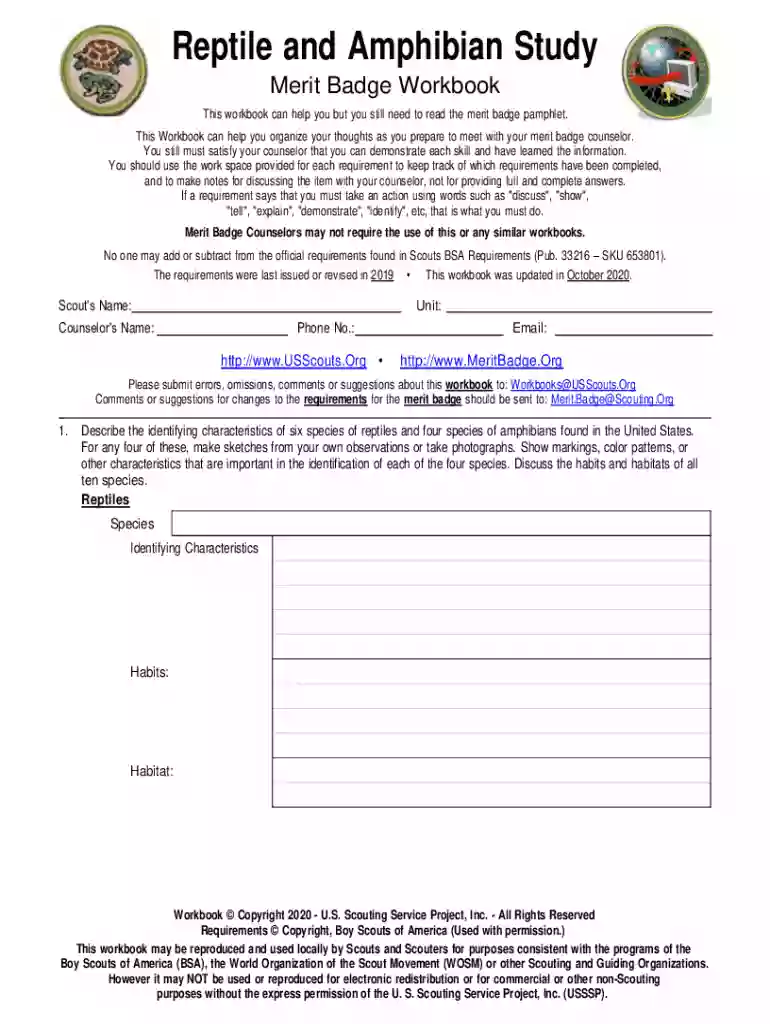
Type text, add images, blackout confidential details, add comments, highlights and more.

Draw your signature, type it, upload its image, or use your mobile device as a signature pad.

Send it via email, link, or fax. You can also download it, export it or print it out.
The Disability Awareness Merit Badge is part of the Boy Scouts program, designed to educate young scouts about different disabilities and the challenges individuals with disabilities face. The merit badge aims to foster empathy, understanding, and support. It encourages scouts to learn about various disabilities, both visible and invisible, and emphasizes the importance of developing inclusive attitudes and actions.
The worksheet serves as a guide to help scouts complete the requirements for the Disability Awareness Merit Badge. It includes sections where scouts can jot down notes, responses, and reflections on the tasks completed.
Research Phase: Begin with researching different disabilities. This may involve reading articles, watching documentaries, and interviewing professionals.
Complete Worksheet Sections: Fill out the worksheet sections, detailing the types of disabilities studied and insights gained.
Engage in Simulations: Participate in at least two disability simulations and document the experiences and challenges faced on the worksheet.
Community Engagement: Volunteer for events or organizations that support individuals with disabilities. Reflect this experience in the worksheet.
Discussion and Review: Discuss learnings with a merit badge counselor and submit the worksheet for review.
The worksheet comprises multiple sections dedicated to ensuring the scout thoroughly completes and reflects on each part of the merit badge requirements.
The primary users of this worksheet are Boy Scouts aiming to earn the Disability Awareness Merit Badge. It may also be utilized by merit badge counselors who guide the scouts through the process.


To fully understand and engage with the worksheet, certain key terms and concepts are essential.
Real-world scenarios provide insight into how this worksheet aids in the completion of the merit badge requirements.
While the worksheet itself is an educational tool, it operates within the framework of the Boy Scouts program which involves specific legal considerations for activities involving minors.
The Disability Awareness Merit Badge Worksheet serves as an educational resource supporting young scouts in understanding and appreciating the experiences of individuals with disabilities. Through structured activities and reflections, scouts develop empathy and learn to promote an inclusive society.
We've got more versions of the reptile amphibian merit badge workbook form. Select the right reptile amphibian merit badge workbook version from the list and start editing it straight away!
At DocHub, your data security is our priority. We follow HIPAA, SOC2, GDPR, and other standards, so you can work on your documents with confidence.
Do TWO of the following: ☐ a. Talk to a Scout who has a disability and learn about his experiences taking part in Scouting activities and earning differentRead more
Disability Preference (XP) Ten points are added to the passing examination score or rating of: A veteran who served at any time and has a present service-


