Definition & Meaning
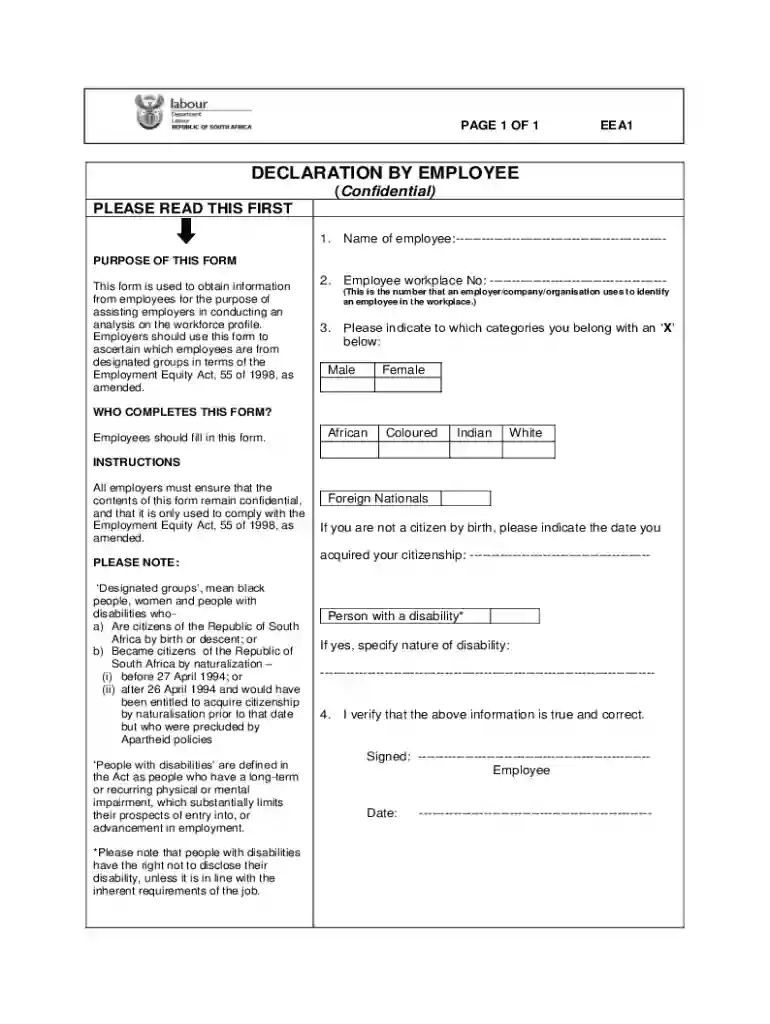
The "Declaration by Employee Confidential) Please Read This First" form is primarily utilized to comply with the Employment Equity Act, 55 of 1998. Its purpose is to collect critical demographic information from employees, including gender, race, citizenship status, and disability status. This information helps employers understand workforce diversity and align with legal requirements, while maintaining employee confidentiality.
Purpose of the Form
- Compliance: Ensures adherence to legal standards set by the Employment Equity Act.
- Demographic Analysis: Assists employers in assessing and improving workforce diversity.
- Confidentiality: Protects the privacy of employees, ensuring their information is securely handled.
Key Elements of the Form
This employee declaration form contains several integral sections, designed to collect necessary information:
- Personal Information: Includes fields for employee name, ID number, and contact details.
- Demographic Details:
- Gender identification
- Racial and ethnic backgrounds
- Citizenship status
- Disability status
- Declaration Statement: Acknowledgment by the employee that the provided information is accurate.
Specific Sections Explained
- Gender Identification: Allows employees to declare their gender, which contributes to gender parity studies.
- Racial and Ethnic Background: Helps in understanding the diverse cultural makeup of the workforce.
- Disability Status: Ensures that employers can make accommodations and promote inclusivity.
Steps to Complete the Form
Filling out the "Declaration by Employee Confidential) Please Read This First" form involves several steps to ensure accuracy and completeness.
- Review the Instructions: Begin by thoroughly reading the form's introductory guide to understand the requirements.
- Fill Personal Information: Enter easy-to-read personal details, ensuring correctness.
- Provide Demographic Details: Clearly mark the applicable checkboxes for gender, race, and disability status; ensure the accuracy of information.
- Sign the Declaration: Officially sign and date the form to acknowledge the truthfulness of the information.
- Submit the Form: Return the completed form to the designated HR representative or compliance officer.
Who Typically Uses This Form
The primary users of this form include:
- Employees: Required to complete the form as part of their employment onboarding process.
- Human Resources Departments: Use collected information for compliance and reporting.
- Compliance Officers: Ensure that the collected data aligns with legal requirements and audit standards.
Employer Responsibilities
- Data Security: Employers must securely manage and store the collected information.
- Reporting: Use the data for accurate compliance reporting.
- Accommodations: Utilize information to provide necessary workplace accommodations.
Legal Use of the Form
The legal framework surrounding this form is centered on compliance with the Employment Equity Act.
Compliance Requirements
- Data Collection: Must be comprehensive and adhere to anti-discriminatory practices.
- Employee Consent: Require explicit consent from employees when collecting personal data.
- Confidentiality: Organizations must handle the form with strict confidentiality procedures to protect employee privacy.
Important Terms Related to This Form
Understanding specific terms can aid in the correct completion and utility of the form:
- Employment Equity Act: A legislation aimed at promoting equal opportunities in the workplace.
- Confidentiality: Ensuring sensitive information is kept private.
- Demographics: Statistical data relating to the population and particular groups within it.
How to Obtain the Form
Accessing the "Declaration by Employee Confidential) Please Read This First" form can be done through various methods:
- HR Department: Most companies distribute this form during the onboarding process.
- Company Intranet: Some organizations make forms accessible on secured online platforms.
- Email Request: Employees can request the form via email from their HR department.
Digital vs. Paper Versions
Organizations may offer both digital and paper versions of the form. Each format caters to different preferences:
- Digital: Easily fillable and can be submitted electronically.
- Paper: Traditional format, preferred by employees who may not have digital access.
Examples of Using the Form
The application of this form varies based on company and industry needs. Here are some scenarios:
- Example 1: New Employee Onboarding: A new hire completes the form during their first week to enable HR to configure their profile in compliance with equity laws.
- Example 2: Annual Compliance Review: An existing employee might be asked to update their information during an annual review.
Practical Scenarios
- Scenario 1: An employee may wish to update their demographic data due to a change in citizenship or disability status.
- Scenario 2: For auditing, HR might aggregate non-personally identifiable data for annual diversity reporting.