Lewis structure worksheet 3 2026

Get Form
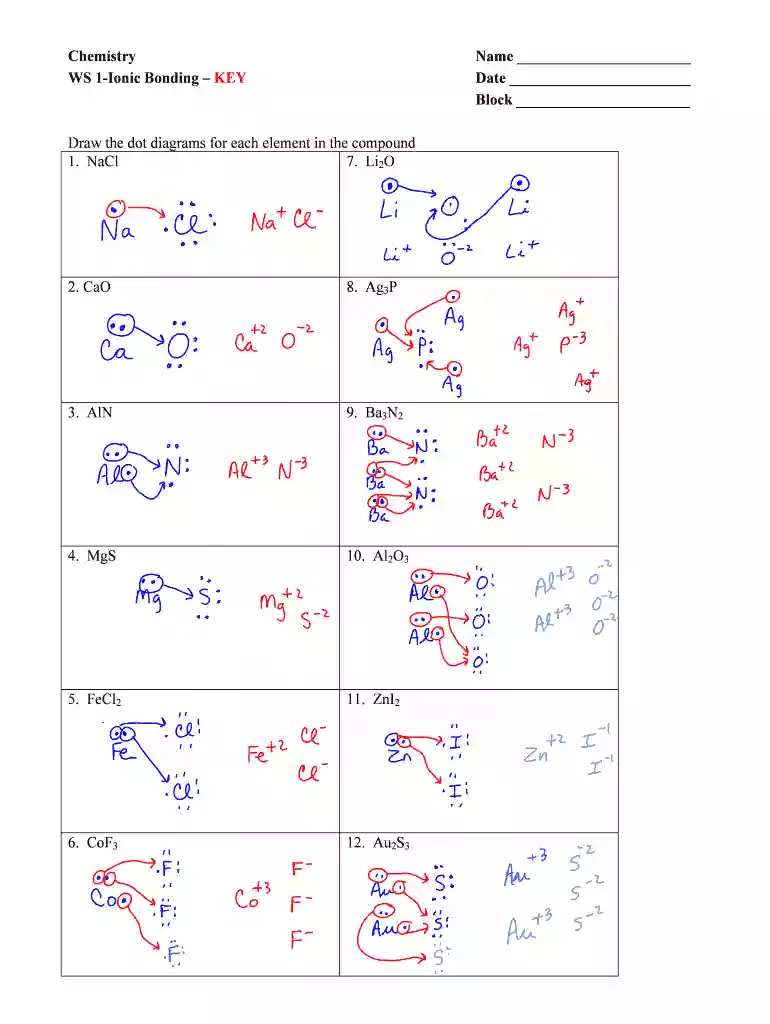
lewis dot structure worksheet pdf with answers Preview on Page 1

Here's how it works

01. Edit your lewis dot structure worksheet pdf with answers online
Type text, add images, blackout confidential details, add comments, highlights and more.

02. Sign it in a few clicks
Draw your signature, type it, upload its image, or use your mobile device as a signature pad.

03. Share your form with others
Send lewis dot structure worksheet with answers pdf via email, link, or fax. You can also download it, export it or print it out.

Definition and Meaning of Lewis Structure Worksheet 3

The Lewis structure worksheet 3 is an educational tool widely used in chemistry to help students visualize and understand molecular bonding through the use of electron dot diagrams. These worksheets typically guide users in drawing Lewis structures for covalent and ionic compounds, illustrating how atoms bond and share electrons. This structured approach allows students to recognize patterns in molecular geometry, valence electrons, and bond types, essential for grasping chemical reactions and molecular interactions.

Key Features of the Lewis Structure Worksheet

  • Visual Learning: Provides a graphical representation of how atoms combine, facilitating a clearer understanding of chemical bonding.
  • Multiple Compounds: Often includes a variety of compounds for practice, aiding in different learning scenarios.
  • Assessment Tool: Serves as a formative assessment instrument for educators to evaluate students’ grasp on the subject.

How to Use the Lewis Structure Worksheet 3

Using this worksheet entails several steps to effectively complete the assignment and enhance comprehension of chemical structures.

Steps to Utilize the Worksheet

  1. Identify the Atoms: Start by noting the types of atoms involved in the compound.
  2. Determine Valence Electrons: Calculate the total number of valence electrons available for the compound, accounting for charges in ionic compounds.
  3. Draw the Structure: Begin placing electrons around the atoms, adhering to the octet rule where applicable (such as for main group elements).
  4. Assess Bonding: Analyze whether single, double, or triple bonds are necessary based on the required electron sharing between atoms.
  5. Verify the Structure: Ensure all atoms have a complete outer shell of electrons, adjusting bonds as needed.

These steps provide a methodical approach to grasping the key concepts behind Lewis structures.

Who Typically Uses the Lewis Structure Worksheet 3

This worksheet is primarily utilized by students in high school and college-level chemistry courses. Additionally, educators and tutors use it to assist learners in understanding fundamental concepts in chemical bonding.


decoration image ratings of Dochub

Audience and Their Goals

  • Students: Aimed at mastering Lewis structures to prepare for exams and advance comprehension of chemical reactions.
  • Teachers: Leverage the worksheet for instructional purposes and to gauge students’ understanding of material.
  • Tutors: Utilize it as a teaching aid to provide targeted support based on individual student needs.

Important Terms Related to Lewis Structure Worksheet 3

Familiarizing oneself with key terminology is essential when engaging with the Lewis structure worksheet 3. Understanding these concepts can streamline the learning process.

Glossary of Terms

  • Valence Electrons: Electrons in the outer shell of an atom crucial for bond formation.
  • Octet Rule: A principle stating that atoms tend to bond in a way that results in eight electrons in their valence shell.
  • Covalent Bond: A chemical bond formed by the sharing of electron pairs between atoms.
  • Ionic Binding: Attraction between oppositely charged ions, characterized by electron transfer.

This vocabulary helps articulate the fundamental principles underlying the creation and interpretation of Lewis structures.

Examples of Using the Lewis Structure Worksheet 3

Practical examples highlight the application and advantages of the Lewis structure worksheet 3 for chemistry education.

Sample Applications

  • Drawing Water (H₂O): A common exercise involves sketching the Lewis structure for water, demonstrating how two hydrogen atoms bond with one oxygen atom.
  • Ionic Compounds: Worksheets may ask students to create Lewis structures for ionic compounds like sodium chloride (NaCl), elaborating on the transfer of electrons.
  • Complex Molecules: Engaging with more complex molecules such as glucose (C₆H₁₂O₆) can provide deeper insights into carbon's bonding capabilities.

These examples showcase the diverse learning opportunities presented within the worksheet.

Key Elements of the Lewis Structure Worksheet 3

Understanding the core elements of the worksheet enhances the ability to effectively use it as a learning tool.

Essential Components

  • Clear Instructions: Each worksheet typically includes guidance on how to approach drawing structures.
  • Compound List: A range of chemical compounds to practice drawing structures for a well-rounded understanding.
  • Answer Key: Many worksheets may include an answer key that provides illustrations of correct structures for educators and students alike.

These elements work together to promote effective learning and understanding of chemical bonding concepts.

be ready to get more

Complete this form in 5 minutes or less

Get form

Got questions?

We have answers to the most popular questions from our customers. If you can't find an answer to your question, please contact us.
Contact us

Yes, you can utilize DocHub for signing any business and personal paperwork, including your lewis structure worksheet with answers pdf. All eSignatures you generate with our tool are legally binding and court-admissible, as DocHub complies with criteria required by ESIGN and UETA. Save your completed paperwork with a detailed Audit Trail if necessary.

If you store your papers in Google Drive, there is no need to download your lewis structure worksheet 3 on the computer and upload it back to our editor. A significantly easier way is to install a browser extension developed by DocHub to streamline this flow. The extension allows editing PDFs right in your internet browser. Alternatively, you can integrate your DocHub and Gmail accounts for more efficient modifying.

Ozone is a bent molecule; its molecular shape is trigonal planar.
Ozone is an odorless, colorless gas made up of three oxygen molecules (O3) and is a natural part of the environment.
0:04 2:24 Lewis Dot Structure for O3 (Ozone) - YouTube YouTube Start of suggested clip End of suggested clip So well put two here theres a chemical bond. And then two here. So we used four valence electronsMoreSo well put two here theres a chemical bond. And then two here. So we used four valence electrons remember we have 18.. Now well complete the octet on the outside oxygens. Weve used 8 plus 8 16.

Security and compliance

At DocHub, your data security is our priority. We follow HIPAA, SOC2, GDPR, and other standards, so you can work on your documents with confidence.

Learn more
ccpa2
pci-dss
gdpr-compliance
hipaa
soc-compliance

People also ask

Step 1: Determine the total number of valence electrons. Step 2: Write the skeleton structure of the molecule. Step 3: Use two valence electrons to form each bond in the skeleton structure.
0:01 3:44 Draw the Lewis Structure of Ozone (O3) - YouTube YouTube Start of suggested clip End of suggested clip Oxygens. There we go each of the outer oxygens now has eight electrons that is a complete octetMoreOxygens. There we go each of the outer oxygens now has eight electrons that is a complete octet octet rule but ive still only used 16 electrons total i need 18.
This calculator provides the structure of the molecule with all the covalent bonds present in ance with Lewiss theory. It shows the valence electrons of each atom in a molecule ing to the octet rule in the Lewis Structure model.
4:52 7:43 How to draw lewis structures in 3D - Dr K - YouTube YouTube Start of suggested clip End of suggested clip At 109.5 degrees from each other just like in tetrahedral. Now were going to place in the threeMoreAt 109.5 degrees from each other just like in tetrahedral. Now were going to place in the three fluorines like this. And then we remove the extra bond. And then we add in the lone. Pair.
The ozone molecule is O3 , and each O centre contributes 6 electrons to the valence shell. A reasonable Lewis structure would be: O=O+O .

lewis structure worksheet pdf with answers